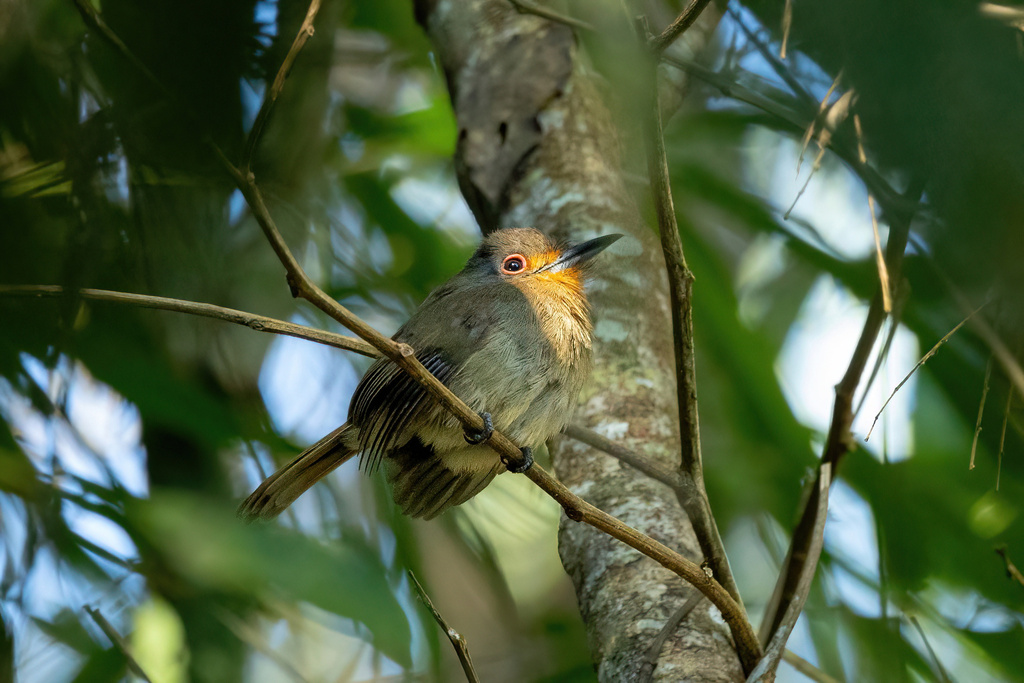
Fulvous-chinned Nunlet
Photo © Thibaud Aronson
Photo © Thibaud Aronson — CC BY-SA 4.0 — Source: iNaturalist photo #215225972The fulvous-chinned nunlet (Nonnula sclateri) is a species of near-passerine bird in the family Bucconidae, the puffbirds, nunlets, and nunbirds. It is found in Bolivia, Brazil, and Peru. == Taxonomy and systematics == The fulvous-chinned nunlet is monotypic. Its relationship to others of its genus has not been detailed but it is believed to be most closely related to the rusty-breasted nunlet (N. rubecula) and brown nunlet (N. brunnea). It has sometimes been considered conspecific with the latter. == Description == The fulvous-chinned nunlet is 14 to 15.5 cm (5.5 to 6.1 in) long. Two males weighed 15.4 and 17 g (0.54 and 0.60 oz) and two females 19 and 19.9 g (0.67 and 0.70 oz). Its upperparts, wings, and tail are dull brown. Its lores are reddish brown and the cheeks dark gray. The chin is pale rufous ("fulvous") that blends to reddish brown on the throat and breast. The center of the belly is whitish and the flanks dull fulvous. The eye is brown with a narrow coral red or reddish purple ring around it. The maxilla is black, the mandible dark gray to greenish gray, and the feet gray to olive gray. == Distribution and habitat ==…
Mapinguari National Park
Brazil
+354 birds
Vast tracts of western Amazonian rainforest blanket the remote terrain of this 56,827 square kilometre national park in Amazonas state, where seasonal rivers wind through dense…
VIEW NATIONAL PARKSerra do Divisor National Park
Brazil
+448 birds+10 mammals
Where the western Amazon meets the Andes foothills, Serra do Divisor National Park sprawls across one of South America's most biodiverse and least accessible frontiers. Spanning…
VIEW NATIONAL PARKBahuaja Sonene National Park
San Pedro de Putina Punco, Peru
+602 birds+8 mammals
Where the Madre de Dios and Heath rivers converge in southeastern Peru rises one of South America's most biodiverse wilderness regions: a vast protected realm of…
VIEW NATIONAL PARKNo community photos yet. Log in to add the first one.
No community observations of this species yet.