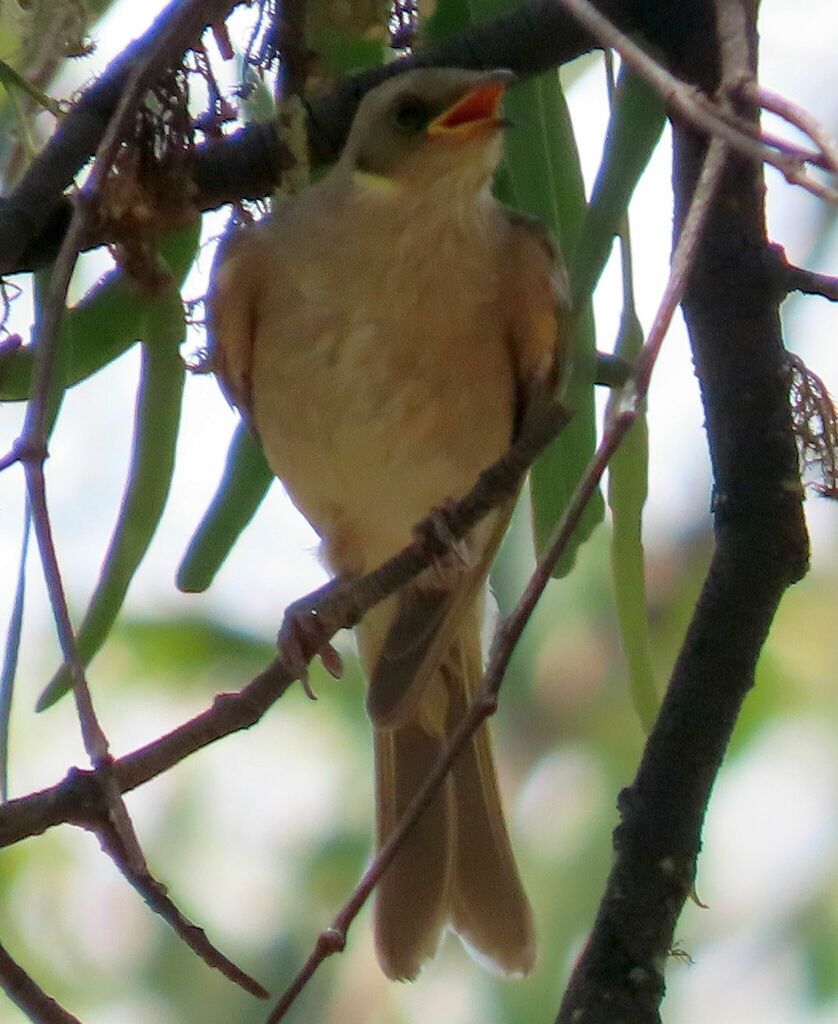
Fuscous Honeyeater
Photo © ian_mcallan
Photo © ian_mcallan — CC BY 4.0 — Source: iNaturalist #225024951Identification
The fuscous honeyeater is a subtly coloured bird, appearing dull grey-brown to olive-brown on its upperparts, with buffy-grey underparts. The most distinctive feature is a small black and yellow plume formed by the rear edge of the ear coverts, which catches the light when the bird is active. Its bill is black and the eye-ring dark, giving it a somewhat austere expression. Several similar species share its range, including the grey-fronted honeyeater, yellow-plumed honeyeater and white-plumed honeyeater, so careful observation of plumage details and calls is important for certain identification.
Fuscous honeyeaters are highly vocal birds with a distinctive repertoire. Their most characteristic call is a rollicking "arig arig a taw taw", which is often the best way to locate them in the field. They also produce a clear, flutey "cheer tor cheer" and maintain contact with an incessant "chip" call when moving through the canopy.
Range & Habitat
This species is endemic to eastern Australia, where it inhabits subtropical and tropical dry forests. Fuscous honeyeaters live in colonies in dry eucalypt forest and woodland, mostly found inland of the Great Dividing Range. However, in New South Wales and Queensland they also venture into coastal heathy forest, and are occasionally spotted in gardens and patches of remnant forest on farms.
The birds are mostly sedentary year-round, though they will make nomadic movements in response to drought and the flowering of eucalypts. In the southeastern part of their range, they undertake seasonal altitudinal movements, descending from higher elevations during the colder months.
Behaviour & Diet
These honeyeaters are mainly insectivorous, foraging actively among the outer and upper foliage, branches and trunks of eucalypts. They frequently take insects on the wing, sallying out from perches with characteristic honeyeater agility. Despite their preference for insects, they are opportunistic feeders that will readily consume nectar from eucalypts and mistletoes, as well as lerp and honeydew when available.
Fuscous honeyeaters are colonial birds, living together in groups and maintaining their bonds through their various vocalizations. Their restless, active foraging style makes them relatively conspicuous despite their muted plumage.
Best Time & Places to See It
The best places to find fuscous honeyeaters are in dry eucalypt forests and woodlands inland of the Great Dividing Range, or in coastal heathy forests of New South Wales and Queensland. They can also turn up in gardens adjacent to suitable habitat and remnant forest patches on farmland. Since they are mostly sedentary, they should be findable year-round, though their movements in response to eucalypt flowering and drought may affect local abundance.
Listen for their distinctive "arig arig a taw taw" call to locate birds in dense foliage. Early morning, when honeyeaters are most vocal and active, offers the best viewing opportunities.
Photography Tips
Photographing fuscous honeyeaters requires patience and attention to their foraging behaviour. Focus on the outer and upper branches of eucalypts where they actively forage for insects and nectar. The birds' small black and yellow ear plume is a key field mark worth capturing in detail. Their active, restless nature means keeping a fast shutter speed will help freeze their constant movement through the canopy.
Early morning light works well to illuminate the subtle grey-brown and olive-brown tones of their plumage. Since they often forage high in the canopy, a telephoto lens is essential. Listen for their calls to anticipate where they will appear next, and position yourself with good light behind or to the side of likely perches.
Carnarvon National Park
Philadelphia, Australia
+179 birds+17 mammals
Across 15,000 square kilometres of inland Queensland, rugged sandstone plateaus rise above eucalypt woodlands and open grasslands, carved by creeks that have worn deep gorges into…
VIEW NATIONAL PARKHerberton Range National Park
Australia
+115 birds+10 mammals
Rainforest-clad ridges and rocky outcrops define this 324-square-kilometre reserve in far north Queensland, where the mountainous terrain of the Herberton Range rises through layered eucalypt woodland…
VIEW NATIONAL PARKDaintree National Park
Dedin, Australia
+362 birds+37 mammals
Daintree National Park is one of the world’s oldest and most biologically diverse tropical rainforests, protecting an extraordinary landscape where ancient forests meet the Great Barrier…
VIEW NATIONAL PARKGreater Bendigo National Park
Whipstick, Australia
+202 birds+8 mammals
Across the red volcanic plains of inland Victoria, Greater Bendigo National Park sprawls across more than 1,000 square kilometres of eucalyptus woodland, open grassland, and scattered…
VIEW NATIONAL PARKChiltern-Mt Pilot National Park
Australia
+229 birds+12 mammals
Granite ridges and eucalyptus woodlands define this 869-square-kilometre park straddling the border between Victoria and New South Wales, where rugged terrain rises sharply from gentler foothill…
VIEW NATIONAL PARKKinglake National Park
Australia
+164 birds+11 mammals
Where the volcanic plains of central Victoria rise into forested ridges, Kinglake National Park encompasses roughly 844 square kilometres of diverse habitat that represents one of…
VIEW NATIONAL PARKRoyal National Park
Sydney, Australia
+296 birds+46 mammals
Where sandstone ridges plunge toward the Tasman Sea, Royal National Park unfolds across 343 square kilometres of southeastern Australian coastal wilderness. The park's defining character emerges…
VIEW NATIONAL PARKNaracoorte Caves National Park
Australia
+116 birds+12 mammals
Beneath the grassy limestone plains of southeastern South Australia lies one of the Southern Hemisphere's most significant underground landscapes. Naracoorte Caves National Park encompasses a mosaic…
VIEW NATIONAL PARKLockyer National Park
Australia
+130 birds+5 mammals
Steep ridges and weathered escarpments rise from the Brisbane Valley in southeastern Queensland, where Lockyer National Park sprawls across 267 square kilometres of eucalypt woodland and…
VIEW NATIONAL PARKSundown National Park
Australia
+211 birds+9 mammals
Granite ridges and eucalypt woodlands define this 305-square-kilometre expanse of southeastern Queensland, where the landscape descends from sandstone plateaus into open forests and grassy clearings that…
VIEW NATIONAL PARKBald Rock National Park
Australia
+122 birds+15 mammals
Granite peaks and weathered stone dominate the landscape of this 202-square-kilometre national park in inland New South Wales, where rugged tors and rocky outcrops rise dramatically…
VIEW NATIONAL PARKGirraween National Park
Australia
+193 birds+21 mammals
Granite boulders rise like the bones of the earth across these 278 square kilometres of southeastern Queensland, where the Great Dividing Range descends towards the coastal…
VIEW NATIONAL PARKMorton National Park
Australia
+253 birds+57 mammals
Across nearly 4,800 square kilometers of New South Wales's Southern Tablelands, rugged sandstone plateaus rise above sheltered valleys where cool-climate eucalypt woodland meets grassy heath and…
VIEW NATIONAL PARKHeathcote National Park
Sydney, Australia
+119 birds+16 mammals
Sandstone ridges and eucalypt woodlands rise from the Cumberland Plain southwest of Sydney, where Heathcote National Park unfolds across 82 square kilometres of bushland shaped by…
VIEW NATIONAL PARKGreat Sandy National Park
Australia
+306 birds+40 mammals
Where coastal dunes rise inland from the Queensland coastline, Great Sandy National Park encompasses a landscape of remarkable ecological diversity shaped by subtropical humid conditions year-round.…
VIEW NATIONAL PARKGirringun National Park
Australia
+231 birds+10 mammals
Where granite gorges cleave through subtropical woodland in North Queensland, Girringun National Park unfolds across rugged terrain shaped by millions of years of weathering and erosion.…
VIEW NATIONAL PARKWooroonooran National Park
Australia
+240 birds+28 mammals
Where the Great Dividing Range rises sharply inland from Queensland's tropical coast, Wooroonooran National Park encompasses a landscape of steep, forested gorges and cascading waterways carved…
VIEW NATIONAL PARKNoosa National Park
Marcus Beach, Australia
+216 birds+8 mammals
Subtropical eucalypt woodland and open forest meet coastal heathland along the Noosa Peninsula, where the temperate waters of the Tasman current moderate the Queensland climate into…
VIEW NATIONAL PARKBlue Mountains National Park
Australia
+220 birds+43 mammals
Dramatic sandstone cliffs rise in tiers across this mountainous plateau west of Sydney, their rust-coloured faces weathered into amphitheatres and gorges where eucalyptus forest clings to…
VIEW NATIONAL PARKKosciuszko National Park
Australia
+211 birds+52 mammals
Where the Great Dividing Range reaches its highest peaks in southeastern Australia, Kosciuszko National Park encompasses a landscape of windswept plateaus, rocky ridges, and deep river…
VIEW NATIONAL PARKBouddi National Park
Gosford, Australia
+147 birds+17 mammals
Sandstone ridges rise sharply from the Tasman Sea along the central New South Wales coast, their weathered faces etched by millennia of salt spray and storm…
VIEW NATIONAL PARKKu-ring-gai Chase National Park
Sydney, Australia
+216 birds+39 mammals
Where Hawkesbury sandstone cliffs plunge toward sheltered bays and creeks, Ku-ring-gai Chase National Park unfolds across rugged terrain just north of Sydney, a mosaic of eucalyptus…
VIEW NATIONAL PARKBarrington Tops National Park
Australia
+175 birds+47 mammals
Where the New England Plateau rises above the Hunter Valley, temperate rainforest cloaks the highest reaches of Barrington Tops, its dense canopy fed by year-round precipitation…
VIEW NATIONAL PARKWarrumbungle National Park
Coonabarabran, Australia
+183 birds+22 mammals
Volcanic peaks and weathered ridges rise abruptly from the inland tablelands of central New South Wales, their exposed rock faces glowing ochre and rust in the…
VIEW NATIONAL PARKOxley Wild Rivers National Park
Australia
+202 birds+45 mammals
Where the New England Tablelands descend toward the coast, river gorges carve through temperate forests in a landscape of dramatic geological contrast. Oxley Wild Rivers National…
VIEW NATIONAL PARKBen Boyd National Park
Eden, Australia
+255 birds+47 mammals
Where the temperate forests of the far south coast meet towering sea cliffs, Ben Boyd National Park unveils one of New South Wales' most dramatic coastal…
VIEW NATIONAL PARKGrampians National Park
Australia
+214 birds+18 mammals
Where sandstone ridges rise above the Western District of Victoria, Grampians National Park unfolds across rolling terrain sculpted by ancient geology and sustained by a temperate…
VIEW NATIONAL PARKMount Buffalo National Park
Myrtleford, Australia
+124 birds+7 mammals
Granite peaks rise abruptly from the volcanic plains of northeastern Victoria, their exposed rock faces and windswept ridges defining Mount Buffalo National Park's rugged character. The…
VIEW NATIONAL PARKNo community photos yet. Log in to add the first one.
No community observations of this species yet.