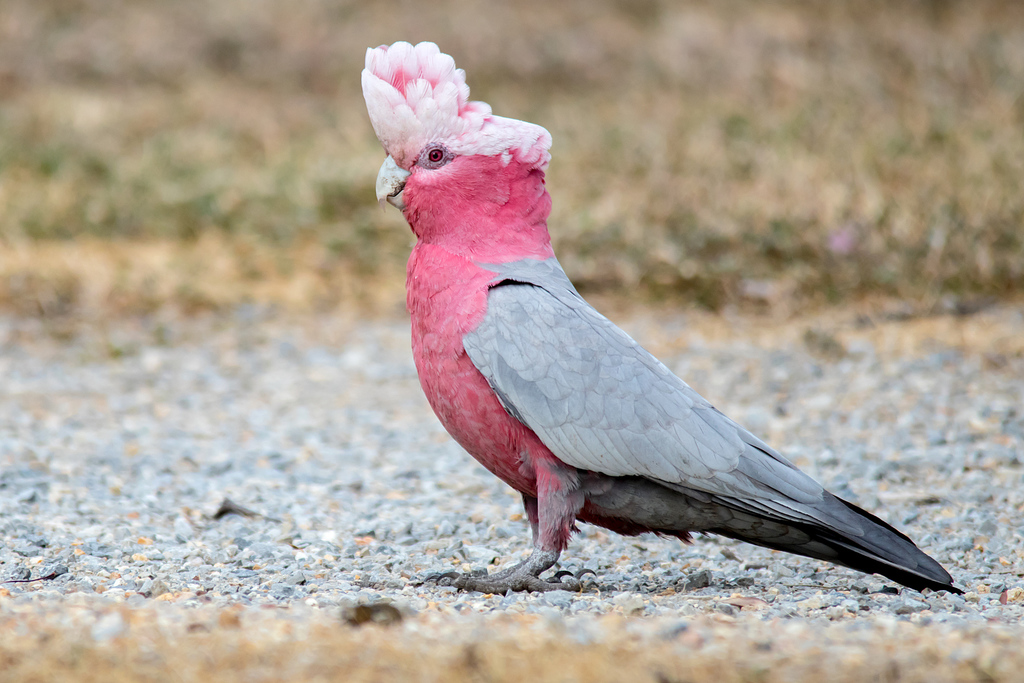
Galah
Photo © Andrew Allen
Photo © Andrew Allen — CC BY 4.0 — Source: iNaturalist photo #147415773Identification
The galah is a medium-sized cockatoo approximately 35 cm in length, weighing 270–350 g. It is unmistakable in appearance: a striking combination of pale silver-grey upperparts and pale grey rump contrasts sharply with its bright pink face, breast, and distinctive mobile crest. The bird has a bone-coloured beak and characteristic carunculated (bumpy-textured) bare eye-rings. Sexing is possible in adults: males display very dark brown, almost black irises, while females show mid-brown or red irises. Juveniles are duller overall, with greyish crowns and breasts, brown irises, and smooth (non-carunculated) eye-rings.
Range & Habitat
The galah is endemic to mainland Australia and one of the continent's most abundant and widespread bird species, found everywhere except the driest interior regions and far northern Cape York Peninsula. It has also been successfully introduced to Tasmania (from the mid-20th century onwards) and South Auckland, New Zealand. The species thrives in modified and unmodified landscapes, from metropolitan areas including Adelaide, Perth, and Melbourne to open habitats with scattered trees. It avoids only dense, high-rainfall forests. European settlement has dramatically favoured the galah through forest clearing in fertile areas and the creation of stock-watering points in arid zones, enabling rapid coastal colonisation in recent decades.
Behaviour & Diet
Galahs are highly social birds, typically found in flocks ranging from 10 to 1,000 individuals, often in mixed flocks with pink cockatoos, little corellas, and sulphur-crested cockatoos. They forage primarily on the ground in open grassland, with peak feeding activity in the morning and late afternoon. The diet consists mainly of seeds, though birds will opportunistically strip leaves and bark from trees; large flocks occasionally cause significant tree damage through defoliation. They nest in tree cavities, laying two to five white eggs that are incubated by both parents for approximately 25 days. Chicks fledge around 49 days after hatching.
Best Time & Places to See It
The galah's abundance and adaptability make it one of Australia's most accessible cockatoo species. It can be encountered year-round throughout most of the mainland, with particularly good viewing opportunities in open grasslands and woodland areas, especially during early morning and late afternoon feeding sessions. Major population concentrations occur in and around metropolitan areas. Birdwatchers in Tasmania and New Zealand may also encounter established populations. The species' gregarious nature means that flocks are often conspicuous and approachable, making it an excellent subject for both novice and experienced observers.
Photography Tips
The galah's striking pink and grey plumage photographs beautifully in natural light, with early morning and golden-hour conditions bringing out the warmth in the pink coloration. The mobile crest provides dynamic compositional possibilities, especially during alert or social moments within flocks. Capture the distinctive eye colouration as a identifying detail; position yourself to illuminate the carunculated eye-ring. Large feeding flocks in open grassland offer opportunities for behavioural and landscape photography. The bird's confidence around humans, especially in urban and suburban settings, allows relatively close approach for detailed portraiture and crest-display photography.
Barrington Tops National Park
Belair National Park
Ben Boyd National Park
Blue Mountains National Park
Boodjamulla National Park
Bouddi National Park
Bribie Island National Park
Budawang National Park
Budj Bim National Park
Nothing matches these filters.
No community photos yet. Log in to add the first one.
No community observations of this species yet.