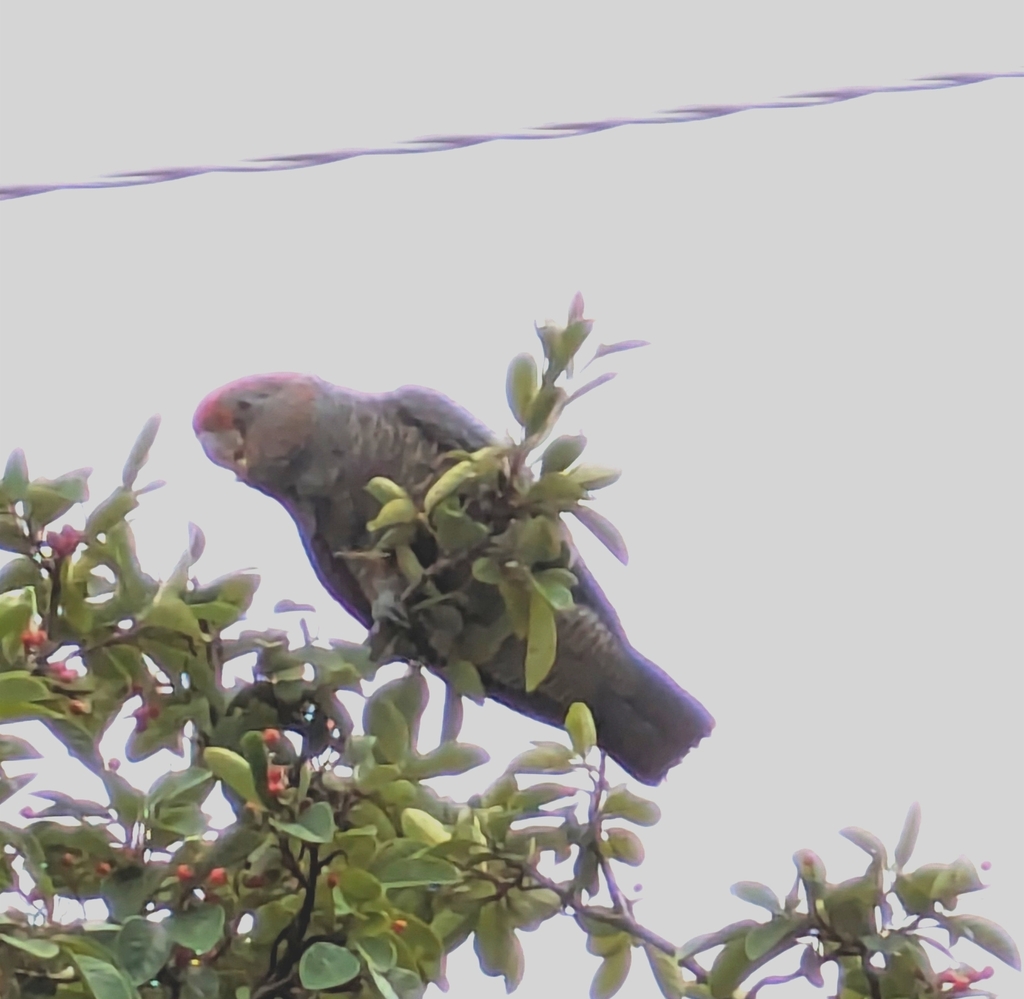
Gang-gang Cockatoo
Photo © John Cull
Photo © John Cull — CC0 1.0 — Source: iNaturalist #213557182Identification
The gang-gang cockatoo is a medium-sized parrot, 32–37 cm in length with a distinctive appearance that makes it unmistakable among Australian cockatoos. Males are instantly recognizable by their bright red head and crest contrasting against a mostly grey body, while females are more subtly coloured with a small fluffy grey crest and grey head. Both sexes display the characteristic wispy crest and pale scalloping on their feathers, with yellow or pink edges on the underparts giving a delicate appearance. The bird's most reliable field mark is its extraordinary call—a distinctive creaky-gate or cork-popping sound that echoes through the forest and is far more identifiable than the bird itself, as gang-gangs are quiet for cockatoos.
Range & Habitat
Endemic to south-eastern Australia's cooler and wetter regions, gang-gangs inhabit the forests and woodlands of the mountains and alpine bushland, favouring areas with dense shrub understories. They range throughout the south-eastern coastal regions and are the faunal emblem of the Australian Capital Territory. Notably, they undertake short seasonal migrations, moving into more open habitats during winter but returning to denser forests for breeding, as they require tall trees to excavate nesting cavities. Historically present on King Island off Tasmania, they have become extinct there, though an introduced population exists on Kangaroo Island.
Behaviour & Diet
Gang-gangs are highly social and monogamous birds that breed from spring through summer, laying 2–3 white eggs with an incubation period of four weeks. Unlike most cockatoos, they nest in young, solid trees rather than ancient hollows, and both parents share incubation and chick-rearing duties. They typically nest near water sources. Their diet consists mainly of eucalypt flowers and buds, which they forage for in the canopy, making them important pollinators within their forest ecosystems.
Best Time & Places to See It
Spring and summer are ideal for observing gang-gangs during their breeding season in the mountain forests and woodlands of south-eastern Australia, particularly in the Australian Capital Territory where they are most iconic. Listen for their characteristic creaky-gate call to locate them in dense forest canopies. Winter offers the chance to see them in more open habitats as they migrate to lower elevations, though they are more reliably found in their preferred dense woodlands during the breeding months.
Photography Tips
The male's brilliant red head provides striking contrast against the grey plumage and makes for compelling portraits, while females offer more subtle photographic challenge with their elegant grey tones and delicate crest. Gang-gangs favour the canopy, so patience and positioning yourself with light filtering through the understory will enhance images. Capture them in flight to appreciate their 62–76 cm wingspan, though in-flight shots may initially resemble the Galah. Early morning sessions in breeding season, when birds are more active and vocal, offer the best opportunities for both photography and sound recording of their distinctive call.
Alpine National Park
Ben Boyd National Park
Blue Mountains National Park
Budawang National Park
Budj Bim National Park
Chiltern-Mt Pilot National Park
Flinders Chase National Park
Grampians National Park
Great Otway National Park
Nothing matches these filters.
No community photos yet. Log in to add the first one.
No community observations of this species yet.