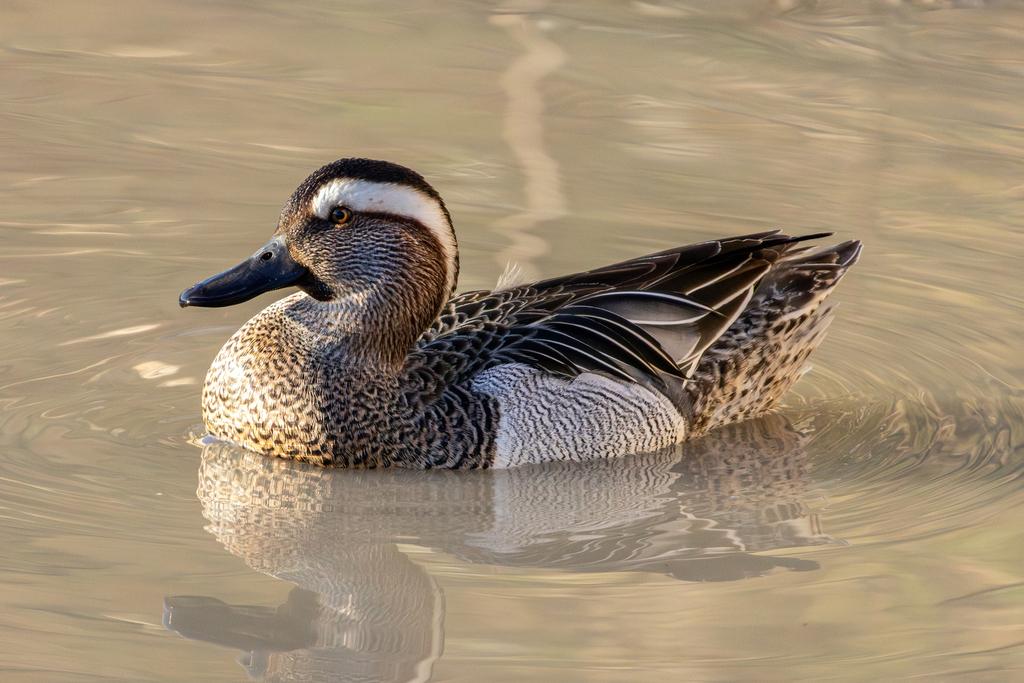
Garganey
Photo © Diego González Dopico
Photo © Diego González Dopico — CC BY 4.0 — Source: iNaturalist photo #480949628Identification
The garganey is a small dabbling duck, measuring 41 cm in length with a wingspan of 58–69 cm and weighing 300–440 g. The adult male is unmistakable, featuring a brown head and breast with a distinctive broad white crescent over the eye. The rest of the plumage is grey, with loose grey scapular feathers, a grey bill, and grey legs. In flight, males display a pale blue speculum with a white border, and when swimming show prominent white edges on the tertials.
Female garganeys require more careful identification. They are brown overall and can be confused with the common teal, but stronger face markings and more frequent head-shaking while dabbling are good distinguishing features. The female shows a pale eyebrow, dark eye line, and a pale lore spot bordered by a second dark line. Confusion with female blue-winged teals is possible, but garganeys have a different head and bill shape, and blue-winged teals have yellow legs rather than grey.
Range & Habitat
The garganey breeds across much of Europe and the Palearctic, but is strictly migratory with the entire population moving to Africa, India, Bangladesh, and Australasia during the Northern Hemisphere winter, where large flocks can occur. In the British Isles, garganeys are rare breeding birds, with most breeding in quiet marshes in Norfolk and Suffolk. In Ireland, a few pairs breed in County Wexford and at Lough Beg in County Londonderry, with occasional breeding elsewhere.
Their breeding habitat consists of grassland adjacent to shallow marshes and steppe lakes. The species is protected under the Agreement on the Conservation of African-Eurasian Migratory Waterbirds (AEWA).
Behaviour & Diet
Like other small ducks such as the Eurasian teal, garganeys rise easily from the water with a fast, twisting, wader-like flight. These birds feed mainly by skimming rather than upending. The male has a distinctive crackling mating call, while the female is rather silent for a female duck but can manage a feeble quack.
Best Time & Places to See It
Garganeys are migratory, so viewing opportunities depend on location. In breeding areas such as Norfolk, Suffolk, and parts of Ireland, spring and summer offer the best chances to observe them. In wintering grounds across Africa, India, Bangladesh, and Australasia, large flocks can be found during the Northern Hemisphere winter months. Notable locations include Santragachi in India and the natural reservoirs of Sylhet district in Bangladesh.
Photography Tips
The male garganey's striking plumage—particularly the white eye-crescent and grey colouration—makes it a rewarding subject for photographers. The pale blue speculum with white border is best captured during flight shots. When photographing on water, aim to capture the prominent white edges on the tertials. Early morning light works well to highlight the male's distinctive head and breast markings. Patience is needed when photographing females or in mixed flocks, as they require careful observation to distinguish from similar species like the common teal.
Bwindi Impenetrable National Park
Kanha Tiger Reserve
Mabamba Swamp
Murchison Falls National Park
Queen Elizabeth National Park
Aberdare National Park
Abijata-Shalla Lakes National Park
Alaska Maritime National Wildlife Refuge
Alpilles Regional Nature Park
Nothing matches these filters.
No community photos yet. Log in to add the first one.
No community observations of this species yet.