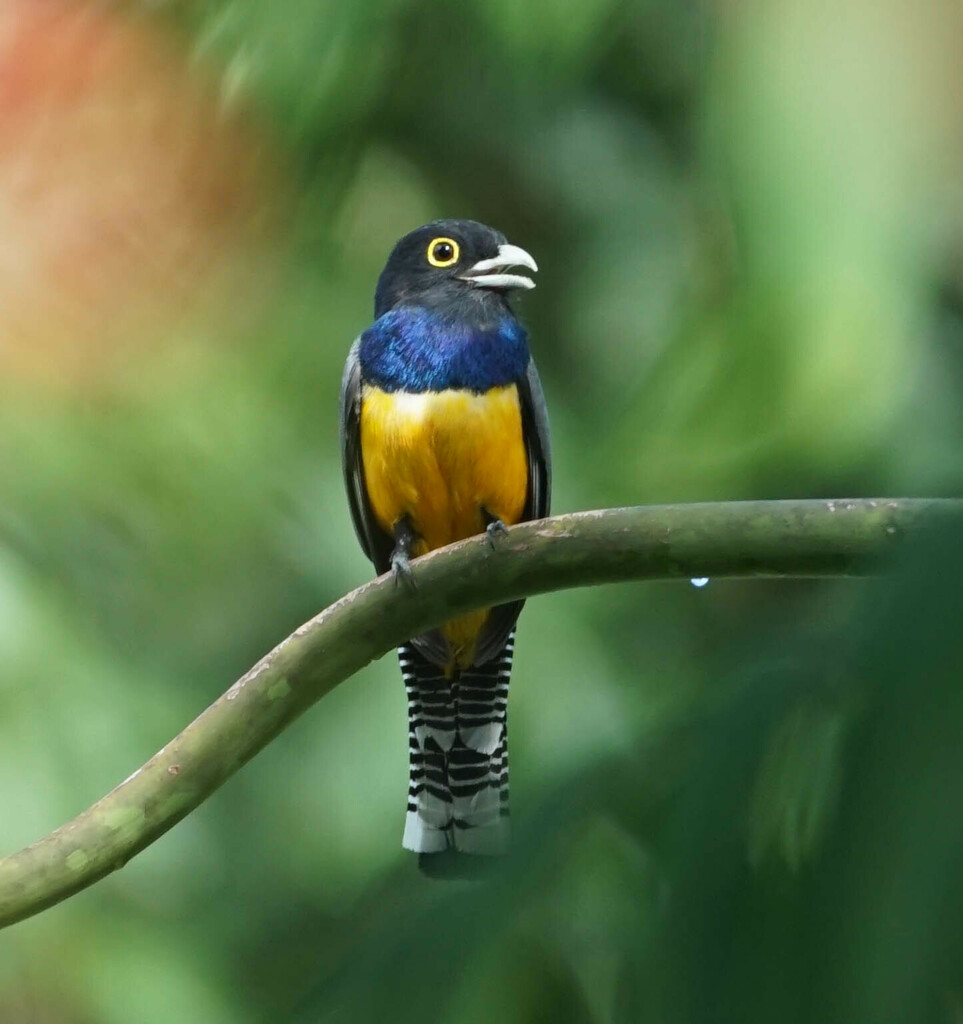
Gartered Trogon
Photo © Carrie Seltzer
Photo © Carrie Seltzer — CC BY 4.0 — Source: iNaturalist photo #264529035Identification
The gartered trogon is a small trogon, measuring 23 to 25 cm long and weighing 38 to 57 grams. Like most trogons, males and females display distinctly different plumages. The nominate male sports a violet-blue head, neck, and upper breast with a black face and throat outlined by a pale yellow eye-ring. A narrow white band separates the bright upper breast from the vibrant yellow lower breast and belly. The upperparts are metallic green, while the tail's upper surface is violet-blue with black tips and the underside displays fine black and white barring with broad white feather tips. Wings are mostly black with some whitish markings. Females are considerably duller, with gray head, face, upper breast, and upperparts, an incomplete eye-ring, and a more muted yellow belly. The underside of the female's tail follows a different black-and-white pattern than the male's.
Two other subspecies show notable variations. T. c. sallaei has a blackish head and upper breast with a blue nape and lower breast, yellower-green upperparts, and a green upper tail surface. T. c. concinnus resembles sallaei but features bluer upperparts and tail coloration.
Range & Habitat
The gartered trogon is distributed across a broad neotropical range spanning Mexico, all of Central America, and parts of northern South America including Colombia, Ecuador, Peru, and Venezuela. The three subspecies occupy distinct regions: T. c. sallaei inhabits the Caribbean slope of central Mexico and extends through the Caribbean and Pacific slopes of southern Mexico, Belize, Guatemala, and El Salvador into northern Honduras and possibly Nicaragua. T. c. concinnus ranges from Costa Rica through most of Panama into western Colombia, and separately from western Ecuador into northwestern Peru. The nominate T. c. caligatus occupies the Caribbean slope of Panama's Darién Province through northern Colombia into western Venezuela.
This species favors semi-open landscapes including forest edges, clearings, gallery forest, secondary forest, and shaded coffee and cacao plantations. In Mexico it also inhabits denser evergreen forest and rainforest. Elevations range up to 1,400 meters in Central America, though the species is generally more common in lowland areas. It remains a year-round resident throughout Mexico, though its movements elsewhere remain poorly documented.
Behaviour & Diet
The gartered trogon typically feeds by hovering to pick fruit and invertebrates from vegetation, a characteristic foraging technique among trogons. Notably, this species consumes a larger proportion of fruit than most other trogons, while still taking many types of insects and other invertebrates. It occasionally participates in mixed-species foraging flocks, expanding its feeding opportunities through cooperative search.
Breeding occurs seasonally, with distinct timing across its range: March to June in Mexico, May to July in El Salvador, and February to June in Costa Rica. Nests are constructed in arboreal wasp, ant, or termite nests, or in holes within rotten trees, with typical clutches comprising two or three eggs. The species produces a distinctive "long series of rapid hollow downslurred notes" described as "kyu-kyu-kyu-kyu-kyu-kyu," along with a "rolling chattering" call.
Best Time & Places to See It
The gartered trogon is fairly common to common throughout most of its range, making it a rewarding subject for nature travellers and birdwatchers. The species is notably rare in Venezuela, so other parts of its distribution offer better odds. Peak viewing opportunities align with breeding season—March to June in Mexico offers excellent chances to observe territorial males and hear their distinctive vocalizations. Central American locations, particularly in Costa Rica and Panama, provide reliable sightings year-round, with breeding activity evident from February through July depending on locality.
Look for this species in forest edges, secondary forest, and gallery forest habitats, as well as in shaded plantations. Early morning visits to semi-open woodland areas will increase your chances of encountering hovering birds actively foraging.
Photography Tips
The gartered trogon's compact size and preference for semi-open habitats create favorable photography conditions compared to many forest birds. Position yourself along forest edges and clearings where the bird's hovering foraging behavior provides excellent opportunities for flight photography. The male's striking violet-blue, green, and yellow plumage photographs beautifully in good light, making overcast mornings ideal for capturing detail without harsh shadows.
Focus on capturing the bird in hover while feeding, as this active behavior showcases its distinctive field marks and tail patterns. Listen for the male's rapid, rhythmic song to locate individuals, then maintain a patient vigil in likely feeding areas. The contrast between the male's vibrant colors and the female's more subdued gray and yellow tones offers compelling compositional opportunities for illustrating sexual dimorphism.
Corcovado National Park
Puerto Jiménez, Costa Rica
+444 birds+48 mammals
Where the Osa Peninsula juts into the Pacific, rainforest descends almost to the tide line, and Corcovado National Park protects one of Central America's most intact…
VIEW NATIONAL PARKManuel Antonio National Park
Quepos, Costa Rica
+426 birds+22 mammals
Where tropical rainforest descends steeply to a rocky Pacific coastline, Manuel Antonio National Park distills Central American biodiversity into one of Costa Rica's most compressed and…
VIEW NATIONAL PARKArenal Volcano National Park
Peñas Blancas, Costa Rica
+551 birds+21 mammals
Straddling the border between Alajuela and Guanacaste in northwestern Costa Rica, this national park rises dramatically around one of Central America's most active volcanic systems. The…
VIEW NATIONAL PARKTortuguero National Park
Roxana, Costa Rica
+420 birds+23 mammals
Canals and lagoons thread through a labyrinth of lowland rainforest where the Caribbean coast of Costa Rica meets the wetland frontier. This is terrain shaped by…
VIEW NATIONAL PARKBraulio Carrillo National Park
Las Horquetas, Costa Rica
+547 birds+18 mammals
Where the Caribbean slope descends from the central volcanic cordillera toward the humid lowlands of Heredia, Braulio Carrillo National Park preserves one of Costa Rica's most…
VIEW NATIONAL PARKPiedras Blancas National Park
Golfito, Costa Rica
+386 birds+24 mammals
Where the Golfo Dulce meets the southwestern Pacific coast of Costa Rica, Piedras Blancas National Park protects a dramatic transition zone where lowland rainforest descends toward…
VIEW NATIONAL PARKSanta Rosa National Park
Santa Elena, Costa Rica
+359 birds+30 mammals
Where Pacific-facing slopes descend from volcanic uplands toward the Guanacaste lowlands, Santa Rosa National Park unfolds across a mosaic of tropical dry forest, gallery woodland, and…
VIEW NATIONAL PARKGuanacaste National Park
Santa Elena, Costa Rica
+461 birds+17 mammals
Where the Pacific slopes of northwestern Costa Rica rise toward the Continental Divide, dry tropical forest gives way to cloud-laden peaks and misty ridges—a landscape that…
VIEW NATIONAL PARKCerros de Amotape National Park
District of San Jacinto, Ecuador
+246 birds+1 mammals
Arid mountains rise abruptly from Peru's northwestern frontier, their slopes clothed in xerophytic scrubland and seasonal deciduous forest that transforms these Andean foothills into one of…
VIEW NATIONAL PARKNatural Utría National Park
Alto Baudó (Pie de Pató), Colombia
+372 birds+11 mammals
Where the Chocó's coastal mountains plunge toward the Pacific, Utría National Park preserves one of Colombia's most biodiverse and least-visited wilderness expanses. Sprawling across 1,287 square…
VIEW NATIONAL PARKNatural Farallones de Cali National Park
Buenaventura, Colombia
+733 birds+27 mammals
Where the Pacific coastal plain meets the western slopes of the Andes, Farallones de Cali National Park sprawls across nearly 3,500 square kilometers of dramatic topography…
VIEW NATIONAL PARKNatural Uramba Bahía Málaga National Park
Buenaventura, Colombia
+308 birds+15 mammals
Where the Pacific coastal rainforest descends to mangrove estuaries and rocky headlands, Uramba Bahía Málaga National Park unfolds across nearly 1,000 square kilometres of Colombia's Valle…
VIEW NATIONAL PARKEl Tamá National Park
Toledo, Colombia
+435 birds
Where the Andes descend toward the Caribbean coastal lowlands of northern Colombia, El Tamá National Park sprawls across nearly 3,800 square kilometres of montane forest, cloud…
VIEW NATIONAL PARKBaru Volcano National Park
Cerro Punta, Panama
+402 birds+6 mammals
Where the land rises sharply toward the Caribbean's western spine, Baru Volcano National Park sprawls across roughly 220 square kilometres of southwestern Panama, anchored by the…
VIEW NATIONAL PARKGeneral de División Omar Torrijos Herrera National Park
La Pintada, Panama
+401 birds+2 mammals
Across the highlands of central Panama, where the continental divide funnels moisture-laden trade winds into steep river valleys, the terrain rises and falls in a landscape…
VIEW NATIONAL PARKSoberanía National Park
Cristóbal, Panama
+495 birds+34 mammals
Rainforest and riverine woodland blanket the rolling terrain of this 714-square-kilometre national park in Colón Province, where the Caribbean watershed feeds a maze of streams and…
VIEW NATIONAL PARKDarién National Park
Tucutí, Panama
+534 birds+13 mammals
Where the spine of Central America crumbles into wetland and rainforest, Darién National Park sprawls across more than 20,000 square kilometres of some of the tropics'…
VIEW NATIONAL PARKPortobelo National Park
Portobelo, Panama
+366 birds+9 mammals
Where the Caribbean's turquoise waters meet the Darién's verdant shore, Portobelo National Park sprawls across 570 square kilometers of coastal forest, mangrove wetland, and coral-fringed islands…
VIEW NATIONAL PARKParque Internacional la Amistad
Teribe, Panama
+325 birds+11 mammals
Where the continental divide rises between the Caribbean and Pacific watersheds, a wilderness of extraordinary biological richness unfolds across the Talamanca Range and into lowland rainforest—a…
VIEW NATIONAL PARKDzibilchantún National Park
Barcelona, Mexico
+144 birds+2 mammals
Across the limestone plains of Yucatán, where cenotes pierce the bedrock and tropical forest clings to shallow soils, lies Dzibilchantún—a modest yet ecologically vital national park…
VIEW NATIONAL PARKLagunas de Montebello National Park
Laguna de Montebello, Mexico
+360 birds+2 mammals
Where turquoise lagoons pierce the limestone plateau of southeastern Chiapas, the Lagunas de Montebello National Park unfolds across roughly 174 square kilometers of spectral water and…
VIEW NATIONAL PARKSian Ka’an
Chunyaxché, Mexico
+350 birds+16 mammals
Where the Yucatán Peninsula dissolves into wetland and mangrove, a vast mosaic of forest, lagoon, and coastal margin creates one of Mexico's most biodiverse strongholds. Across…
VIEW BIOSPHERE RESERVEMontes Azules
Candelaria, Mexico
+395 birds+47 mammals
Where jungle-clad limestone plateaus plunge into canyon systems carved by the Usumacinta River, Mexico's most pristine rainforest reserve unfolds across the Lacandón region of Chiapas. Montes…
VIEW BIOSPHERE RESERVETikal National Park
Tikal, Guatemala
+399 birds+16 mammals
Dense rainforest canopy rises above the limestone plateau of Petén, where archaeological wonder and ecological richness merge seamlessly across one of Central America's most biodiverse landscapes.…
VIEW NATIONAL PARKLaguna del Tigre National Park
Petén, Guatemala
+399 birds+29 mammals
Where the Petén lowlands dissolve into wetland and forest, Laguna del Tigre National Park protects one of Guatemala's most ecologically vital landscapes. This sprawling reserve encompasses…
VIEW NATIONAL PARKSierra del Lacandón National Park
Petén, Guatemala
+348 birds+7 mammals
Where the Petén rainforest rises into limestone ridges and deep ravines, Sierra del Lacandón National Park protects one of Central America's most intact tropical wilderness zones.…
VIEW NATIONAL PARKCarara National Park
Tárcoles, Costa Rica
+397 birds+19 mammals
Where the Pacific coastal plain meets transitional forest, Carara National Park straddles one of Central America's most dynamic ecological boundaries. The park's landscape encompasses lowland deciduous…
VIEW NATIONAL PARKPalo Verde National Park
Bagaces, Costa Rica
+318 birds+24 mammals
Dry forest spreads across Palo Verde's low-lying terrain in northwestern Guanacaste, where seasonal rivers and lagoons etch through deciduous woodland that sheds its canopy each winter.…
VIEW NATIONAL PARKCahuita National Park
Talamanca, Costa Rica
+359 birds+15 mammals
Where the Caribbean shoreline dissolves into mangrove creeks and coral gardens, Cahuita's mosaic of habitats unfolds across the Limón coast. The park's signature feature—a living coral…
VIEW NATIONAL PARKRincón de la Vieja National Park
Liberia, Costa Rica
+451 birds+30 mammals
Where volcanic slopes rise abruptly from the Guanacaste lowlands, Rincón de la Vieja National Park sprawls across a landscape shaped by geothermal drama and seasonal extremes.…
VIEW NATIONAL PARKTapantí Macizo de la Muerte National Park
Orosi, Costa Rica
+503 birds+18 mammals
Where montane cloud forest rises steeply from the Orosi Valley, Tapantí Macizo de la Muerte National Park enfolds a landscape of perpetual moisture and emerald complexity.…
VIEW NATIONAL PARKLa Amistad International Park
Crorina, Costa Rica
+532 birds+20 mammals
Where the Caribbean slopes of Costa Rica's Talamanca Mountains rise steeply inland from Limón, the boundary between two nations dissolves into an unbroken expanse of rainforest.…
VIEW NATIONAL PARKBarbilla National Park
Chirripó, Costa Rica
+226 birds
Where the Caribbean slope of Costa Rica's eastern cordillera plunges into perpetual moisture, Barbilla National Park rises as one of Central America's most water-rich ecosystems. Fed…
VIEW NATIONAL PARKVolcán Tenorio National Park
Guatuso, Costa Rica
+480 birds+12 mammals
Where volcanic slopes rise through Costa Rica's northwestern borderlands, Volcán Tenorio National Park sprawls across terrain shaped by ancient lava flows and mineral-rich springs. The park's…
VIEW NATIONAL PARKMarino Ballena National Park
Bahía Ballena, Costa Rica
+336 birds+8 mammals
Where mangrove forests meet coral-fringed shorelines along Costa Rica's southern Pacific coast, Marino Ballena National Park encompasses a marine and terrestrial mosaic that ranks among Central…
VIEW NATIONAL PARKMarino Las Baulas National Park
Santa Cruz, Costa Rica
+246 birds+9 mammals
Where the Pacific meets a mosaic of dry forest and mangrove estuary, this coastal national park protects one of Central America's most dynamic wildlife theatres. The…
VIEW NATIONAL PARKCaño Negro National Wildlife Refuge
Caño Negro District, Costa Rica
+486 birds+16 mammals
Where the San Juan River's seasonal floodplain opens into expansive wetlands, Caño Negro Wildlife Sanctuary sprawls across one of Central America's most productive freshwater ecosystems. This…
VIEW WILDLIFE SANCTUARYGandoca-Manzanillo National Wildlife Refuge
Manzanillo, Costa Rica
+394 birds+18 mammals
Where the Caribbean coastal plain surrenders to water-logged forest and mangrove tangles, Gandoca-Manzanillo Wildlife Sanctuary shelters one of Costa Rica's most biodiverse lowland wetland ecosystems. The…
VIEW WILDLIFE SANCTUARYBarra del Colorado National Wildlife Refuge
Tortuguero, Costa Rica
+462 birds+36 mammals
Where the Caribbean's restless waters meet the Limón Province coastline, Barra del Colorado National Wildlife Sanctuary unfolds across a landscape of extraordinary ecological complexity. This equatorial…
VIEW WILDLIFE SANCTUARYCurú National Wildlife Refuge
Paquera, Costa Rica
+249 birds+8 mammals
Where the Pacific coast of Puntarenas dissolves into dry deciduous forest and mangrove fringe, Curú Wildlife Sanctuary holds one of Costa Rica's most ecologically vital yet…
VIEW WILDLIFE SANCTUARYNo community photos yet. Log in to add the first one.
No community observations of this species yet.