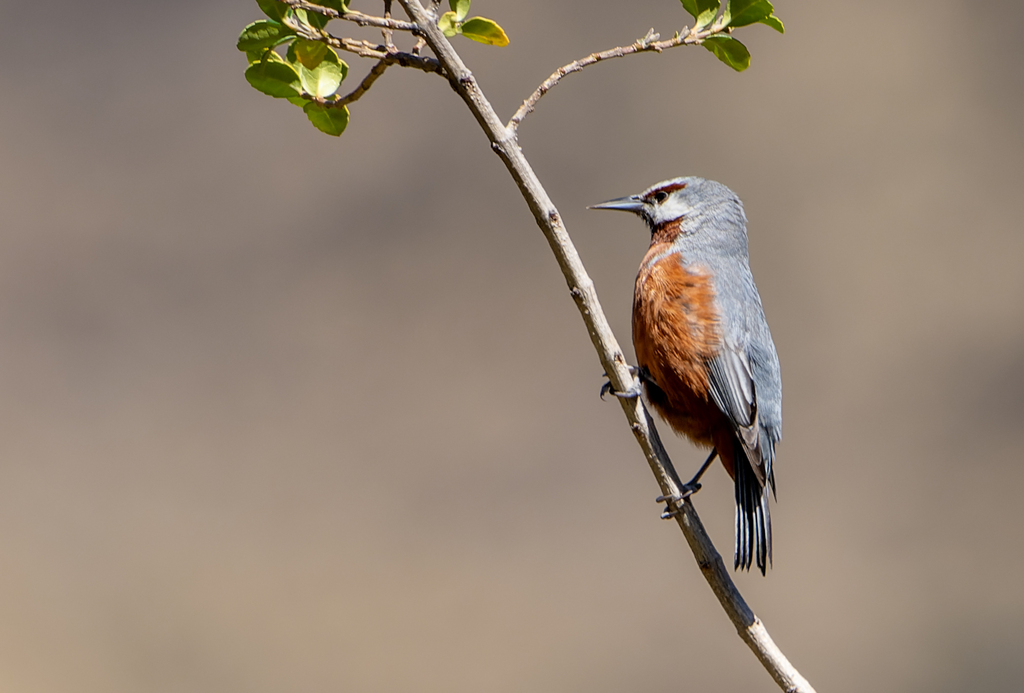
Giant Conebill
Photo © David F. Belmonte
Photo © David F. Belmonte — CC BY 4.0 — Source: iNaturalist photo #586528497The giant conebill (Conirostrum binghami) is a small passerine bird, one of the tanager family. It is closely related to the regular conebills Conirostrum though it differs in its larger size and nuthatch-like foraging habits. The giant conebill is 15 centimetres (5.9 in) in length and weighs 22–27 grams (0.78–0.95 oz). It is grey above, deep chestnut below, and with a white patch on the cheeks. It is found in the Andes from Colombia to Ecuador, and Peru to Bolivia. It lives in Polylepis trees of the family Rosaceae. The giant conebill lives individually or in groups of 5 or less. It peels bark off Polylepis trees to find insects. It also eats aphids and sugary solutions secreted by Gynoxys. The species is a seasonal breeder, nesting at the start of the rainy season (September to December in Bolivia where it has been studied). The nest is an open cup set on the branches of Polylepis, and the average clutch size is 1.8 eggs. Both parents incubate the eggs, feed the chicks and remove the fecal sacs. Its decline is attributed to the destruction and fragmentation of Polylepis woodland. == Taxonomy == The taxonomy is complicated. The giant conebill was…
Antisana National Park
Quijos, Ecuador
+432 birds+21 mammals
Where the eastern Andean slopes descend into the Amazon basin, Antisana National Park sprawls across roughly 2,500 square kilometers of some of South America's most dramatic…
VIEW NATIONAL PARKCotopaxi National Park
Mulaló, Ecuador
+211 birds+6 mammals
High in Ecuador's volcanic corridor, where the páramo transitions into cloud forest along the slopes of Cotopaxi volcano, the national park unfolds across nearly 500 square…
VIEW NATIONAL PARKCajas National Park
Cuenca, Ecuador
+190 birds+7 mammals
High in the Andes above Cuenca, where elevation ranges from 3,100 to 4,200 metres, the páramo landscape dominates—a windswept realm of cushion plants, alpine grasses, and…
VIEW NATIONAL PARKHuascarán National Park
Independencia, Peru
+201 birds+5 mammals
Where granite peaks pierce the Andean sky above 6,000 metres, Huascarán National Park sprawls across more than 11,500 square kilometres of Peru's Cordillera Blanca, a landscape…
VIEW NATIONAL PARKLauca National Park
Putre, Chile
+139 birds+17 mammals
Where the Andes rise toward the altiplano in Chile's far north, Lauca National Park sprawls across more than 3,000 square kilometres of some of South America's…
VIEW NATIONAL PARKNo community photos yet. Log in to add the first one.
No community observations of this species yet.