Skip to content
ATLAS
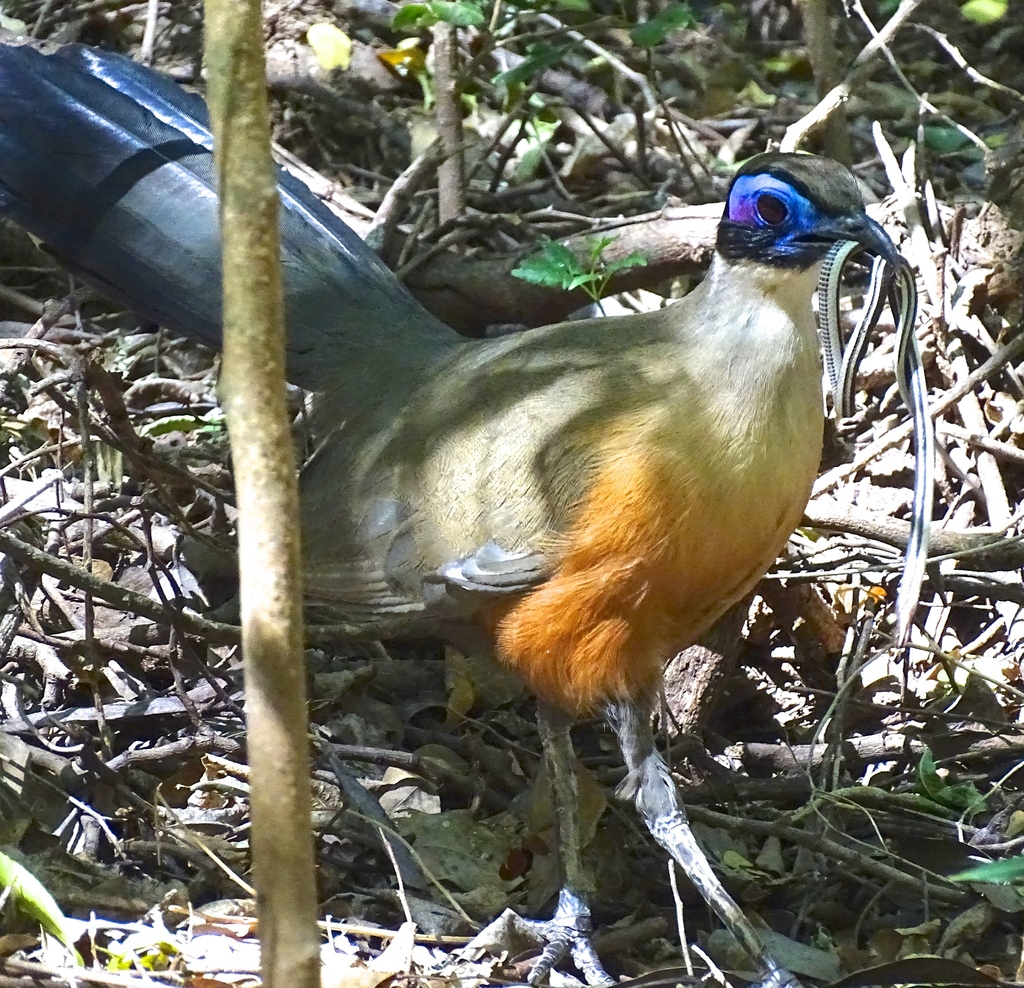
Giant Coua

Giant Coua

Coua gigas
Photo © Sandra KellerPhoto © Sandra Keller — CC BY 4.0 — Source: iNaturalist #194745494
ABOUT

The giant coua (Coua gigas) is a bird species from the Coua genus in the cuckoo family that is endemic to the dry forests of western and southern Madagascar. Couas probably originated from a particular Asian ground-cuckoo. The genus Coua contains 10 species, more than any other genus in Madagascar. This species is listed as Vulnerable by the IUCN due to a rapidly decreasing population, resulting from defroestation and hunting pressures. == Taxonomy == The giant coua was described by French polymath Georges-Louis Leclerc, Comte de Buffon in 1780 in his Histoire Naturelle des Oiseaux. The bird was also illustrated in a hand-coloured plate engraved by François-Nicolas Martinet in the Planches Enluminées D'Histoire Naturelle, which was produced under the supervision of Edme-Louis Daubenton to accompany Buffon's text. Neither the plate caption nor Buffon's description included a scientific name, but in 1783, Dutch naturalist Pieter Boddaert coined the binomial name Cuculus gigas in his catalogue of the Planches Enluminées. The giant coua is now placed in the genus Coua that was erected by the Swiss naturalist Heinrich Rudolf Schinz in 1821. The generic name is from koa, the Malagasy word for the couas. The specific epithet gigas is the Latin word…

HOTSPOTS
Sort by
National Park

Ankarafantsika National Park

Madagascar
+137 birds+12 mammals
National Park

Isalo National Park

Sakamalio·Madagascar
+89 birds+4 mammals
National Park

Tsingy de Bemaraha National Park

Begara·Madagascar
+81 birds+10 mammals

Nothing matches these filters.

Where to see & photograph the Giant Coua →
COMMUNITY
Share your photos of Giant Coua Inspire other photographers and contribute to the atlas.
Drag your photos here or select a file from your device JPG, PNG or WebP · Up to 10 photos of 25 MB

Your photo, your rights. Always credited to you.

Sort by

No community photos yet. Log in to add the first one.

0 Observed by
0 Hotspots reported
0 Countries

No community observations of this species yet.

Wild Atlas Guide

  • About
  • Contact
  • Privacy Policy
  • Terms of Use
  • Send Feedback

Community

  • Submit a Hotspot
  • Operators Directory
  • Add your business
  • Business Terms
© 2026 Wild Atlas Guide — Content & data compilation protected.
Privacy Policy · Cookie settings · Copyright & data use

Contact Us

We'd love to hear from you. We'll reply as soon as possible.

Send Feedback

Found an error? Have a suggestion? We read every message.

Submit a hotspot Add your business
Sign in
MENU
Sign in

or

Enter your username or email and we'll send you a link to reset your password.

or

Biological profile

Giant Coua

A compact view of how this species lives, moves and responds to its environment.

The species at a glance

Select a card to explore the details.

Movement
Does it remain in the same area?
It generally remains in the same region
How does it move?
Local Ranging
Can its movements be anticipated?
Yes, its movements tend to repeat
Do its movements change with the seasons?
No, they are not tied to one season
Do all populations follow the same calendar?
Yes, broadly speaking
Activity
When is it active?
Mainly active by day
Does it have inactive periods?
No known inactive period
How to detect it
Is it easy to find?
It takes some patience
How can you detect it?
AcousticVisual
Does it tend to hide?
It hides in some situations
Do you need a specific technique?
Usually not
Which seasonal signs help?
None Known
Habitat
Which environment does it live in?
Terrestrial
Which places does it prefer?
Forest
Can it adapt to different habitats?
It needs very specific habitats
At what level of the habitat does it move?
Ground
Feeding
What kind of food does it eat?
FrugivoreInvertivore
How does it get its food?
Ground Foraging
Social life
Does it usually live alone or in a group?
It usually lives in pairs
Does it gather at certain times?
It does not usually gather seasonally
Reproduction
How does it breed?
Territorial
Where does it breed?
ShrubTree
Spatial ecology
Does it defend a territory?
Yes, it defends a territory
How far does it usually travel?
Within a local area
In which major regions does it live?
Afrotropical
Environmental response
Does its calendar change from place to place?
It changes little between places
Sensitivity
Is it affected by human disturbance?
Observe it calmly and keep your distance
When does it need the most space?
Nest
Global profile. Local behaviour and timing may vary.
Discover
Book
AllBirdsMammalsCountriesHotspotsHidesExperiencesOperators

Before you choose a photo

Please confirm the photo rights and credit terms first.

Read the photo rights and credit terms

I'm the author of this photo or hold the rights to it, and I keep full ownership. I grant Wild Atlas Guide a free, non-exclusive licence to display it on the site and in Wild Atlas Guide's own channels, including social media, always credited to me by my display name or the Instagram handle I choose to provide. I confirm it does not reveal a sensitive wildlife location or a recognisable person without their permission. I can withdraw future social use for this photo or ask for it to be removed at any time.

Please accept the photo rights and credit terms to continue.

Add your photo

    Uploading…

    We use cookies to measure traffic and improve Wild Atlas Guide. You decide. Privacy policy