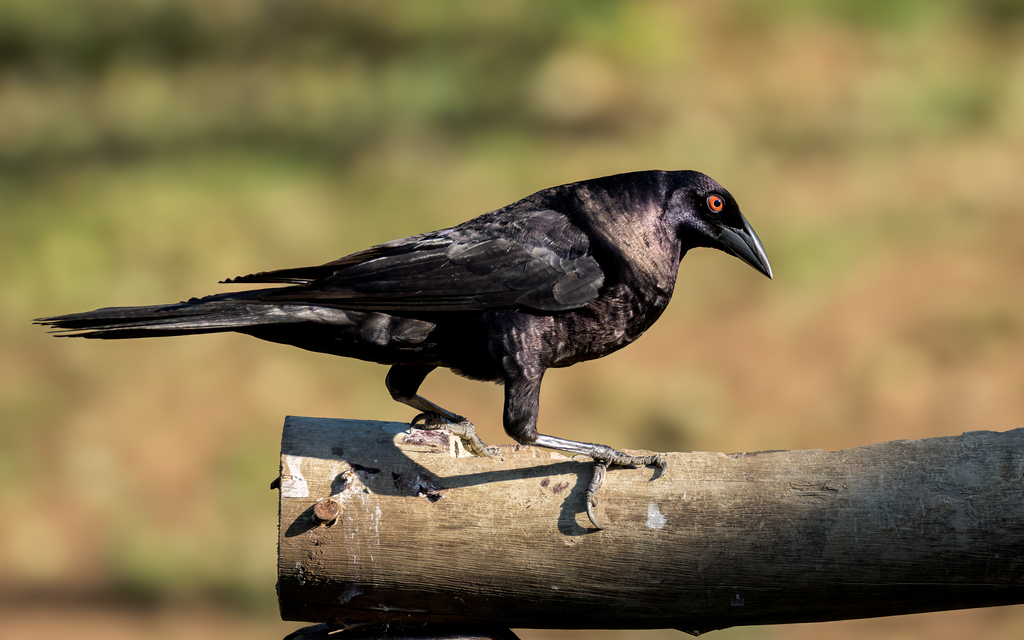
Giant Cowbird
Photo © Chris Kirby-Lambert
Photo © Chris Kirby-Lambert — CC BY 4.0 — Source: iNaturalist photo #607989275Identification
The giant cowbird is a large, robust passerine measuring 34 cm in length for males and 29 cm for females. Males are unmistakable with their iridescent black plumage, long tail, long bill, small head, and distinctive neck ruff that expands dramatically during display—features that give them a somewhat ungainly silhouette. Females are noticeably smaller and less iridescent, lacking the prominent neck ruff, which makes their proportions appear more balanced. Juvenile males resemble adults but show brown tones and a pale bill rather than the glossy black of mature birds. These are relatively quiet icterids, though males produce an unpleasant screeched whistle (shweeaa-tpic-tpic) and both sexes give sharp chek-chik calls. They are also skilled mimics.
Range & Habitat
The giant cowbird is distributed from southern Mexico south through Central America to northern Argentina, with populations also present on Trinidad and Tobago—islands the species may have colonised relatively recently. It is the only cowbird species found in deep forest, though it also frequents open woodland and cultivated areas with large trees. This adaptability to diverse habitats from lowland forests to agricultural zones makes it more widely distributed than its cowbird relatives.
Behaviour & Diet
The giant cowbird is a brood parasite, laying its eggs in the nests of oropendolas and caciques rather than raising its own young. Eggs occur in two colour forms: whitish and unspotted, or pale blue-green with dark spots and blotches. Unlike some parasitic birds, giant cowbirds do not destroy host eggs or chicks. Because their colonial icterid hosts defend their nests vigorously, individual cowbirds must patrol extensive territories to locate sufficient nesting opportunities; multiple giant cowbird eggs may be laid in a single host nest.
This gregarious bird forages on the ground and in trees, feeding mainly on insects and seeds, particularly rice. It also searches for fruit, nectar, and arthropods along waterways, in banana plantations, and cornfields. In Brazil, it uniquely exploits capybaras, riding on them to pick off ticks and horse flies—a behaviour rarely seen in other cowbird species.
Best Time & Places to See It
Giant cowbirds are year-round residents throughout their range, making them accessible to travellers at any season. Look for them in open woodlands with scattered large trees, forest edges, and cultivated landscapes. Observing them near colonial nesting sites of oropendolas and caciques during breeding season offers the best chance of encounters. Their gregarious nature means they often occur in small groups, particularly when foraging.
Photography Tips
Photograph males during display to capture the dramatic expansion of the neck ruff and iridescent sheen of their black plumage—backlighting enhances the iridescence. Their habit of foraging on the ground and in low vegetation provides good opportunities for accessible angles. The striking size difference between males and females makes comparative shots rewarding. Look for behavioural moments such as the capybara-cleaning interaction in South American locations, or document them near host-bird colonies to capture their bold, aggressive character in context.
Amacayacu National Park
Amazônia National Park
Anavilhanas National Park
Antisana National Park
Arenal Volcano National Park
Bahuaja Sonene National Park
Barbilla National Park
Barra del Colorado National Wildlife Refuge
Brasília National Park
Nothing matches these filters.
No community photos yet. Log in to add the first one.
No community observations of this species yet.