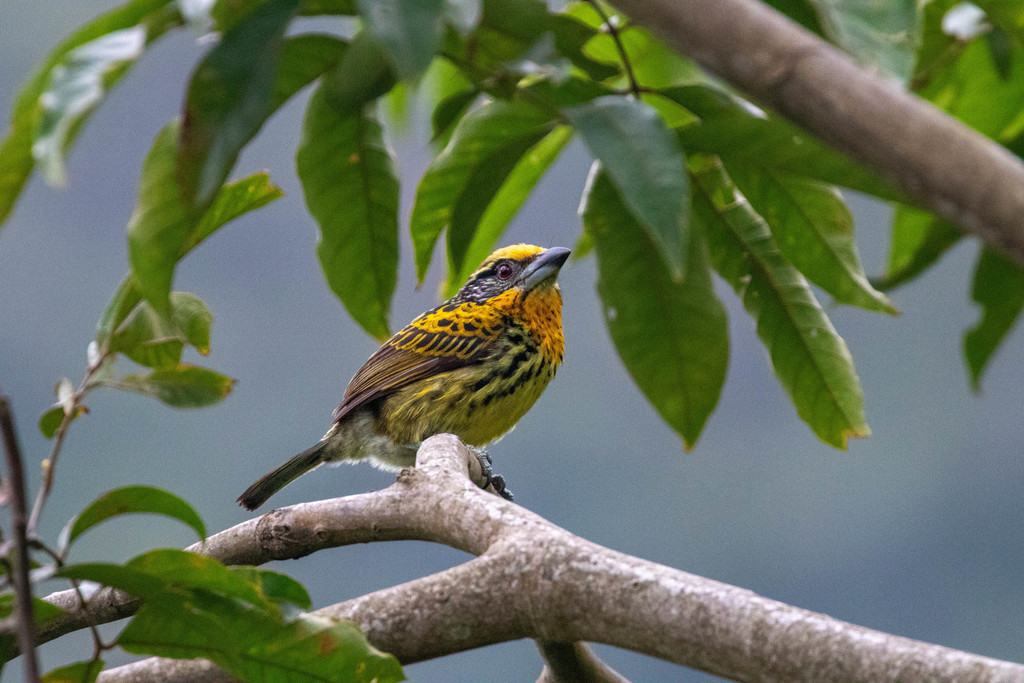
Gilded Barbet
Photo © Thibaud Aronson
Photo © Thibaud Aronson — CC BY-SA 4.0 — Source: iNaturalist photo #112929618Identification
The gilded barbet is a compact, large-headed bird measuring approximately 20 cm in length, belonging to the toucan-related New World barbet family. It is characterized by predominantly black upperparts, tail, and wings, with a distinctive black facial mask. The most striking features are the narrow yellow eyebrows that extend as parallel lines over the mantle, and yellow spotting on the greater wing coverts with yellow edging on the flight feathers. The belly is pale yellow with black streaking on the flanks, while the throat ranges from red to orange depending on the subspecies, and the crown varies from deep yellow to brownish-orange to reddish-orange.
Females are notably different from males, displaying extensive orange-yellow edging on the wing-coverts, yellowish streaking on the auriculars and back, and black streaking extending across the chest as well as the flanks. In westernmost populations, females have a distinctive black-streaked throat. Both sexes share dark maroon eyes, greyish legs, and a grey bill broadly tipped with black, making them relatively easy to identify once encountered.
Range & Habitat
The gilded barbet inhabits the tropical moist lowland forests and woodlands of western South America, with a range spanning Bolivia, Brazil, Colombia, Ecuador, Peru, and Venezuela. The bird's distribution follows the river basins of the western Amazon and Orinoco regions, occurring mainly in lowlands but also extending into the lower foothills of the eastern Andes. Its range encompasses the eastern Andes drainages, the western Amazon Basin from eastern Colombia-Venezuela through Ecuador to southeastern Peru and northern Bolivia, and extends northwestward through the Orinoco drainage into eastern Venezuela.
The species shows a preference for frugivorous feeding, spending much of its time in the canopy and mid-story levels of forest where fruit-bearing trees are abundant. It avoids certain riverine strips and generally favors the upland forest environments across its fragmented but substantial geographic range.
Behaviour & Diet
The gilded barbet is largely frugivorous, spending much of its time foraging in the forest canopy and mid-story vegetation for fruits and berries. Like other barbets, it is a relatively stocky bird with a stubby bill adapted for its feeding ecology. The species' thickset build and large head are characteristic features of the New World barbet family, reflecting their specialized ecological niche as fruit-eaters in tropical forests.
Best Time & Places to See It
Birdwatchers and nature travelers seeking the gilded barbet should focus their efforts on the tropical lowland forests of the western Amazon and Orinoco basins. Key regions include eastern Ecuador, Peru, Colombia, and Venezuela, particularly around river systems and their tributary areas. Bolivia offers additional opportunities, particularly in areas around the Madeira River tributaries in the north and central regions.
Photography Tips
The gilded barbet's striking color pattern—combining black, yellow, and red or orange tones—makes it a rewarding photographic subject. Focus on capturing the distinctive yellow eyebrow lines and the contrasting throat coloration. The bird's preference for the forest canopy may present challenges, so patience and knowledge of its fruiting tree preferences will improve sighting opportunities. Early morning hours when birds are most active in foraging are optimal for photography.
Yasuní National Park
Aguarico, Ecuador
+601 birds+43 mammals
Where the western Amazon basin converges with Ecuador's Orellana Province, lowland rainforest reaches toward the horizon in an unbroken canopy of staggering botanical density. Yasuní National…
VIEW NATIONAL PARKSumaco Napo-Galeras National Park
Loreto, Ecuador
+563 birds+4 mammals
Where Ecuador's Amazon transitions into cloud forest, a massive shield volcano rises from the emerald lowlands of Orellana Province, anchoring one of the continent's most biodiverse…
VIEW NATIONAL PARKNatural Sierra de Chiribiquete National Park
Solano, Colombia
+359 birds+27 mammals
Massive table-top mountains rise abruptly from the lowland rainforest of southeastern Colombia, their sheer sandstone cliffs and isolated summits creating some of the most dramatic topography…
VIEW NATIONAL PARKNatural la Paya National Park
Puerto Leguízamo, Colombia
+262 birds+4 mammals
Where the Amazon's western reaches fold into the Andes foothills, La Paya National Park sprawls across more than 8,500 square kilometers of pristine Amazonian rainforest in…
VIEW NATIONAL PARKNatural Río Puré National Park
La Pedrera, Colombia
+40 birds+1 mammals
Where the Río Puré carves through northwestern Amazonia on the Colombia–Peru border, a landscape of flooded forests, terra firme ridges, and whitewater tributaries protects nearly 14,600…
VIEW NATIONAL PARKNatural Sumapaz National Park
Cubarral, Colombia
+368 birds+1 mammals
Where the Andes descend toward the Amazon basin, the high páramo grasslands of Sumapaz National Park sprawl across more than five thousand square kilometers of Meta…
VIEW NATIONAL PARKNatural Sierra de la Macarena National Park
Vista Hermosa, Colombia
+566 birds+15 mammals
Across nearly 20,000 square kilometres of Colombia's Meta Department, the terrain rises from lowland savanna into Andean foothills through a mosaic of gallery forests, palm-fringed wetlands,…
VIEW NATIONAL PARKAmacayacu National Park
Leticia, Colombia
+567 birds+25 mammals
Where the Rio Amazonas curves through the tri-border region where Colombia, Peru, and Brazil converge, Amacayacu National Park sprawls across more than 5,250 square kilometres of…
VIEW NATIONAL PARKMapinguari National Park
Brazil
+354 birds
Vast tracts of western Amazonian rainforest blanket the remote terrain of this 56,827 square kilometre national park in Amazonas state, where seasonal rivers wind through dense…
VIEW NATIONAL PARKJaú National Park
Brazil
+354 birds+3 mammals
Vast floodplain forests and blackwater rivers define this remote corner of western Amazonas, where the Rio Negro and its tributaries have carved an intricate mosaic of…
VIEW NATIONAL PARKAnavilhanas National Park
Brazil
+468 birds+8 mammals
Across the Rio Negro in central Amazonas, an archipelago of over a thousand islands rises from the world's largest rainforest river system, creating a labyrinth of…
VIEW NATIONAL PARKSerra do Divisor National Park
Brazil
+448 birds+10 mammals
Where the western Amazon meets the Andes foothills, Serra do Divisor National Park sprawls across one of South America's most biodiverse and least accessible frontiers. Spanning…
VIEW NATIONAL PARKPico da Neblina National Park
Brazil
+103 birds
Where the Amazon's western rampart rises into perpetual mist, Pico da Neblina National Park sprawls across more than 33,000 square kilometres of some of Earth's least…
VIEW NATIONAL PARKYanachaga–chemillén National Park
Palcazu, Peru
+639 birds+6 mammals
Where the eastern slopes of Peru's central cordillera plunge into cloud forest, Yanachaga–Chemillén National Park protects nearly three thousand square kilometres of montane wilderness that few…
VIEW NATIONAL PARKManu National Park
Manu, Peru
+892 birds+26 mammals
Across the eastern slopes of the Peruvian Andes, tropical rainforest descends into the Amazon basin with a complexity that few terrestrial ecosystems match. Manu National Park…
VIEW NATIONAL PARKSierra del Divisor National Park
Alto Tapiche, Peru
+298 birds+2 mammals
Where the western Amazon meets the Andes foothills, nearly 41,000 square kilometres of pristine rainforest rise across Peru's Alto Tapiche region in a landscape of extraordinary…
VIEW NATIONAL PARKBahuaja Sonene National Park
San Pedro de Putina Punco, Peru
+602 birds+8 mammals
Where the Madre de Dios and Heath rivers converge in southeastern Peru rises one of South America's most biodiverse wilderness regions: a vast protected realm of…
VIEW NATIONAL PARKIchigkat Muja – Cordillera del Cóndor National Park
Río Santiago, Peru
+101 birds
Where the Andes descend into the western Amazon, the Río Santiago carves through a landscape of profound biological complexity. Ichigkat Muja – Cordillera del Cóndor National…
VIEW NATIONAL PARKTingo Maria National Park
Mariano Dámaso Beraún, Peru
+423 birds
Where the eastern slopes of the Peruvian Andes descend toward the Amazon basin, the landscape fractures into a maze of limestone ridges, humid gorges, and cloud-wrapped…
VIEW NATIONAL PARKCordillera Azul National Park
Pampa Hermosa, Peru
+322 birds+1 mammals
Where the eastern Andes descend into the western Amazon basin, Cordillera Azul National Park sprawls across nearly 38,000 square kilometres of some of Peru's most pristine…
VIEW NATIONAL PARKNo community photos yet. Log in to add the first one.
No community observations of this species yet.