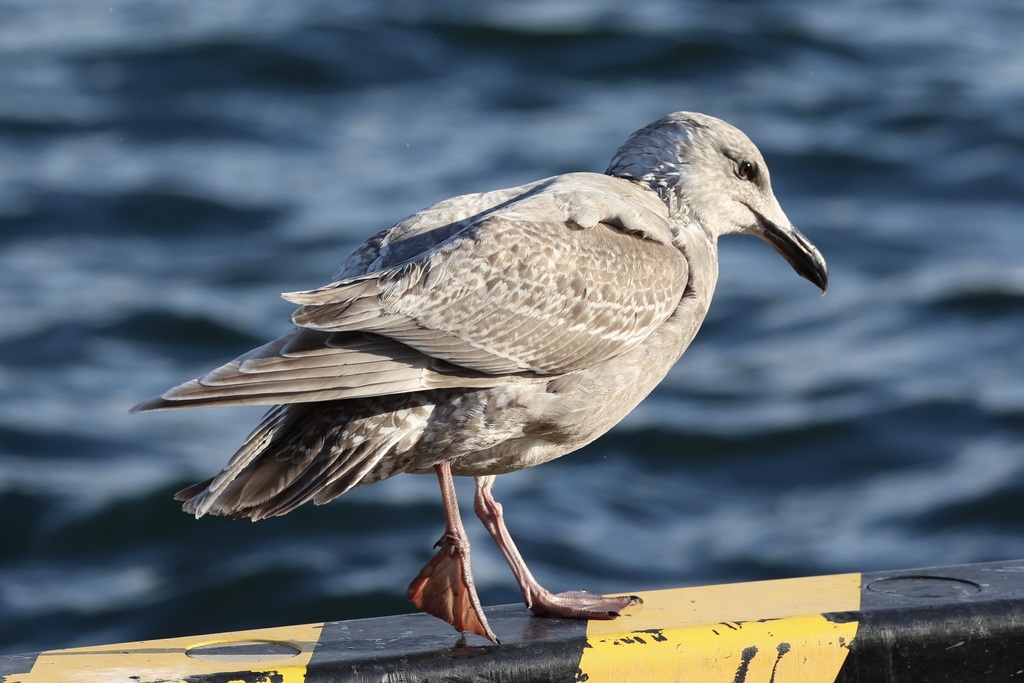
Glaucous-winged Gull
Photo © Andrew Holle
Photo © Andrew Holle — CC0 1.0 — Source: iNaturalist photo #525916138Identification
The Glaucous-winged Gull is a large gull measuring 50–68 cm in length with a wingspan of 120–150 cm. Adults are predominantly white-headed with a white neck, breast, belly, and tail. The most distinctive feature is the silver-gray mantle (back and wings), which is darker than the Glaucous Gull but paler than both the Herring Gull and Western Gull. Notably, the primary flight feathers at the wingtips are grey, typically matching the shade of the mantle rather than contrasting sharply. Adults have bright yellow bills marked with a red subterminal spot, pink legs, and dark irises surrounded by pink orbital skin. During winter, the head and nape become darker with a mottled or smudged pattern, and the bill dulls with dark markings near the tip. Young birds are brown or gray with black beaks and require four years to develop full adult plumage.
Range & Habitat
This species is rarely found far from the ocean and is a resident along the Pacific coast from western Alaska to Washington, including the Puget Sound region. They breed on the northwest coast of Alaska during summer months and in the Russian Far East. In winter, populations shift southward along the coasts of California, Oregon, Baja California, Baja California Sur, and Sonora. The species is exceptionally rare as a vagrant to the Western Palearctic, with occasional records from Morocco, the Canary Islands, Ireland, and Britain.
Glaucous-winged Gulls are remarkably long-lived birds, typically living about 15 years, though some individuals exceed this considerably. Records include birds living more than 21 years in British Columbia and at least 22 years and 9 months in Washington, with the longevity record exceeding 37 years for a bird banded as a chick in British Columbia.
Behaviour & Diet
These gulls nest during summer, with each pair producing two or three chicks that fledge at six weeks old. They feed opportunistically along the coast, scavenging for dead or weak animals, fish, mussels, and other food scraps. In urban areas, they are notorious for their boldness around humans, readily accepting offered food and tearing open unprotected garbage bags in search of edibles. Their calls are distinctive, ranging from low-pitched "kak-kak-kak" or "wow" sounds to higher-pitched wailing calls.
Best Time & Places to See It
Glaucous-winged Gulls are year-round residents along the Pacific Northwest coast, making them reliably observable from Alaska south to Washington. Summer months offer opportunities to see breeding birds and young fledglings, while winter birding along the California and Oregon coasts may yield sightings as birds migrate southward. The Puget Sound region is particularly productive for observation. Coastal harbors, beaches, and urban waterfront areas attract these adaptable gulls, especially where food is available.
Photography Tips
Photograph adult plumage in good light to capture the distinctive silver-gray mantle and the subtle grey wingtips that do not contrast sharply with the back—a key identifying feature. Winter birds offer interesting compositional opportunities with their darker, mottled head patterns. Focus on the yellow bill with its red subterminal spot and the dark eye surrounded by pink orbital skin for detailed portraits. Young birds in brown or gray plumage provide visual contrast and tell a four-year developmental story. In the Puget Sound region, be alert to hybrids with Western Gulls (Olympic Gulls), which may show darker wingtip contrasts and heavier bills, adding variety to your portfolio.
Gulf Islands National Park Reserve
Southern Gulf Islands Electoral Area, Canada
+268 birds+26 mammals
Scattered across the Salish Sea in British Columbia's southwestern corner, this national park reserve stitches together a fragmented archipelago of forested islands and rocky outcrops where…
VIEW NATIONAL PARKKenai Fjords National Park
Kenai Peninsula Borough, United States
+164 birds+19 mammals
Granite peaks and tidewater glaciers dominate Alaska's Kenai Peninsula, where nearly 7,900 square kilometers of pristine coastal wilderness descend from the Harding Icefield toward the Gulf…
VIEW NATIONAL PARKKatmai National Park
Lake and Peninsula Borough, United States
+160 birds+19 mammals
Across southwestern Alaska's Lake and Peninsula Borough, nearly 27,000 square kilometers of subarctic wilderness sprawl between volcanic peaks and coastal wetlands, anchored by the confluence of…
VIEW NATIONAL PARKPinnacles National Park
San Benito County, United States
+197 birds+33 mammals
Jagged volcanic spires thrust from chaparral-covered ridges across 222 square kilometers of central California's inner Coast Ranges, their pale stone crowns catching the afternoon light like…
VIEW NATIONAL PARKGlacier Bay National Park
Unorganized Borough, United States
+221 birds+15 mammals
Tidewater glaciers calving into fjords of impossible blue, where temperate rainforest rises steeply from the water's edge and alpine peaks pierce the clouds—this is the ecological…
VIEW NATIONAL PARKHawaiʻi Volcanoes National Park
Hawaiʻi County, United States
+84 birds+2 mammals
Where volcanic slopes descend toward the Pacific across more than five thousand square kilometers, Hawaiʻi Volcanoes National Park presents one of Earth's most dynamic laboratories of…
VIEW NATIONAL PARKDenali National Park
Denali Borough, United States
+144 birds+18 mammals
Across nearly 31,000 square kilometres of interior Alaska, subarctic boreal forest gives way to alpine tundra, where the raw architecture of mountains—including the continent's tallest peak—shapes…
VIEW NATIONAL PARKMount Rainier National Park
Pierce County, United States
+187 birds+25 mammals
A volcanic colossus dominates the Cascade Range in western Washington, its 4,392-meter summit crowned year-round with glacial ice that cascades down toward temperate rainforest and subalpine…
VIEW NATIONAL PARKRedwood National Park
Humboldt County, United States
+343 birds+43 mammals
Where the Pacific fog rolls deep into northern California's coastal valleys, some of the tallest trees on Earth rise from a landscape shaped by tectonic forces…
VIEW NATIONAL PARKOlympic National Park
Jefferson County, United States
+263 birds+35 mammals
Where temperate rainforest meets alpine wilderness, Olympic National Park sprawls across nearly 11,000 square kilometers of the Pacific Northwest's most pristine landscape. The park's three distinct…
VIEW NATIONAL PARKWrangell-Saint Elias National Park
Unorganized Borough, United States
+155 birds+13 mammals
Where granite peaks thrust above 5,400 metres and vast fields of glacial ice dominate the landscape, Wrangell-Saint Elias encompasses one of North America's most extreme wilderness…
VIEW NATIONAL PARKKluane National Park and Reserve
Canada
+171 birds+17 mammals
Where granite peaks thrust through boreal forest to touch the sky, Kluane National Park and Reserve sprawls across southwestern Yukon as one of North America's most…
VIEW NATIONAL PARKGwaii Haanas National Park Reserve and Haida Heritage Site
Area E (Moresby Island), Canada
+98 birds+8 mammals
Where temperate rainforest meets the Pacific's edge, the islands of southern Haida Gwaii rise as one of North America's most pristine coastal wilderness areas. Spanning approximately…
VIEW NATIONAL PARKSt. Paul Island
Saint Paul, United States
+255 birds+8 mammals
Windswept tundra rolls across this remote Pribilof island, where volcanic basalt cliffs plunge into the Bering Sea and fog rolls in thick enough to erase the…
VIEW PROTECTED LANDSCAPEEl Vizcaíno
Laguna San Ignacio, Mexico
+317 birds+29 mammals
Where the Baja California peninsula thins into a tapestry of salt lagoons and coastal desert, one of Mexico's most biodiverse reserves sprawls across half a million…
VIEW BIOSPHERE RESERVEChannel Islands National Park
Santa Barbara County, United States
+330 birds+15 mammals
A chain of eight volcanic islands rises from the cold Pacific waters off the California coast, their rugged sea cliffs and windswept terrain shaped by millions…
VIEW NATIONAL PARKLake Clark National Park
United States
+158 birds+11 mammals
Where subarctic tundra meets volcanic terrain and pristine waterways, Lake Clark National Park unfolds across southwestern Alaska as a landscape carved by ice age glaciers and…
VIEW NATIONAL PARKArctic National Wildlife Refuge
Arctic Village, United States
+132 birds+15 mammals
Across the northernmost reaches of Alaska's Unorganized Borough, where the Brooks Range rises from the coastal plain and tundra spreads endlessly toward the Arctic Ocean, lies…
VIEW WILDLIFE SANCTUARYKodiak National Wildlife Refuge
United States
+221 birds+22 mammals
Where temperate rainforest meets subarctic coast, Kodiak National Wildlife Refuge sprawls across Alaska's largest island, a sanctuary defined by steep valleys carved by tidewater glaciers and…
VIEW WILDLIFE SANCTUARYKenai National Wildlife Refuge
United States
+152 birds+16 mammals
Across Alaska's Kenai Peninsula, where glacial valleys descend toward the Cook Inlet and the Gulf of Alaska, lies one of North America's most expansive subarctic wildlife…
VIEW WILDLIFE SANCTUARYAlaska Maritime National Wildlife Refuge
Alaska, United States
+391 birds+58 mammals
Where the North Pacific collides with Alaska's rugged coastline, a sprawling archipelago of islands, rocky outcrops, and coastal headlands forms one of North America's most remote…
VIEW WILDLIFE SANCTUARYYukon Delta National Wildlife Refuge
Bethel, United States
+156 birds+12 mammals
Across the Yukon Delta sprawls one of North America's most expansive coastal wetland sanctuaries, where the boreal subarctic climate strips down existence to essentials. This vast…
VIEW WILDLIFE SANCTUARYTogiak National Wildlife Refuge
Alaska, United States
+24 birds+1 mammals
Where subarctic tundra and coastal wetlands converge along the Bering Sea, Togiak National Wildlife Sanctuary protects one of southwestern Alaska's most ecologically vital landscapes. Rolling tundra…
VIEW WILDLIFE SANCTUARYIzembek National Wildlife Refuge
Cold Bay, United States
+138 birds+9 mammals
Where the Aleutian archipelago reaches westward into the Bering Sea, subarctic tundra and shallow coastal waters converge to create one of Alaska's most ecologically vital wildlife…
VIEW WILDLIFE SANCTUARYBecharof National Wildlife Refuge
United States
+146 birds+2 mammals
Across southwestern Alaska's windswept lowlands, where the Bristol Bay watershed spills into vast tidal flats and sedge marshes, lies one of North America's most pristine subarctic…
VIEW WILDLIFE SANCTUARYTule Lake National Wildlife Refuge
Siskiyou County, United States
+255 birds+9 mammals
Across the high volcanic plateau of northeastern California, where summer heat scorches the alkali flats and winter winds sweep unobstructed through open water and marsh, Tule…
VIEW WILDLIFE SANCTUARYSacramento National Wildlife Refuge
Glenn County, United States
+247 birds+13 mammals
Across the flat expanse of Glenn County's Sacramento Valley, shallow pools and seasonal marshes create one of California's most vital wetland sanctuaries—a landscape shaped by water…
VIEW WILDLIFE SANCTUARYSan Luis National Wildlife Refuge
Merced County, United States
+219 birds+14 mammals
Across the floor of California's San Joaquin Valley, where semi-arid grasslands meet shallow seasonal wetlands, San Luis National Wildlife Sanctuary preserves a critical mosaic of habitats…
VIEW WILDLIFE SANCTUARYDon Edwards San Francisco Bay National Wildlife Refuge
Fremont, United States
+286 birds+20 mammals
Where the San Francisco Bay's shallow margins dissolve into tidal salt marshes and mudflats, this wildlife sanctuary preserves one of California's most ecologically vital estuarine systems.…
VIEW WILDLIFE SANCTUARYFarallon National Wildlife Refuge
San Francisco, United States
+384 birds+16 mammals
Windswept granite peaks rising abruptly from the Pacific, the Farallon Islands form a wildlife sanctuary of extraordinary seabird abundance and ecological significance just twenty-seven miles west…
VIEW WILDLIFE SANCTUARYSalton Sea National Wildlife Refuge
Imperial County, United States
+289 birds+4 mammals
Across the floor of California's inland desert, where summer temperatures soar and rainfall is measured in tenths of inches, lies an improbable oasis of shallow water…
VIEW WILDLIFE SANCTUARYBear River Migratory Bird Refuge
Box Elder County, United States
+254 birds+9 mammals
Where the Bear River winds through the semi-arid basin country of northwestern Utah, a sprawling wildlife sanctuary transforms the high desert into a haven for migratory…
VIEW WILDLIFE SANCTUARYKīlauea Point National Wildlife Refuge
Kilauea, United States
+79 birds+1 mammals
At the northernmost tip of Kauai, where the Pacific trades collide with volcanic rock, Kīlauea Point National Wildlife Sanctuary crowns a dramatic headland overlooking one of…
VIEW WILDLIFE SANCTUARYMidway Atoll National Wildlife Refuge
United States
+91 birds+1 mammals
Straddling the international date line roughly midway between North America and Asia, this atoll sanctuary rises from the North Pacific as a cluster of coral and…
VIEW WILDLIFE SANCTUARYNo community photos yet. Log in to add the first one.
No community observations of this species yet.