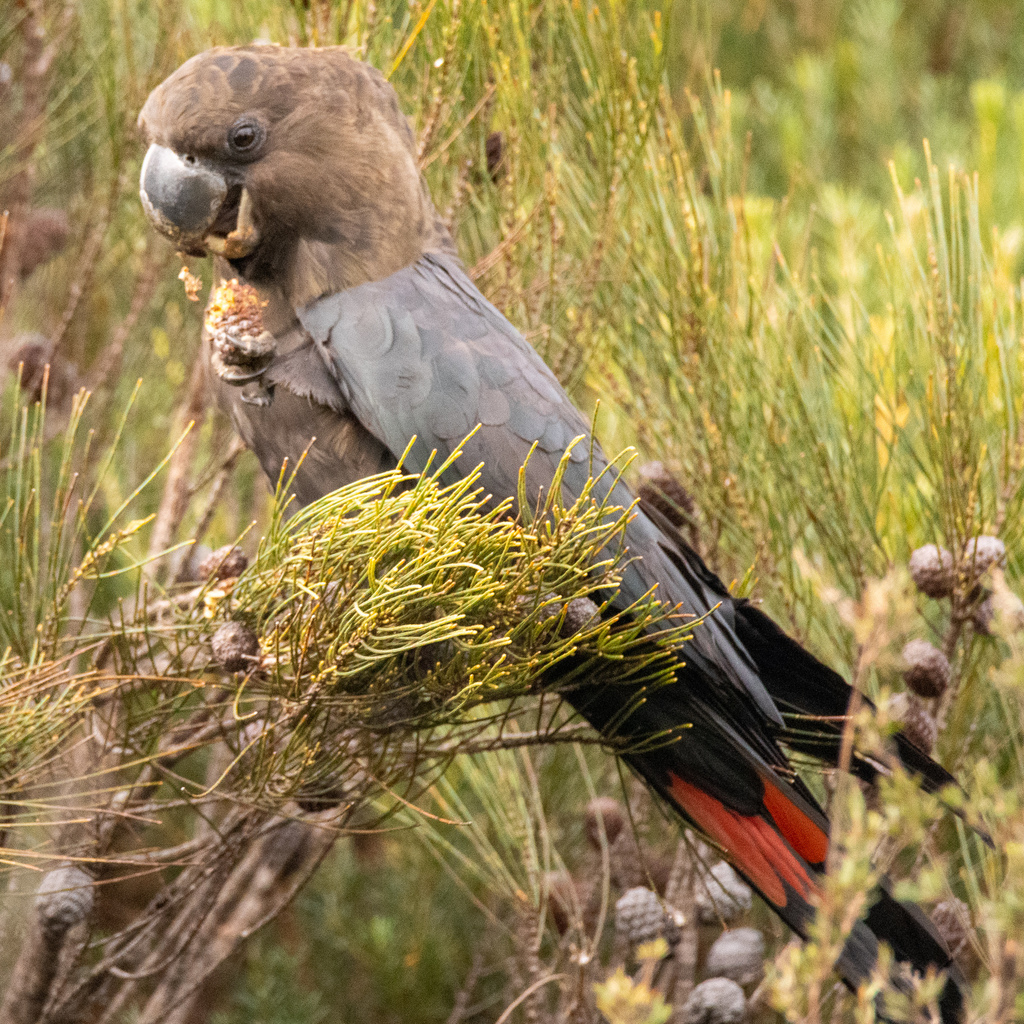
Glossy Black Cockatoo
Photo © Jonno Downes
Photo © Jonno Downes — CC BY 4.0 — Source: iNaturalist #110935013Identification
The glossy black cockatoo is the smallest member of its subfamily, reaching 46–50 cm in length. This species is strikingly sexually dimorphic. Males are predominantly blackish brown with a chocolate-brown head and striking red patches on the tail. Females are duller dark brown overall, featuring distinctive yellow flecks around the neck and collar, with a barred red tail rather than the male's patched pattern. Their closest relative is the red-tailed black cockatoo, and together they form the genus Calyptorhynchus, distinguished from other black cockatoos by their unique tail colouration, head pattern, and pronounced sexual dimorphism.
Range & Habitat
Found across eastern Australia, glossy black cockatoos inhabit open forests and woodlands, typically associated with casuarina woodland. The south-eastern subspecies ranges between southeastern Queensland and Mallacoota in Victoria, with isolated populations in central Queensland's Eungella region and in the Riverina and Pilliga forests. The Kangaroo Island subspecies, now restricted to the northern and western parts of the island, once also inhabited the southern Fleurieu Peninsula mainland but disappeared from there by the 1970s as habitat vanished.
Behaviour & Diet
Glossy black cockatoos are specialist seed-eaters, primarily feeding on she-oak seeds (Casuarina species and Allocasuarina species). The Kangaroo Island population particularly favours the most recent season's cones of drooping she-oak over older cones. These birds use their powerful bills to shred cones, which they hold in their feet, before extracting seeds with their tongues. The species is protected internationally under CITES Appendix II, reflecting its conservation status across much of its range.
Best Time & Places to See It
The south-eastern subspecies is listed as vulnerable under federal and state legislation, while the Kangaroo Island population is listed as endangered. The Kangaroo Island subspecies, once numbering as few as 150 individuals in the 1990s, has recovered to approximately 370 birds following conservation efforts including predator deterrence measures. Travellers seeking this species should focus on Kangaroo Island in South Australia or casuarina woodlands in eastern Queensland and Victoria, where habitat conditions remain suitable.
Photography Tips
The glossy black cockatoo's dramatic sexual dimorphism offers excellent photographic contrast—capture males' striking red tail patches against their dark plumage, and females' subtle yellow neck markings and barred tails. Their behaviour of holding cones in their feet while feeding provides distinctive action shots. Early morning visits to casuarina-dominated woodlands increase encounter likelihood. The bird's dark coloration requires careful exposure management; avoid blown highlights on any red tail patches, and use adequate shutter speed to freeze wing movement during flight.
Kroombit Tops National Park
Valentine Plains, Australia
+152 birds+6 mammals
Where eucalypt woodlands rise into sandstone plateaus, Kroombit Tops unfolds across nearly 906 square kilometres of northeastern Queensland's most biodiverse terrain. The park's defining feature is…
VIEW NATIONAL PARKCarnarvon National Park
Philadelphia, Australia
+179 birds+17 mammals
Across 15,000 square kilometres of inland Queensland, rugged sandstone plateaus rise above eucalypt woodlands and open grasslands, carved by creeks that have worn deep gorges into…
VIEW NATIONAL PARKNerang National Park
Gold Coast, Australia
+126 birds+13 mammals
Steep subtropical rainforest clads the hinterland ridges of southeast Queensland's Gold Coast, where Nerang National Park sprawls across 34 square kilometres of protected bushland between the…
VIEW NATIONAL PARKSpringbrook National Park
Australia
+195 birds+25 mammals
Subtropical rainforest meets open eucalypt woodland across a mountainous terrain where the McPherson Range rises sharply from the Queensland coast, creating a patchwork of microclimates and…
VIEW NATIONAL PARKLamington National Park
Australia
+227 birds+24 mammals
Where subtropical rainforest rises steeply from the Queensland coast, Lamington National Park spreads across 541 square kilometres of one of Australia's most biodiverse mountain landscapes. The…
VIEW NATIONAL PARKSydney Harbour National Park
Sydney, Australia
+203 birds+26 mammals
Where Sydney Harbour's sheltered waters meet the sandstone headlands of New South Wales, a mosaic of coastal heathland, eucalyptus woodland and rocky shores creates one of…
VIEW NATIONAL PARKRoyal National Park
Sydney, Australia
+296 birds+46 mammals
Where sandstone ridges plunge toward the Tasman Sea, Royal National Park unfolds across 343 square kilometres of southeastern Australian coastal wilderness. The park's defining character emerges…
VIEW NATIONAL PARKInnes National Park
Barcelona, Australia
+141 birds+10 mammals
Granite ridges and weathered stone outcrops rise across South Australia's Fleurieu Peninsula, defining a landscape where ancient rock formations meet open eucalypt woodland and heathland scrub.…
VIEW NATIONAL PARKGirraween National Park
Australia
+193 birds+21 mammals
Granite boulders rise like the bones of the earth across these 278 square kilometres of southeastern Queensland, where the Great Dividing Range descends towards the coastal…
VIEW NATIONAL PARKMorton National Park
Australia
+253 birds+57 mammals
Across nearly 4,800 square kilometers of New South Wales's Southern Tablelands, rugged sandstone plateaus rise above sheltered valleys where cool-climate eucalypt woodland meets grassy heath and…
VIEW NATIONAL PARKHeathcote National Park
Sydney, Australia
+119 birds+16 mammals
Sandstone ridges and eucalypt woodlands rise from the Cumberland Plain southwest of Sydney, where Heathcote National Park unfolds across 82 square kilometres of bushland shaped by…
VIEW NATIONAL PARKGlass House Mountains National Park
Australia
+151 birds+8 mammals
Conical peaks of volcanic origin rise dramatically from the coastal lowlands of southeastern Queensland, their weathered slopes cloaked in eucalyptus woodland and open sclerophyll forest that…
VIEW NATIONAL PARKBribie Island National Park
Brisbane, Australia
+284 birds+20 mammals
Across tidal flats and shallow waterways north of Brisbane, Bribie Island National Park spreads across nearly four hundred square kilometres of subtropical coastal wilderness—a patchwork of…
VIEW NATIONAL PARKFlinders Chase National Park
Australia
+142 birds+14 mammals
Granite ridges and windswept mallee scrubland define this 1,630-square-kilometre expanse on Kangaroo Island, where ancient rock formations rise abruptly from coastal heathland and woodland mosaics. The…
VIEW NATIONAL PARKGreat Sandy National Park
Australia
+306 birds+40 mammals
Where coastal dunes rise inland from the Queensland coastline, Great Sandy National Park encompasses a landscape of remarkable ecological diversity shaped by subtropical humid conditions year-round.…
VIEW NATIONAL PARKNoosa National Park
Marcus Beach, Australia
+216 birds+8 mammals
Subtropical eucalypt woodland and open forest meet coastal heathland along the Noosa Peninsula, where the temperate waters of the Tasman current moderate the Queensland climate into…
VIEW NATIONAL PARKBlue Mountains National Park
Australia
+220 birds+43 mammals
Dramatic sandstone cliffs rise in tiers across this mountainous plateau west of Sydney, their rust-coloured faces weathered into amphitheatres and gorges where eucalyptus forest clings to…
VIEW NATIONAL PARKKosciuszko National Park
Australia
+211 birds+52 mammals
Where the Great Dividing Range reaches its highest peaks in southeastern Australia, Kosciuszko National Park encompasses a landscape of windswept plateaus, rocky ridges, and deep river…
VIEW NATIONAL PARKBouddi National Park
Gosford, Australia
+147 birds+17 mammals
Sandstone ridges rise sharply from the Tasman Sea along the central New South Wales coast, their weathered faces etched by millennia of salt spray and storm…
VIEW NATIONAL PARKKu-ring-gai Chase National Park
Sydney, Australia
+216 birds+39 mammals
Where Hawkesbury sandstone cliffs plunge toward sheltered bays and creeks, Ku-ring-gai Chase National Park unfolds across rugged terrain just north of Sydney, a mosaic of eucalyptus…
VIEW NATIONAL PARKBarrington Tops National Park
Australia
+175 birds+47 mammals
Where the New England Plateau rises above the Hunter Valley, temperate rainforest cloaks the highest reaches of Barrington Tops, its dense canopy fed by year-round precipitation…
VIEW NATIONAL PARKDorrigo National Park
Gleniffer, Australia
+172 birds+17 mammals
Where subtropical rainforest transitions into cool temperate woodland, Dorrigo National Park rises across the volcanic tablelands of far northern New South Wales, cloaked in the perpetually…
VIEW NATIONAL PARKWarrumbungle National Park
Coonabarabran, Australia
+183 birds+22 mammals
Volcanic peaks and weathered ridges rise abruptly from the inland tablelands of central New South Wales, their exposed rock faces glowing ochre and rust in the…
VIEW NATIONAL PARKOxley Wild Rivers National Park
Australia
+202 birds+45 mammals
Where the New England Tablelands descend toward the coast, river gorges carve through temperate forests in a landscape of dramatic geological contrast. Oxley Wild Rivers National…
VIEW NATIONAL PARKNew England National Park
Australia
+169 birds+35 mammals
Temperate eucalypt woodlands and cool rainforest pockets define this upland reserve where granite peaks rise above the New England Plateau in northeastern New South Wales. Here,…
VIEW NATIONAL PARKBudawang National Park
Australia
+80 birds+17 mammals
Rugged sandstone ridges rise dramatically across the New South Wales Southern Tablelands, their weathered faces sculpted by millennia of wind and water into a landscape of…
VIEW NATIONAL PARKBen Boyd National Park
Eden, Australia
+255 birds+47 mammals
Where the temperate forests of the far south coast meet towering sea cliffs, Ben Boyd National Park unveils one of New South Wales' most dramatic coastal…
VIEW NATIONAL PARKNo community photos yet. Log in to add the first one.
No community observations of this species yet.