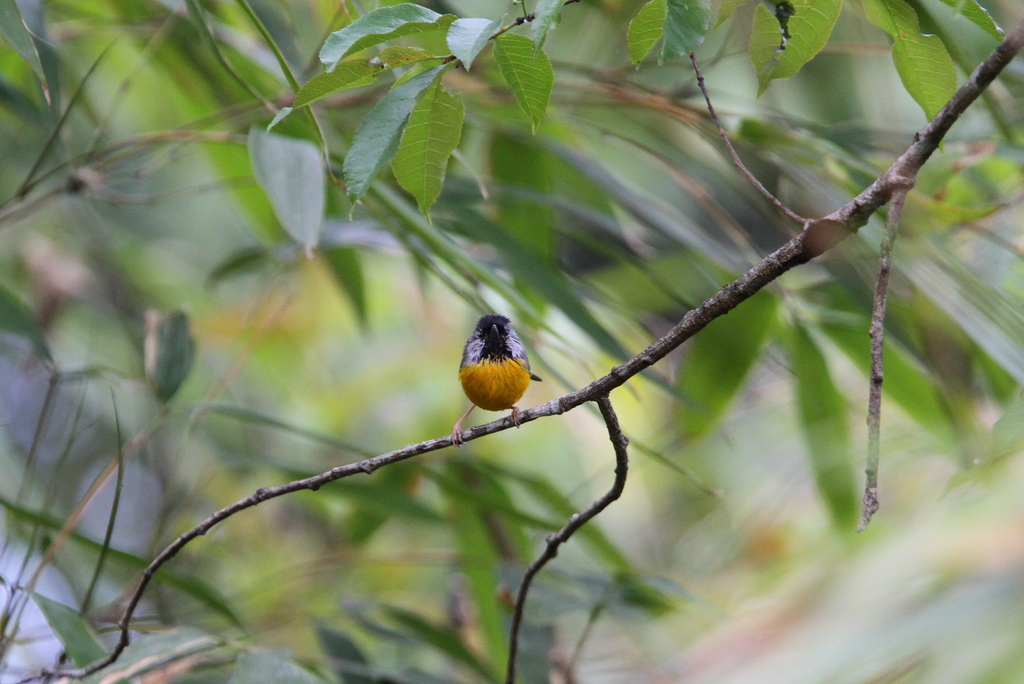
Golden-breasted Fulvetta
Photo © Christoph Moning
Photo © Christoph Moning — CC BY 4.0 — Source: iNaturalist #59045522Identification
The golden-breasted fulvetta is a small songbird measuring 10–11.5 cm in length, weighing just 5–10 grams. Despite its modest size, it is unmistakable in the field. The head and crown are black or grey, contrasting sharply with predominantly yellow underparts. The black wings feature distinctive orange-yellow slashes, while the secondaries are tipped white and the brown tail has two-thirds of its base edged in orange-yellow. The throat varies from grey to yellowish depending on the subspecies. A key field mark is the median crown stripe, which varies in presence, prominence, and colour across populations. Males and females are indistinguishable by plumage.
Range & Habitat
This species ranges across the eastern Himalayan region and beyond, occurring from central Nepal through Bhutan, northern India, and Myanmar to western China and northern Vietnam. It is an altitudinal migrant, breeding at elevations of 2,000–2,800 metres and descending to foothills as low as 1,600 metres in winter, occasionally reaching 1,300 metres. The golden-breasted fulvetta inhabits broad-leaved evergreen forests and montane bamboo zones, preferring low strata where it forages for insects.
Behaviour & Diet
This is an insectivorous species that forages at low heights within its forest habitat. Golden-breasted fulvettas are highly social birds, particularly in winter, when they move in groups of up to 30 individuals. They frequently join mixed-species foraging flocks, a behaviour common among Himalayan forest birds that enhances foraging efficiency and predator detection. Their small size and agile movements make them well-suited to gleaning insects from foliage and branches.
Best Time & Places to See It
The altitudinal migration pattern offers seasonal opportunities: breeding populations at higher elevations (2,000–2,800 m) are present in the breeding season, while winter birds descend to lower elevations (1,300–1,600 m), potentially making them slightly easier to encounter. The species' vast range across Nepal, Bhutan, northeastern India, Myanmar, western China, and northern Vietnam means that montane bamboo forests and broad-leaved evergreen woodland throughout this region offer the best chances. Look for them in mixed-species flocks during the winter months when aggregations are largest.
Photography Tips
The golden-breasted fulvetta's small size and preference for foraging low in dense forest vegetation present both challenge and opportunity. Focus on capturing the striking contrast between the dark head and yellow underparts, and the vivid orange-yellow markings on the wings and tail base—these are the species' defining features. Winter flocks offer more individuals to photograph but also more competition for frame space. Early morning light in montane forests will best render the subtle gradations of plumage colour. Patient positioning near known mixed-species flocks will reward you with multiple shooting opportunities.
Gaoligong Mountain National Nature Reserve
Giant Panda National Park
Huanglong Scenic and Historic Interest Area
Jiuzhai Valley
Khangchendzonga National Park
Mount Nanling Forest Park
Wolong National Nature Reserve
Nothing matches these filters.
No community photos yet. Log in to add the first one.
No community observations of this species yet.