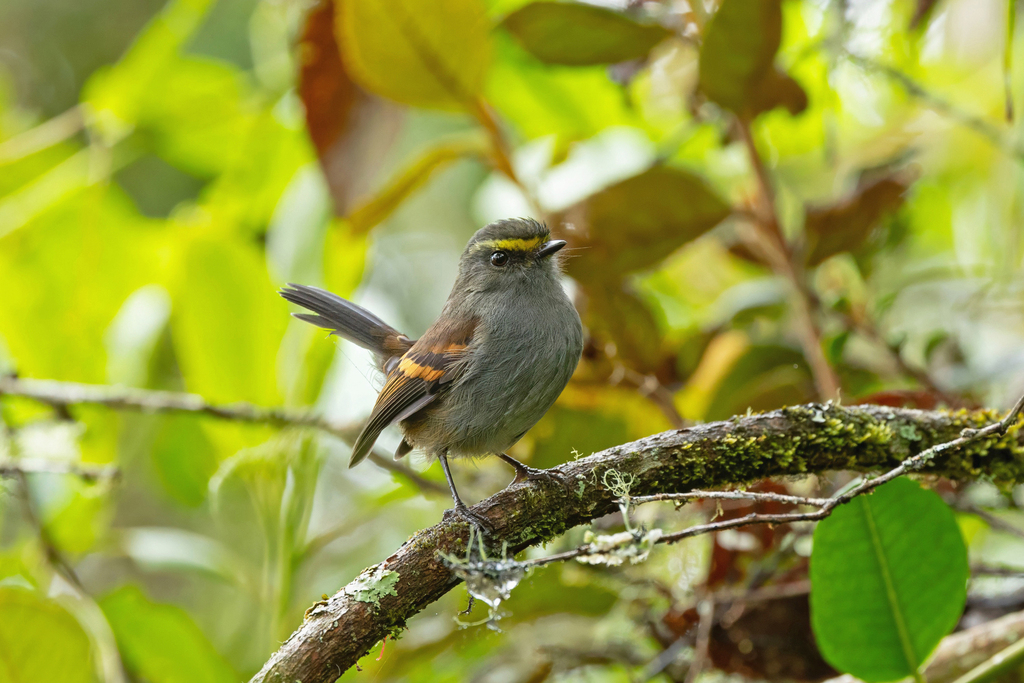
Golden-browed Chat-Tyrant
Photo © Thibaud Aronson
Photo © Thibaud Aronson — CC BY-SA 4.0 — Source: iNaturalist #343474877The golden-browed chat-tyrant (Silvicultrix pulchella) is a species of passerine bird in the family Tyrannidae, the tyrant flycatchers. It is found in Bolivia and Peru. == Taxonomy and systematics == The golden-browed chat-tyrant has a complicated taxonomic history. It was formally described in 1876 as Ochthoeca pulchlla. For a time it and Jelski's chat-tyrant (now Silvicultrix jelskii) were considered conspecific and later both were treated as subspecies of the crowned chat-tyrant (then Tyrannula frontalis). In 1966 Meyer de Schauensee placed the crowned chat-tyrant in genus Ochthoeca, returning the golden-browed chat-tyrant to its original genus, though still as a subspecies of the crowned chat-tyrant. Wesley Lanyon moved the crowned chat-tyrant to Silvicultrix when he erected that genus in 1986. By 1990 some authors had elevated the golden-browed chat-tyrant to a full species. By 2006 the IOC had recognized the golden-browed chat-tyrant as a species and then adopted the change in genus to Silvicultrix in 2009. The first version of BirdLife International's Handbook of the Birds of the World (HBW), published in 2007, included the golden-browed chat-tyrant as a full species. The Clements taxonomy and the South American Classification Committee of the American Ornithological Society (SACC) later accepted it as a species.…
Yanachaga–chemillén National Park
Palcazu, Peru
+639 birds+6 mammals
Where the eastern slopes of Peru's central cordillera plunge into cloud forest, Yanachaga–Chemillén National Park protects nearly three thousand square kilometres of montane wilderness that few…
VIEW NATIONAL PARKManu National Park
Manu, Peru
+892 birds+26 mammals
Across the eastern slopes of the Peruvian Andes, tropical rainforest descends into the Amazon basin with a complexity that few terrestrial ecosystems match. Manu National Park…
VIEW NATIONAL PARKNo community photos yet. Log in to add the first one.
No community observations of this species yet.