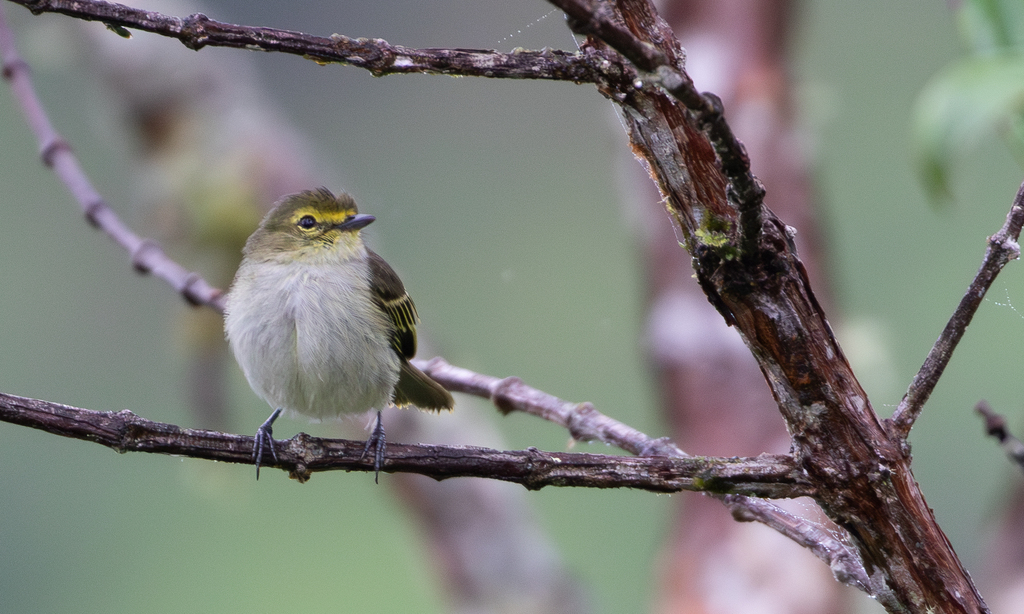
Golden-faced Tyrannulet
Photo © RJ Baltierra
Photo © RJ Baltierra — CC BY 4.0 — Source: iNaturalist photo #489394431Identification
The golden-faced tyrannulet is a small flycatcher, measuring 10.5 to 11.5 cm in length. Its most distinctive feature is its bright yellow forehead, supercilium, and eye-ring, contrasting sharply with a dark eye-stripe on an otherwise yellowish-white face. The crown, back, and rump are bright olive-green, while the wings are dusky with bright yellow edges on the coverts and flight feathers. The throat is yellowish-white, and the breast, flanks, and belly are dull whitish. Both sexes share identical plumage. The bird has a small, rounded blackish bill, brown or brownish-gray iris, and gray legs and feet.
Range & Habitat
This species is found across the Andes of northwestern Venezuela, the Serranía del Perijá on the Venezuela-Colombia border, the Colombian Andes (except Nariño Department), and along the eastern Andean slope throughout Ecuador and into Peru as far as San Martín Department. It inhabits humid montane forest interiors and edges, secondary woodland, semi-deciduous forest, coffee plantations, and gardens at elevations ranging from 1,000 to 2,450 meters, depending on location.
Behaviour & Diet
The golden-faced tyrannulet is a year-round resident throughout its range. It feeds primarily on insects and small fruits, particularly mistletoes, foraging singly or in pairs. This bird typically spends equal time foraging independently and participating in mixed-species feeding flocks, actively gleaning food from the forest canopy while perched horizontally with its tail cocked or making short flights. The species is highly vocal, with a distinctive plaintive dawn song described as "chu-de-de'e'e" or a "laughing series: tee-heeheeheehee." Daytime calls include a clear "cleeuw" or "peeur" and a ringing "teer-tif."
Breeding occurs throughout most of the year. Females construct dome-shaped nests with side entrances in hanging moss or moss bunches on tree trunks, typically 5 to 12 meters above ground. The clutch consists of two cream-white eggs with liver-brown spots. The female incubates for approximately 17 days, and both parents provision nestlings for 17 to 19 days until fledging.
Best Time & Places to See It
The golden-faced tyrannulet is common and widespread throughout its range, classified as Least Concern. It is particularly common in Venezuela and Colombia, widespread in Ecuador, and common throughout Peru. The species occurs in several protected areas across its range, making it accessible to dedicated birdwatchers year-round.
Photography Tips
Focus on capturing the distinctive bright yellow facial markings that give this species its name. The bird's habit of foraging in the canopy with a characteristic horizontal perch and cocked tail provides recognizable posture for identification in photos. Early morning visits during dawn song periods may reward patient photographers with vocal activity and more active behavior. The small size and preference for canopy foraging demand patience and attention to mixed-species flocks, which may include this bird. Look for the contrast between the yellow face and dark eye-stripe, which is key to field identification in photographs.
Yasuní National Park
Aguarico, Ecuador
+601 birds+43 mammals
Where the western Amazon basin converges with Ecuador's Orellana Province, lowland rainforest reaches toward the horizon in an unbroken canopy of staggering botanical density. Yasuní National…
VIEW NATIONAL PARKSangay National Park
Cebadas, Ecuador
+320 birds+10 mammals
High in Ecuador's Andean spine, where the Western Cordillera rises to touch perpetual snow, a landscape of volcanic drama and ecological intensity unfolds across Sangay National…
VIEW NATIONAL PARKRío Negro-Sopladora National Park
Chontal, Ecuador
+84 birds
Where the eastern cordillera of Ecuador descends toward the Amazon basin, the Río Negro-Sopladora National Park sprawls across 615 square kilometers of montane forest and riverine…
VIEW NATIONAL PARKPodocarpus National Park
Zamora, Ecuador
+496 birds+6 mammals
Where the Andes descend toward the Amazon basin, Podocarpus National Park sprawls across nearly 2,800 square kilometres of the most biodiverse terrain in Ecuador's southern highlands.…
VIEW NATIONAL PARKSumaco Napo-Galeras National Park
Loreto, Ecuador
+563 birds+4 mammals
Where Ecuador's Amazon transitions into cloud forest, a massive shield volcano rises from the emerald lowlands of Orellana Province, anchoring one of the continent's most biodiverse…
VIEW NATIONAL PARKAntisana National Park
Quijos, Ecuador
+432 birds+21 mammals
Where the eastern Andean slopes descend into the Amazon basin, Antisana National Park sprawls across roughly 2,500 square kilometers of some of South America's most dramatic…
VIEW NATIONAL PARKLlanganates National Park
Tena, Ecuador
+239 birds+8 mammals
Where the eastern slopes of the Andes plunge toward the Amazon basin, Llanganates National Park sprawls across nearly 3,500 square kilometers of montane wilderness, its terrain…
VIEW NATIONAL PARKNatural Munchique National Park
El Tambo, Colombia
+194 birds
Where the Western Cordillera rises steeply from the Pacific plains of southwestern Colombia, Natural Munchique National Park sprawls across 1,078 square kilometers of montane forest that…
VIEW NATIONAL PARKNatural Serranía de los Yariguíes National Park
El Carmen de Chucurí, Colombia
+320 birds+3 mammals
Where the northern cordilleras of Colombia rise toward cloud forest, the Serranía de los Yariguíes unfolds across nearly 1,820 square kilometers of some of the most…
VIEW NATIONAL PARKNatural Farallones de Cali National Park
Buenaventura, Colombia
+733 birds+27 mammals
Where the Pacific coastal plain meets the western slopes of the Andes, Farallones de Cali National Park sprawls across nearly 3,500 square kilometers of dramatic topography…
VIEW NATIONAL PARKNatural Chingaza National Park
Junín, Colombia
+285 birds+6 mammals
Where the Andes rise above three thousand metres in the Cundinamarca region, high-altitude grasslands and cloud forests converge in a landscape shaped by both geology and…
VIEW NATIONAL PARKNatural el Cocuy National Park
Güicán, Colombia
+313 birds+3 mammals
Where the Andes rise to their highest peaks in Colombia's eastern cordillera, El Cocuy National Park sprawls across more than 6,600 square kilometers of some of…
VIEW NATIONAL PARKPuracé National Natural Park
Puracé, Colombia
+327 birds+2 mammals
Where the Andes thrust upward across southwestern Colombia, Puracé National Natural Park spans nearly 2,631 square kilometers of some of South America's most dramatic montane terrain.…
VIEW NATIONAL PARKGuácharos Cave National Natural Park
Acevedo, Colombia
+359 birds
High in the Andean foothills of southern Huila, where mist-laden slopes rise above 1,600 metres, lies a landscape carved by underground rivers and crowned by karst…
VIEW NATIONAL PARKNatural Uramba Bahía Málaga National Park
Buenaventura, Colombia
+308 birds+15 mammals
Where the Pacific coastal rainforest descends to mangrove estuaries and rocky headlands, Uramba Bahía Málaga National Park unfolds across nearly 1,000 square kilometres of Colombia's Valle…
VIEW NATIONAL PARKNatural Sumapaz National Park
Cubarral, Colombia
+368 birds+1 mammals
Where the Andes descend toward the Amazon basin, the high páramo grasslands of Sumapaz National Park sprawl across more than five thousand square kilometers of Meta…
VIEW NATIONAL PARKEl Tamá National Park
Toledo, Colombia
+435 birds
Where the Andes descend toward the Caribbean coastal lowlands of northern Colombia, El Tamá National Park sprawls across nearly 3,800 square kilometres of montane forest, cloud…
VIEW NATIONAL PARKNatural Sierra de la Macarena National Park
Vista Hermosa, Colombia
+566 birds+15 mammals
Across nearly 20,000 square kilometres of Colombia's Meta Department, the terrain rises from lowland savanna into Andean foothills through a mosaic of gallery forests, palm-fringed wetlands,…
VIEW NATIONAL PARKNo community photos yet. Log in to add the first one.
No community observations of this species yet.