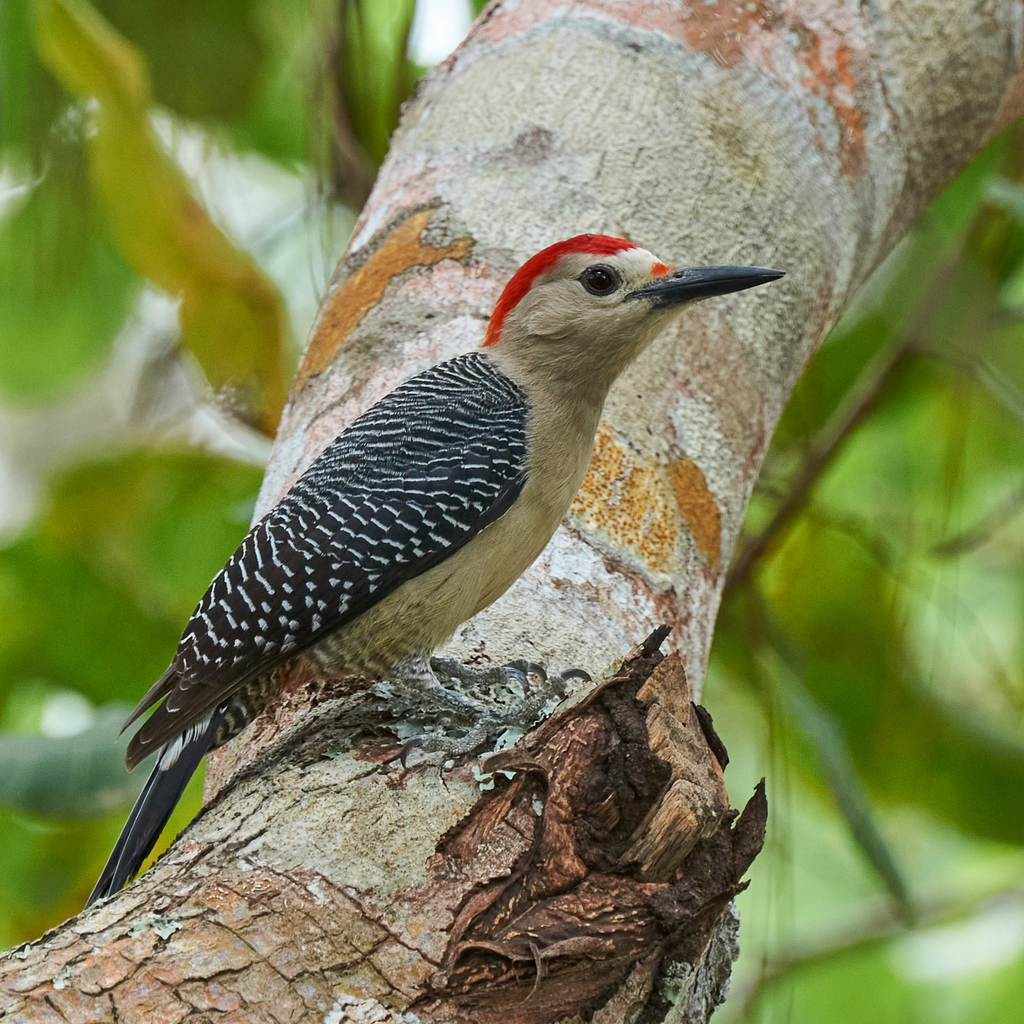
Golden-fronted Woodpecker
Photo © Glynn Morris
Photo © Glynn Morris — CC BY 4.0 — Source: iNaturalist photo #185552465Identification
The Golden-fronted Woodpecker is a medium-sized woodpecker measuring 22–26 cm in length. Males are distinguished by a striking red crown and golden-orange to yellow nape separated by a gap, while females have a grayish crown and paler yellow nape. Both sexes share gray-shaded heads, barred black-and-white upperparts, and mostly black tails with white on the outermost feathers. The belly sports a distinctive yellow patch, and the underparts are smoke to drab gray with blackish barring on the flanks. Their deep red to reddish-brown iris, black bill, and grayish-green legs complete the identification. Juveniles are duller overall with minimal nape color and fine streaking below.
Range & Habitat
This woodpecker ranges from southwestern Oklahoma through central Texas across the Mexican Plateau to Jalisco, San Luis Potosí, and Hidalgo, with twelve recognized subspecies spread from Mexico through Central America. It is a year-round resident throughout its range, though it occasionally wanders into New Mexico and East Texas as a casual visitor. The species thrives in both mesic and xeric landscapes, showing a strong preference for mesquite brushlands and riparian woodlands while readily adapting to urban parks and suburban areas.
Behaviour & Diet
Golden-fronted Woodpeckers remain paired year-round and maintain territories even outside the breeding season. They forage primarily in trees on major limbs, typically below 6 meters, using gleaning, pecking, probing, and occasionally aerial flycatching to capture their varied diet of arthropods, aerial insects, fruits, nuts, and corn. They breed between March and July in Texas, often raising two broods annually. Both sexes excavate cavity nests in tree trunks or limbs—live or dead—as well as utility poles, fence posts, and nest boxes, usually 2–9 meters above ground. Clutches typically contain four or five eggs, with both parents incubating for 12–14 days; young fledge around 30 days after hatching.
Best Time & Places to See It
Central Texas offers the most reliable viewing, where this species is considered common. Look in mesquite brushlands, riparian woodlands, and urban parks year-round. March through July is ideal for observing breeding behavior and territorial interactions. Mexico's sparse population data means northern range birds are easier to locate, though patient observers in appropriate habitat throughout its range can find this adaptable species.
Photography Tips
Capture the striking sexual dimorphism by photographing both males and females—the contrast between the red-crowned male and gray-crowned female is dramatic. Frame birds on major tree limbs at their typical foraging height. The distinctive yellow belly patch and golden nape are key field marks worth emphasizing. During breeding season (March–July), position yourself near nesting cavities in trees or utility poles for behavioral shots of both sexes at the nest entrance. The bird's willingness to use urban areas means suburban parks can offer excellent, accessible photography opportunities.
Big Bend National Park
Brewster County, United States
+345 birds+34 mammals
Where the Chisos Mountains rise abruptly from the Sonoran Desert floor, Big Bend National Park spans over 7,300 square kilometers of one of North America's most…
VIEW NATIONAL PARKDzibilchantún National Park
Barcelona, Mexico
+144 birds+2 mammals
Across the limestone plains of Yucatán, where cenotes pierce the bedrock and tropical forest clings to shallow soils, lies Dzibilchantún—a modest yet ecologically vital national park…
VIEW NATIONAL PARKLagunas de Montebello National Park
Laguna de Montebello, Mexico
+360 birds+2 mammals
Where turquoise lagoons pierce the limestone plateau of southeastern Chiapas, the Lagunas de Montebello National Park unfolds across roughly 174 square kilometers of spectral water and…
VIEW NATIONAL PARKSian Ka’an
Chunyaxché, Mexico
+350 birds+16 mammals
Where the Yucatán Peninsula dissolves into wetland and mangrove, a vast mosaic of forest, lagoon, and coastal margin creates one of Mexico's most biodiverse strongholds. Across…
VIEW BIOSPHERE RESERVESierra de Tamaulipas
El Porvenir, Mexico
+98 birds+19 mammals
Where limestone peaks thrust skyward through dense subtropical forest, Mexico's northeastern frontier reveals one of the continent's most biodiverse mountain ranges. Canyons carved by perennial rivers…
VIEW NATURE RESERVEParque Nacional Cerro de la Estrella
Mexico
+126 birds+4 mammals
Where volcanic peaks rise sharply above Mexico City's sprawling metropolis, Parque Nacional Cerro de la Estrella offers a rare glimpse of high-altitude terrain within one of…
VIEW NATIONAL PARKMontes Azules
Candelaria, Mexico
+395 birds+47 mammals
Where jungle-clad limestone plateaus plunge into canyon systems carved by the Usumacinta River, Mexico's most pristine rainforest reserve unfolds across the Lacandón region of Chiapas. Montes…
VIEW BIOSPHERE RESERVELaguna del Tigre National Park
Petén, Guatemala
+399 birds+29 mammals
Where the Petén lowlands dissolve into wetland and forest, Laguna del Tigre National Park protects one of Guatemala's most ecologically vital landscapes. This sprawling reserve encompasses…
VIEW NATIONAL PARKSierra del Lacandón National Park
Petén, Guatemala
+348 birds+7 mammals
Where the Petén rainforest rises into limestone ridges and deep ravines, Sierra del Lacandón National Park protects one of Central America's most intact tropical wilderness zones.…
VIEW NATIONAL PARKLaguna Atascosa National Wildlife Refuge
Cameron County, United States
+365 birds+19 mammals
Where coastal prairie meets shallow lagoon along the southernmost tip of Texas, Laguna Atascosa National Wildlife Sanctuary sprawls across a landscape sculpted by salt spray and…
VIEW WILDLIFE SANCTUARYSanta Ana National Wildlife Refuge
Hidalgo County, United States
+349 birds+12 mammals
Where the Rio Grande delta meets the semi-arid scrublands of South Texas, Santa Ana National Wildlife Sanctuary preserves a rare mosaic of wetland and thornforest habitat…
VIEW WILDLIFE SANCTUARYLower Rio Grande Valley National Wildlife Refuge
Starbase, United States
+311 birds+11 mammals
Where the Rio Grande delta spreads across the coastal plain of South Texas, a sanctuary of subtropical wetlands and riparian corridors creates a landscape that pulses…
VIEW WILDLIFE SANCTUARYNo community photos yet. Log in to add the first one.
No community observations of this species yet.