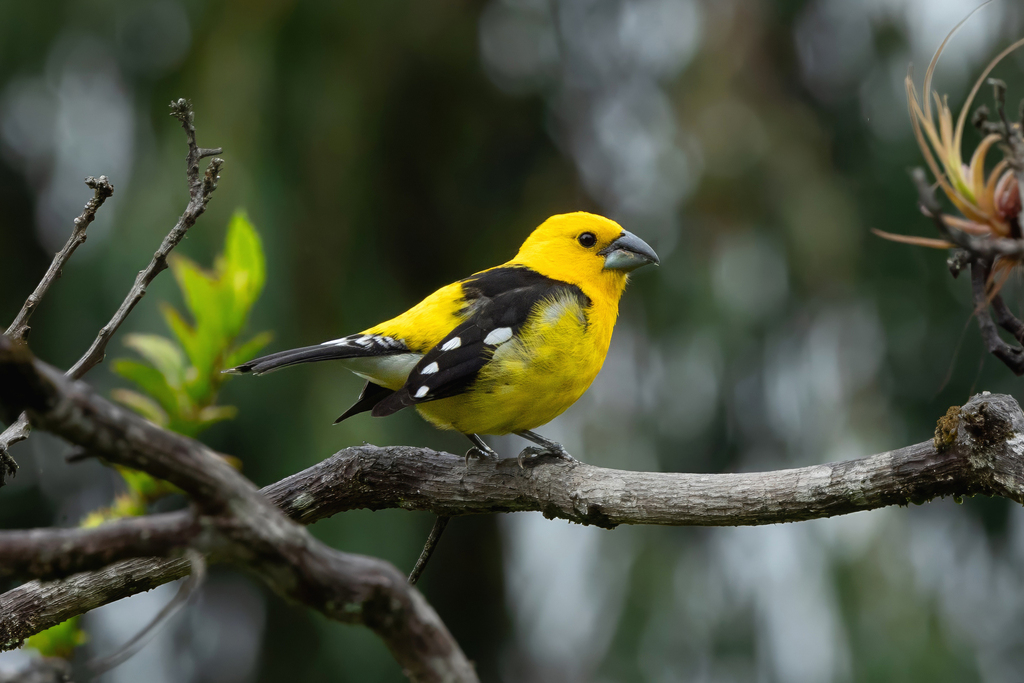
Golden Grosbeak
Photo © Thibaud Aronson
Photo © Thibaud Aronson — CC BY-SA 4.0 — Source: iNaturalist photo #462619603The golden grosbeak (Pheucticus chrysogaster), also known as golden-bellied grosbeak or southern yellow grosbeak, is a species of grosbeak in the family Cardinalidae. It is similar to, and has sometimes been considered conspecific with, the yellow grosbeak. The golden grosbeak is found in Colombia, Ecuador, Peru, Trinidad and Tobago, and Venezuela. Its natural habitats are subtropical or tropical dry forests, subtropical or tropical moist montane forests, subtropical or tropical dry shrubland, and heavily degraded former forest. == Taxonomy == The golden grosbeak belongs to the taxonomic family Cardinalidae. Other members of this family include cardinals, buntings, and other grosbeaks. Its genus, Pheuticus (meaning "shy" in Greek), contains six extant species. The golden grosbeak (P. chrysogaster) used to be considered a member of the same species as the black-thighed grosbeak (P. tibialis) and yellow grosbeak (P. chrysopeplus); collectively, they went under the name yellow grosbeak (P. chrysopeplus). Southern yellow grosbeak was the common name given to the subspecies of yellow grosbeak found in the South American Andes of Ecuador, Peru, Venezuela, and Columbia, now recognized as the separate species golden grosbeak. Recent phylogenetics supports the separation of these three species and suggests that the golden grosbeak is more closely related to…
Sangay National Park
Cebadas, Ecuador
+320 birds+10 mammals
High in Ecuador's Andean spine, where the Western Cordillera rises to touch perpetual snow, a landscape of volcanic drama and ecological intensity unfolds across Sangay National…
VIEW NATIONAL PARKCerros de Amotape National Park
District of San Jacinto, Ecuador
+246 birds+1 mammals
Arid mountains rise abruptly from Peru's northwestern frontier, their slopes clothed in xerophytic scrubland and seasonal deciduous forest that transforms these Andean foothills into one of…
VIEW NATIONAL PARKPodocarpus National Park
Zamora, Ecuador
+496 birds+6 mammals
Where the Andes descend toward the Amazon basin, Podocarpus National Park sprawls across nearly 2,800 square kilometres of the most biodiverse terrain in Ecuador's southern highlands.…
VIEW NATIONAL PARKAntisana National Park
Quijos, Ecuador
+432 birds+21 mammals
Where the eastern Andean slopes descend into the Amazon basin, Antisana National Park sprawls across roughly 2,500 square kilometers of some of South America's most dramatic…
VIEW NATIONAL PARKCotopaxi National Park
Mulaló, Ecuador
+211 birds+6 mammals
High in Ecuador's volcanic corridor, where the páramo transitions into cloud forest along the slopes of Cotopaxi volcano, the national park unfolds across nearly 500 square…
VIEW NATIONAL PARKCajas National Park
Cuenca, Ecuador
+190 birds+7 mammals
High in the Andes above Cuenca, where elevation ranges from 3,100 to 4,200 metres, the páramo landscape dominates—a windswept realm of cushion plants, alpine grasses, and…
VIEW NATIONAL PARKYanachaga–chemillén National Park
Palcazu, Peru
+639 birds+6 mammals
Where the eastern slopes of Peru's central cordillera plunge into cloud forest, Yanachaga–Chemillén National Park protects nearly three thousand square kilometres of montane wilderness that few…
VIEW NATIONAL PARKManu National Park
Manu, Peru
+892 birds+26 mammals
Across the eastern slopes of the Peruvian Andes, tropical rainforest descends into the Amazon basin with a complexity that few terrestrial ecosystems match. Manu National Park…
VIEW NATIONAL PARKHuascarán National Park
Independencia, Peru
+201 birds+5 mammals
Where granite peaks pierce the Andean sky above 6,000 metres, Huascarán National Park sprawls across more than 11,500 square kilometres of Peru's Cordillera Blanca, a landscape…
VIEW NATIONAL PARKNo community photos yet. Log in to add the first one.
No community observations of this species yet.