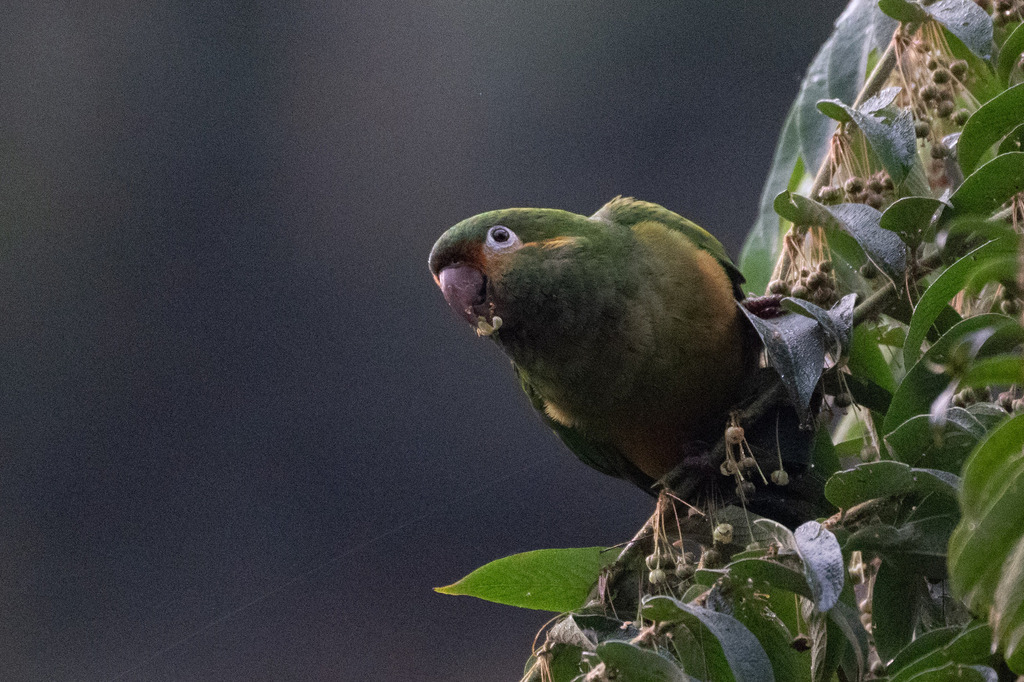
Golden-plumed Parakeet
Photo © cello caruso-turiello
Photo © cello caruso-turiello — CC BY 4.0 — Source: iNaturalist photo #502986238Identification
The golden-plumed parakeet is a large, long-tailed montane parrot with distinctive plumage that makes it recognizable in its highland habitat. Adults are predominantly bright green with striking orange-yellow lores and small golden-yellow crests positioned behind the eyes. The belly is a faded yellowish colour with scattered reddish-orange feathers, while the underside of the flight feathers displays yellowish tones and the tail underside shows strongly reddish coloration. Juveniles closely resemble adults but display paler green, yellow, and orange bellies, and notably have pale pink bills rather than the darker bills of mature birds.
Range & Habitat
This species is endemic to the eastern Andean slopes, occurring in Colombia, Ecuador, and Peru. It inhabits humid temperate highland forests, particularly those dominated by Podocarpus trees, where it has become specially adapted to these cloud forest ecosystems. The species is generally local and uncommon throughout its range, and populations have become increasingly fragmented due to habitat conversion.
Behaviour & Diet
Golden-plumed parakeets are highly social, typically occurring in flocks of 5–15 birds, though gatherings of 35–40 have been recorded. They display a likely nomadic movement pattern, vacating nesting areas after chicks fledge and returning during the breeding season. These parakeets are conspicuous and very active callers, producing shrill vocalizations both in flight and while perched, with calling intensity increasing during breeding season. They favour exposed branches and outer crowns of wax palms for foraging and roosting. Their diet is heavily dependent on Podocarpus cones, supplemented by other plant material, and they spend considerable time foraging within Podocarpus trees. A remarkable characteristic is that this is the only known parakeet species capable of detecting ultraviolet radiation.
Best Time & Places to See It
The breeding season offers the best opportunity for observation, as calling frequency increases substantially during this period, making birds easier to locate. Look for flocks in humid montane forests dominated by Podocarpus and wax palms along the eastern Andean slope. Conservation sites scattered throughout their range in Colombia, Ecuador, and Peru provide protected areas where encounters are more probable, though the species remains uncommon and sightings require patience and persistence.
Photography Tips
Position yourself to capture the birds' striking golden crests and the contrast between their bright green upperparts and faded yellow bellies. Early morning is ideal for photography, as the birds are most active and vocal at this time, and the soft light of dawn flatters their plumage. Watch for flocks feeding in the outer crowns of palms—this exposed behaviour offers excellent photographic opportunities. Capture images of birds in flight to showcase the distinctive yellowish underwing and reddish tail underside. Patience is essential; allow time to locate and observe flocks, and use their frequent shrill calls to pinpoint their location.
Podocarpus National Park
Zamora, Ecuador
+496 birds+6 mammals
Where the Andes descend toward the Amazon basin, Podocarpus National Park sprawls across nearly 2,800 square kilometres of the most biodiverse terrain in Ecuador's southern highlands.…
VIEW NATIONAL PARKYacuri National Park
Las Juntas, Ecuador
+166 birds+1 mammals
Where the eastern slopes of the Andes descend into Ecuador's southern frontier, Yacuri National Park unfolds across nearly 1,300 square kilometers of montane cloud forest and…
VIEW NATIONAL PARKCajas National Park
Cuenca, Ecuador
+190 birds+7 mammals
High in the Andes above Cuenca, where elevation ranges from 3,100 to 4,200 metres, the páramo landscape dominates—a windswept realm of cushion plants, alpine grasses, and…
VIEW NATIONAL PARKPuracé National Natural Park
Puracé, Colombia
+327 birds+2 mammals
Where the Andes thrust upward across southwestern Colombia, Puracé National Natural Park spans nearly 2,631 square kilometers of some of South America's most dramatic montane terrain.…
VIEW NATIONAL PARKGuácharos Cave National Natural Park
Acevedo, Colombia
+359 birds
High in the Andean foothills of southern Huila, where mist-laden slopes rise above 1,600 metres, lies a landscape carved by underground rivers and crowned by karst…
VIEW NATIONAL PARKNatural Nevado del Huila National Park
Planadas, Colombia
+117 birds
Where the Colombian Andes rise above 5,000 metres, tropical cloud forest yields to páramo and glaciated peaks, and the Planadas region of Tolima contains one of…
VIEW NATIONAL PARKManu National Park
Manu, Peru
+892 birds+26 mammals
Across the eastern slopes of the Peruvian Andes, tropical rainforest descends into the Amazon basin with a complexity that few terrestrial ecosystems match. Manu National Park…
VIEW NATIONAL PARKNo community photos yet. Log in to add the first one.
No community observations of this species yet.