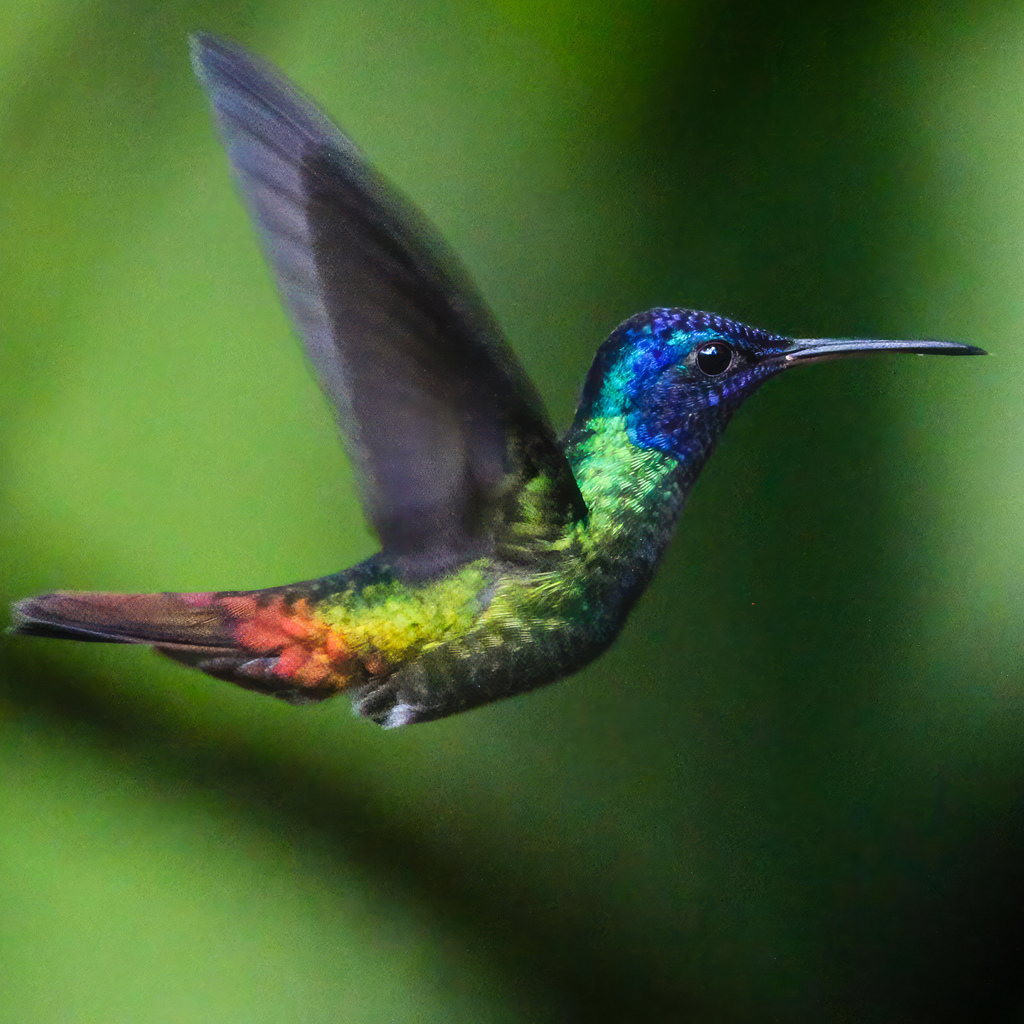
Golden-tailed Sapphire
Photo © Gary T. Leavens
Photo © Gary T. Leavens — CC BY-SA 4.0 — Source: iNaturalist #212675715Identification
The golden-tailed sapphire is a small hummingbird measuring 9.5 to 10 cm in length, with males weighing 4.7 to 6.3 g and females slightly lighter at 4.3 to 5.3 g. Both sexes sport a distinctive slightly curved bill with a black upper mandible and red lower mandible with a black tip. Adult males of the nominate subspecies display a violet-blue head and throat, bright green back transitioning through bronze-green to coppery coverts, and a characteristic copper-bronze tail. Their breast is glittering green, belly bronze-green, and undertail coverts are bronze with whitish edges. Females are more subdued, with a blue crown, green back, and copper-bronze tail, featuring mostly whitish undersides with blue-green throat speckles and green sides. Subspecies variations exist, with some males showing predominantly green throats and different rump colorations.
Range & Habitat
The golden-tailed sapphire is distributed across the northwestern Amazon basin, found in Bolivia, Brazil, Colombia, Ecuador, Peru, and Venezuela. The nominate subspecies is most widespread, occurring in the Serranía del Perijá on the Colombia-Venezuela border, western and northern Venezuela, east-central Colombia, eastern Ecuador, extreme western Brazil, and extreme northeastern Peru. Other subspecies occupy eastern Peru and northern Bolivia. The species favors semi-open landscapes including humid forest edges and gaps, mature secondary forest, gallery forest, and shaded cacao and coffee plantations. Elevation ranges from sea level to 1,500 m in Colombia and Venezuela, and 400 to 1,200 m in Ecuador.
Behaviour & Diet
Golden-tailed sapphires forage for nectar at a variety of flowering shrubs and trees including Aphelandra, Erythrina, and Inga species. Males often forage in the canopy, sometimes gathering in loose, competitive assemblages, while females employ trap-lining behavior, visiting circuits of flowering plants through the forest. Beyond nectar, they supplement their diet with small arthropods, captured either by hawking from perches or gleaning from foliage. The species shows local movements linked to flowering plant availability, though details remain limited.
Best Time & Places to See It
Breeding seasons vary geographically: June to November in eastern Colombia, and January through April in western Brazil, making these periods particularly rewarding for observation. The species is locally common to common in Colombia and Venezuela, offering the best opportunities for sightings in these countries. However, it becomes relatively rare in the Amazonian lowlands further south. Semi-open habitats such as forest edges, secondary growth, and cultivated gardens are ideal locations to search for this species, particularly where flowering shrubs are abundant.
Photography Tips
The golden-tailed sapphire's small size and rapid movements demand a fast shutter speed of at least 1/2000s to freeze wing beats. Males gathering in canopy assemblages present excellent opportunities to photograph iridescent plumage, particularly the violet-blue head and glittering green breast in strong sunlight. Early morning light works best to reveal the species' metallic colors. Focus on flowering shrubs and trees—Erythrina and Inga blooms are particularly attractive to this species—where you can position yourself in advance. Patient staking-out at productive flowering plants during peak foraging hours increases your chances of capturing clean, in-focus images of this glittering jewel.
Amacayacu National Park
Bahuaja Sonene National Park
Cordillera Azul National Park
El Tamá National Park
Manu National Park
Natural el Cocuy National Park
Natural Sierra de la Macarena National Park
Natural Sumapaz National Park
Otishi National Park
Nothing matches these filters.
No community photos yet. Log in to add the first one.
No community observations of this species yet.