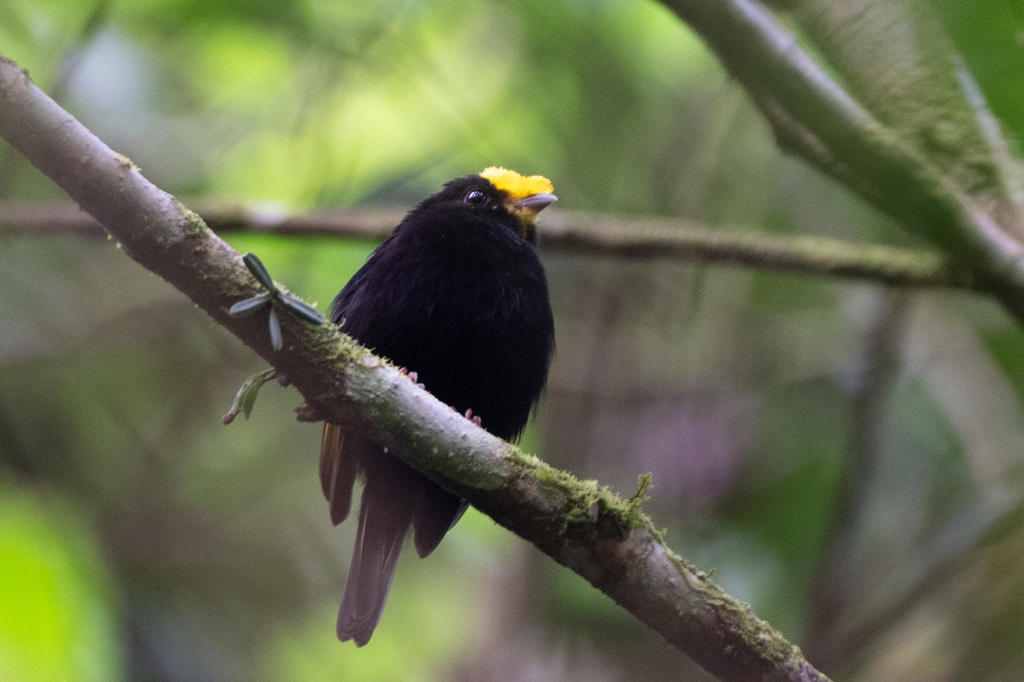
Golden-winged Manakin
Photo © cello caruso-turiello
Photo © cello caruso-turiello — CC BY 4.0 — Source: iNaturalist photo #497763092Identification
The golden-winged manakin is a tiny bird, just 11 cm long, with striking sexual dimorphism. Males are unmistakable: they display a bright golden-yellow forecrown of plush feathers curving forward over the bill, paired with short black plumes that project upward like horns. The hindcrown features a patch of orange-red, the throat is golden-yellow, and the wings and tail are entirely yellow. The rest of the plumage is black. Females are far more subdued, dressed in olive-green above with yellow-olive throat, belly, and wing linings, lacking the male's elaborate crown ornaments. Both sexes share a dark brown iris, pinkish-gray bill, and purplish-pink legs.
Subspecific variation occurs mainly in the intensity and hue of the yellow and red patches on males. M. c. peruvianus, for instance, shows deeper, richer yellows and a darker red on the crown and nape, while M. c. pax features darker yellows overall with a red or flame-orange rear crown.
Range & Habitat
This species has a disjunct distribution across the Andes of Venezuela, Colombia, Ecuador, and Peru, with five recognized subspecies occupying different sections of this mountain range. In Venezuela and Colombia, populations occur on both eastern and western slopes of the Andes; in Ecuador and Peru, they are more restricted. The bird is a year-round resident throughout its range.
The golden-winged manakin inhabits wet montane cloudforest, typically between 1,000 and 2,400 m elevation depending on location, though it will forage in clearings and forest edges. It shows some adaptability, even visiting relatively young second-growth habitat, though it appears to depend on the presence of mossy logs and buttress roots for its reproductive displays.
Behaviour & Diet
This manakin feeds primarily on small fruits, with those of the Melastomataceae genus Miconia favored, supplementing its diet with small insects. It typically forages singly or loosely associates with mixed-species feeding flocks, taking fruits by briefly hovering after short sallies from perches. Males are famous for their elaborate courtship displays on dispersed leks, performed on mossy logs and buttress roots within their territories. The most striking display involves flying from a perch to a log, landing, bouncing upward while flashing yellow wings, and landing again further along the log. Complementary displays include bobbing, plumage-fluffing, bowing, and stamping on the display site.
The breeding season varies by location but in western Ecuador appears to span May to July and possibly October to December. Females build small cup nests from plant fibers, moss, and spider web, often with moss dangling from the bottom, typically placing them in branch forks about 2 m up, though some reach 10 m or higher. Clutch size is two eggs, incubated by the female alone; further reproductive details remain unknown.
Best Time & Places to See It
The golden-winged manakin is uncommon in Venezuela but fairly common in Colombia, Ecuador, and Peru. Its montane cloudforest habitat makes it most accessible during the dry seasons when visibility improves and birds are more active. The breeding season (roughly May to July and possibly October to December in Ecuador) offers the best chance to observe males at their active display sites. Birders should focus on wet montane forests at elevations between 1,200 and 2,100 m, exploring mossy forest sections with suitable display logs and buttress roots where males can be located by their distinctive calls.
Photography Tips
The male's brilliant golden plumage and intricate displays offer compelling photographic opportunities, but the species' preference for dense cloudforest habitat and small size present challenges. Position yourself near known display sites early in the morning when males are most vocal and active. Use a fast shutter speed to freeze the wing-flash display, and ensure adequate lighting for the deep forest understory. The bird's brief hovering while foraging requires anticipation and quick autofocus settings. Patient observation of display logs and buttress roots will reveal behavioral moments—the bounce, the postures, the wing-flash—that define this remarkable little manakin.
Sumaco Napo-Galeras National Park
Loreto, Ecuador
+563 birds+4 mammals
Where Ecuador's Amazon transitions into cloud forest, a massive shield volcano rises from the emerald lowlands of Orellana Province, anchoring one of the continent's most biodiverse…
VIEW NATIONAL PARKAntisana National Park
Quijos, Ecuador
+432 birds+21 mammals
Where the eastern Andean slopes descend into the Amazon basin, Antisana National Park sprawls across roughly 2,500 square kilometers of some of South America's most dramatic…
VIEW NATIONAL PARKNatural Munchique National Park
El Tambo, Colombia
+194 birds
Where the Western Cordillera rises steeply from the Pacific plains of southwestern Colombia, Natural Munchique National Park sprawls across 1,078 square kilometers of montane forest that…
VIEW NATIONAL PARKNatural Serranía de los Yariguíes National Park
El Carmen de Chucurí, Colombia
+320 birds+3 mammals
Where the northern cordilleras of Colombia rise toward cloud forest, the Serranía de los Yariguíes unfolds across nearly 1,820 square kilometers of some of the most…
VIEW NATIONAL PARKNatural Farallones de Cali National Park
Buenaventura, Colombia
+733 birds+27 mammals
Where the Pacific coastal plain meets the western slopes of the Andes, Farallones de Cali National Park sprawls across nearly 3,500 square kilometers of dramatic topography…
VIEW NATIONAL PARKGuácharos Cave National Natural Park
Acevedo, Colombia
+359 birds
High in the Andean foothills of southern Huila, where mist-laden slopes rise above 1,600 metres, lies a landscape carved by underground rivers and crowned by karst…
VIEW NATIONAL PARKNatural Sumapaz National Park
Cubarral, Colombia
+368 birds+1 mammals
Where the Andes descend toward the Amazon basin, the high páramo grasslands of Sumapaz National Park sprawl across more than five thousand square kilometers of Meta…
VIEW NATIONAL PARKEl Tamá National Park
Toledo, Colombia
+435 birds
Where the Andes descend toward the Caribbean coastal lowlands of northern Colombia, El Tamá National Park sprawls across nearly 3,800 square kilometres of montane forest, cloud…
VIEW NATIONAL PARKNo community photos yet. Log in to add the first one.
No community observations of this species yet.