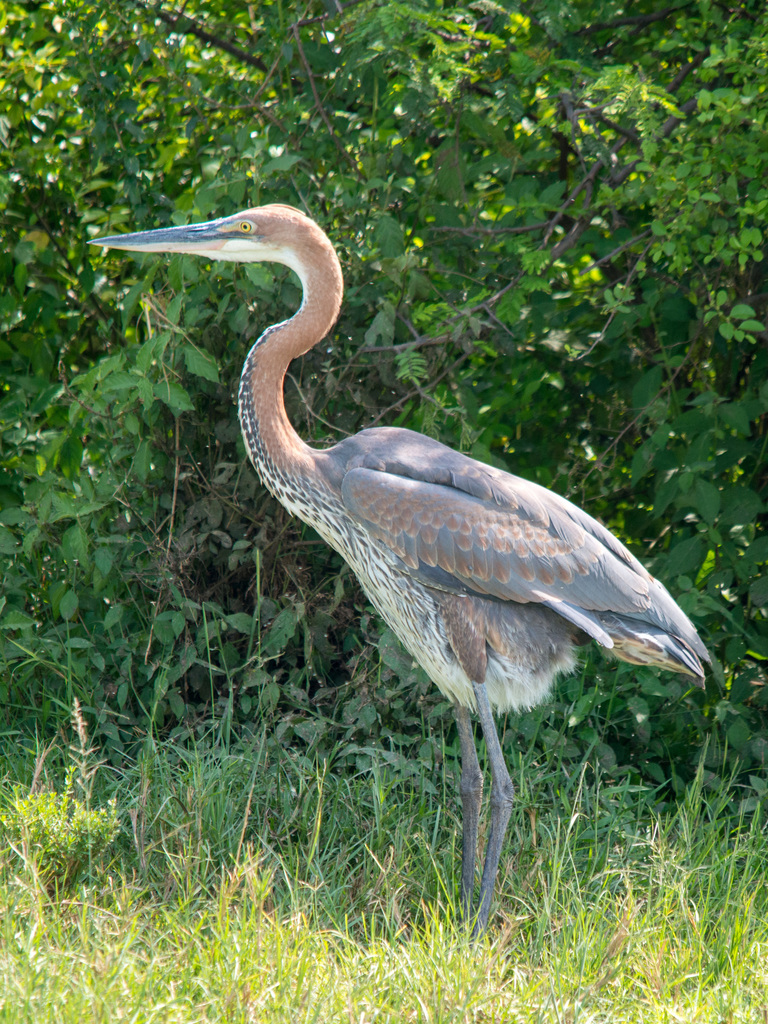
Goliath Heron
Photo © William Stephens
Photo © William Stephens — CC BY 4.0 — Source: iNaturalist photo #63248142Identification
The Goliath heron is the world's largest living heron, a truly magnificent wading bird that commands attention wherever it appears. Standing 120–152 cm tall with a wingspan of 185–230 cm and weighing 4–5 kg, this giant is unmistakable in size. In flight, it presents a slow, ponderous appearance, with legs held vertically rather than extended horizontally as in some other herons. Males and females are similar in appearance, dressed in slate-grey and chestnut plumage that creates a striking and dignified presence.
The bird's plumage combines several rich tones: the head, bushy crest, face, back and sides of the neck are deep chestnut, while the chin and throat are white with black streaks across the foreneck and upper breast. The lower breast and belly show buff coloring with black streaking. The back and upper wings are slate-grey, with a distinctive chestnut shoulder patch visible at the bend of closed wings. The black bill is substantial, measuring 18–20 cm along the culmen, and the yellow eyes with black legs complete the portrait. Juveniles appear paler than adults. The Goliath's only somewhat similar-looking heron, the purple heron, is considerably smaller and more widespread.
Range & Habitat
The Goliath heron is found across sub-Saharan Africa, with smaller, declining populations in Southwest and South Asia. This highly aquatic species rarely ventures far from water and prefers to fly along waterways rather than cross open land. It inhabits lakes, swamps, mangrove wetlands, river deltas, and even small watering holes, typically hunting in shallows though occasionally found near deeper water over dense vegetation. Elevations range from sea level to 2,100 m.
The species shows a strong preference for pristine, undisturbed wetlands and generally avoids areas subject to regular human disturbance. Its dependence on clean, healthy aquatic habitats makes it an indicator of wetland quality and a sentinel species for wetland conservation.
Behaviour & Diet
Goliath herons are solitary, highly territorial foragers that actively defend their feeding grounds against other herons. They are diurnal hunters that often remain remarkably still, standing in shallow water while intently watching for prey or perching on heavy floating vegetation to minimize water disturbance. When prey appears, the heron rapidly spears it with open mandibles, frequently piercing the fish's body with both mandibles before swallowing it whole. This method leaves them vulnerable to kleptoparasitism, with African fish eagles and other large birds frequently stealing their catches.
The diet consists almost entirely of fish, with a preference for relatively large specimens averaging 50–980 g and around 30 cm in length. Preferred species include breams, mullet, tilapia and carp. An individual typically catches only 2–3 fish per day, given the long handling time required for large prey. Beyond fish, they occasionally consume frogs, prawns, small mammals, lizards, snakes, insects and carrion.
Best Time & Places to See It
The Goliath heron's breeding season generally coincides with the rainy season from November to March, though some populations breed year-round with no discernible peak. Breeding may not occur every year. The birds nest on islands or vegetated islands within lakes and large bodies of water, making these locations prime for observation during breeding season. Nesting dispersal is highly variable, ranging from solitary pairs to fairly large colonies, with no apparent geographical preferences within regions.
Look for this majestic heron in pristine, undisturbed wetlands throughout sub-Saharan Africa. Early morning and late afternoon often provide the best viewing opportunities, when the bird is most active. Its deep, distinctive bark—a kowoork call audible from up to 2 km away—can help locate individuals in dense vegetation.
Photography Tips
The Goliath heron's sheer size makes it a rewarding photographic subject, but patience is essential. Position yourself near shallow water margins at dawn or dusk when the bird is most likely to be actively hunting. The heron's slow, deliberate movements mean you'll have good opportunities to frame shots, but be prepared for long periods of stillness before the explosive strike.
The bird's slate-grey and chestnut plumage photographs beautifully in soft morning light, which accentuates the colors without creating harsh shadows. A telephoto lens is advisable, as the species is wary and tends to avoid areas of human disturbance. Focus on capturing the distinctive head crest and the characteristic posture of the bird in its preferred habitat—standing motionless in shallow water or on floating vegetation.
Serengeti National Park
Tanzania
+558 birds+57 mammals
Across Tanzania's northern plateau, where volcanic soils meet acacia woodland and open grassland, unfolds one of Earth's most dynamic ecosystems. The Serengeti National Park sprawls across…
VIEW NATIONAL PARKArusha National Park
Tanzania
+555 birds+16 mammals
Where the slopes of Mount Mawenzi rise above the Arusha region, a compact yet ecologically rich national park unfolds across montane forest, moorland, and alpine zones.…
VIEW NATIONAL PARKRubondo Island National Park
Tanzania
+99 birds+8 mammals
Across the waters of Lake Victoria's northeastern arm, Rubondo Island rises as a freshwater wilderness where papyrus swamps grade into acacia woodlands and dense thickets of…
VIEW NATIONAL PARKMapungubwe National Park
Musina Local Municipality, South Africa
+358 birds+29 mammals
Where the Limpopo River cuts through sandstone ridges at the convergence of South Africa, Botswana, and Zimbabwe, Mapungubwe National Park preserves a landscape of profound ecological…
VIEW NATIONAL PARKChobe National Park
Botswana
+446 birds+45 mammals
Where the Chobe River cuts a sinuous path through northern Botswana, the landscape transforms into one of Africa's most dynamic wetland-savanna mosaics. This national park encompasses…
VIEW NATIONAL PARKVirunga National Park
Uganda
+418 birds+13 mammals
Where the Western Rift Valley fractures the landscape of North Kivu, Virunga National Park sprawls across terrain as geologically dramatic as it is ecologically vital. Volcanic…
VIEW NATIONAL PARKBwindi Impenetrable National Park
Kanyashogi, Uganda
+603 birds+26 mammals
Steep ridges cloaked in montane forest rise from Uganda's southwestern borderlands, where the landscape grows so dense and tangled that early explorers named it impenetrable. At…
VIEW NATIONAL PARKMurchison Falls National Park
Uganda
+608 birds+33 mammals
Where the Victoria Nile compresses through a narrow gorge and explodes across a 45-meter precipice, the landscape speaks in thunder. Murchison Falls National Park sprawls across…
VIEW NATIONAL PARKMgahinga Gorilla National Park
Cyanika, Uganda
+429 birds+6 mammals
Where the Virunga Mountains rise steeply from the Uganda–Rwanda–Democratic Republic of Congo frontier, montane forest cloaks the volcanic slopes in a dense, moisture-laden embrace. Mgahinga Gorilla…
VIEW NATIONAL PARKLake Mburo National Park
Uganda
+505 birds+24 mammals
Rolling acacia woodland and scattered lakes define this intimate savanna preserve in southwestern Uganda, where the rift valley's geological drama shapes every water source and grassland.…
VIEW NATIONAL PARKTsavo East National Park
Athi ward, Kenya
+468 birds+50 mammals
Across the semi-arid lowlands of southeastern Kenya, where acacia woodland fragments into scrubland and the landscape rolls toward the Indian Ocean horizon, lies one of Africa's…
VIEW NATIONAL PARKTsavo West National Park
Mwatate, Kenya
+513 birds+49 mammals
Where volcanic ridges and weathered lava flows meet the semi-arid lowlands of south-central Kenya, Tsavo West National Park unfolds across a landscape sculpted by fire and…
VIEW NATIONAL PARKAmboseli National Park
Etonet/Lenkism ward, Kenya
+501 birds+43 mammals
Where the Amboseli basin opens toward the Tanzanian frontier, a shallow alkaline lake mirrors vast skies across one of East Africa's most iconic savanna landscapes. The…
VIEW NATIONAL PARKMount-Kenya National Park
Abothuguchi west ward, Kenya
+334 birds+11 mammals
Where the slopes of Kenya's second-highest mountain rise steeply from the Meru County foothills, a landscape of profound ecological richness unfolds across Mount Kenya National Park.…
VIEW NATIONAL PARKTarangire National Park
Tanzania
+527 birds+50 mammals
Acacia woodland and grassland sweep across the Manyara Region where the Tarangire River carves through low hills and volcanic soils, creating one of East Africa's most…
VIEW NATIONAL PARKNgorongoro Conservation Area
Tanzania
+626 birds+55 mammals
Volcanic calderas and open grassland dominate this high plateau in northern Tanzania, where the landscape rises above 2,000 metres and ancient geological forces have shaped both…
VIEW WILDLIFE MANAGEMENT AREAToro-Semliki Proposed National Park
Uganda
+474 birds+5 mammals
Where the Albertine Rift's western escarpment rises above the Semliki River valley, a vast mosaic of forest, savanna and wetland converges to create one of East…
VIEW NATIONAL PARKQueen Elizabeth National Park
Uganda
+672 birds+30 mammals
Across the southwestern escarpment of Uganda, where the Western Rift Valley descends through ancient volcanic terrain, Queen Elizabeth National Park sprawls across more than 8,300 square…
VIEW NATIONAL PARKMabamba Swamp
Memere, Uganda
+464 birds+2 mammals
Across the Central Region of Uganda spreads one of Africa's most biodiverse freshwater wetlands, a sprawling nature reserve of roughly 283 square kilometres where papyrus swamps…
VIEW NATURE RESERVEGarden Route National Park
George, South Africa
+353 birds+54 mammals
Sweeping across the Western Cape's coastal and mountainous terrain, this sprawling national park encompasses over five thousand square kilometers of extraordinarily diverse landscape—from coastal limestone cliffs…
VIEW NATIONAL PARKPilanesberg National Park
Moses Kotane Local Municipality, South Africa
+364 birds+49 mammals
Granite peaks and volcanic ridges rise unexpectedly from the savanna floor across this 734-square-kilometre expanse in the North West province, creating a landscape of profound ecological…
VIEW NATIONAL PARKMokala National Park
Siyancuma Local Municipality, South Africa
+246 birds+35 mammals
Across the semi-arid savanna of the Northern Cape, where red earth meets sparse acacia woodland and open grassland punctuated by rocky outcrops, lies a landscape shaped…
VIEW NATIONAL PARKKruger National Park
Ba-Phalaborwa Local Municipality, South Africa
+540 birds+91 mammals
Across the low-lying savanna of northeastern South Africa unfolds one of Africa's largest and most ecologically intact protected areas, where acacia woodlands merge into mopane scrub…
VIEW NATIONAL PARKAgulhas National Park
Cape Agulhas Local Municipality, South Africa
+224 birds+13 mammals
Where the Atlantic and Indian Oceans meet at Africa's southernmost tip, Agulhas National Park stretches across 892 square kilometres of windswept coastal landscape and rugged limestone…
VIEW NATIONAL PARKAugrabies Falls National Park
Kai !Garib Local Municipality, South Africa
+176 birds+20 mammals
Where the Orange River cuts a dramatic scar through the Northern Cape's arid interior, Augrabies Falls National Park sprawls across nearly 1,200 square kilometers of raw,…
VIEW NATIONAL PARKAddo Elephant National Park
Sundays River Valley Local Municipality, South Africa
+388 birds+55 mammals
Where the Eastern Cape's semi-arid scrublands meet transitional woodland, Addo sprawls across 13,478 square kilometres of one of southern Africa's most biodiverse landscapes. The terrain rises…
VIEW NATIONAL PARKMarakele National Park
Modimolle Local Municipality, South Africa
+341 birds+36 mammals
Granite ridges and sprawling grasslands dominate this 1,176-square-kilometre reserve in Limpopo's heartland, where bushveld transitions between rocky outcrops and open savanna. The park's rugged topography creates…
VIEW NATIONAL PARKCamdeboo National Park
Camdeboo Local Municipality, South Africa
+272 birds+24 mammals
Granite ridges and weathered sandstone cliffs rise across a semi-arid landscape where the Karoo transitions into the eastern escarpment of South Africa, creating Camdeboo National Park's…
VIEW NATIONAL PARKZiwa Rhino and Wildlife Ranch
Nakasongola, Uganda
+359 birds+11 mammals
Where papyrus wetlands merge into sprawling savanna, Uganda's central landscape opens into one of East Africa's most vital rhino recovery zones. Ziwa Rhino and Wildlife Ranch…
VIEW WILDLIFE SANCTUARYSperrgebiet National Park
Barcelona, Namibia
+181 birds+18 mammals
Where the Namib's ancient gravel plains meet the Atlantic coast, one of Africa's most remote and geologically austere landscapes unfolds across more than 56,000 square kilometres.…
VIEW NATIONAL PARKSkeleton Coast Park
Barcelona, Namibia
+143 birds+7 mammals
Where the Atlantic's cold Benguela Current collides with one of Africa's most hostile coastlines, the Skeleton Coast Park sprawls across more than 104,000 square kilometres of…
VIEW OBSERVATION POINTNkasa Rupara National Park
Namibia
+283 birds+17 mammals
Where the Zambezi's floodplains spill across the border between Namibia and Botswana, Nkasa Rupara National Park unfolds across 518 square kilometers of wetland and woodland mosaic.…
VIEW NATIONAL PARKBwabwata National Park
Namibia
+377 birds+35 mammals
Where the Kavango River winds through northeastern Namibia, vast floodplains and dense riparian woodland create one of southern Africa's most ecologically dynamic protected landscapes. Spanning 14,249…
VIEW NATIONAL PARKAbijata-Shalla Lakes National Park
Ethiopia
+438 birds+7 mammals
Two crater lakes of contrasting chemistry define this remote corner of Ethiopia's Rift Valley, where soda lakes and freshwater basins create a mosaic of distinct aquatic…
VIEW NATIONAL PARKMago National Park
Ethiopia
+128 birds+3 mammals
Where the Omo River cuts through southern Ethiopia's arid borderlands, Mago National Park sprawls across a landscape of dramatic escarpments, riverine forests, and semi-arid savanna that…
VIEW NATIONAL PARKAwash National Park
Didiga, Ethiopia
+473 birds+23 mammals
Where the Ethiopian Rift Valley carves through volcanic plateaus, a ribbon of riverine forest winds through acacia scrubland and grassland, creating a mosaic of habitats that…
VIEW NATURAL PARKNech Sar National Park
Arba Minch, Ethiopia
+191 birds+10 mammals
Where the East African Rift Valley plateaus drop dramatically toward the shore of Lake Abaya, a mosaic of habitats unfolds across sun-scorched savanna and acacia woodland.…
VIEW NATIONAL PARKYabelo Wildlife Sanctuary
Bedewera, Ethiopia
+359 birds+5 mammals
Where acacia woodlands meet volcanic plateaus in southern Ethiopia, a landscape of austere beauty unfolds across nearly 2,500 square kilometers. Yabelo Wildlife Sanctuary sprawls across semi-arid…
VIEW WILDLIFE SANCTUARYMakgadikgadi Pans National Park
Gucta, Botswana
+272 birds+27 mammals
Where salt-crusted flatlands stretch endlessly toward a shimmering horizon, one of Africa's most extraordinary ecosystems awakens with the rains. The Makgadikgadi Pans comprise vast mineral-rich basins…
VIEW NATIONAL PARKNairobi National Park
Nairobi, Kenya
+515 birds+35 mammals
Just minutes from Kenya's capital, where the Nairobi River winds through acacia woodland and open grassland, lies one of Africa's most paradoxical wildlife sanctuaries. The park's…
VIEW NATIONAL PARKLake Nakuru National Park
Nakuru West, Kenya
+494 birds+32 mammals
Alkaline waters ringed by acacia woodland and grassland create one of East Africa's most distinctive wetland ecosystems, where the interplay of geology and climate sustains a…
VIEW NATIONAL PARKMeru National Park
Igembe Central, Kenya
+408 birds+38 mammals
Granite outcrops and acacia woodland rise across the northern reaches of Meru, where semi-arid savanna transitions into drier scrubland under the fierce equatorial sun. The park's…
VIEW NATIONAL PARKSamburu National Reserve
Samburu, Kenya
+430 birds+42 mammals
Across the arid plains of northern Kenya, where scattered acacia woodland gives way to rocky outcrops and dry riverbeds, Samburu National Park unfolds as one of…
VIEW NATURE RESERVEHell’s Gate National Park
Olkaria ward, Kenya
+388 birds+18 mammals
Volcanic scarps and geothermal vents dominate the floor of Hell's Gate, where the East African Rift has carved a dramatic gorge through crystalline rock formations. The…
VIEW NATIONAL PARKCentral Island National Park
Kenya
+42 birds
Volcanic islands rising starkly from the turquoise waters of Lake Turkana, Central Island National Park presents one of East Africa's most geologically dramatic and climatically austere…
VIEW NATIONAL PARKSouth Island National Park
Loiyangalani ward, Kenya
+25 birds
Across the volcanic plateaus and acacia-dotted plains of northern Kenya's semi-arid interior, South Island National Park rises as a stark and compelling wilderness. The park's dramatic…
VIEW NATIONAL PARKSibiloi National Park
Kenya
+118 birds
Where the northern deserts of Kenya meet the volcanic Chalbi Plain, Sibiloi National Park sprawls across a landscape shaped by millennia of tectonic upheaval and semi-arid…
VIEW NATIONAL PARKArabuko Sokoke Forest Reserve
Kilifi, Kenya
+383 birds+29 mammals
Coastal forest rises from the Indian Ocean plains of Kilifi County, where sandy soils and seasonal rainfall have sculpted a woodland ecosystem unlike anywhere else on…
VIEW NATURE RESERVEWatamu Marine National Park
Dabaso ward, Kenya
+328 birds+12 mammals
Where mangrove channels meet coral gardens and sandy shallows blend into the warm waters of the Indian Ocean, Watamu Marine National Park unfolds across the Kilifi…
VIEW NATIONAL PARKNo community photos yet. Log in to add the first one.
No community observations of this species yet.