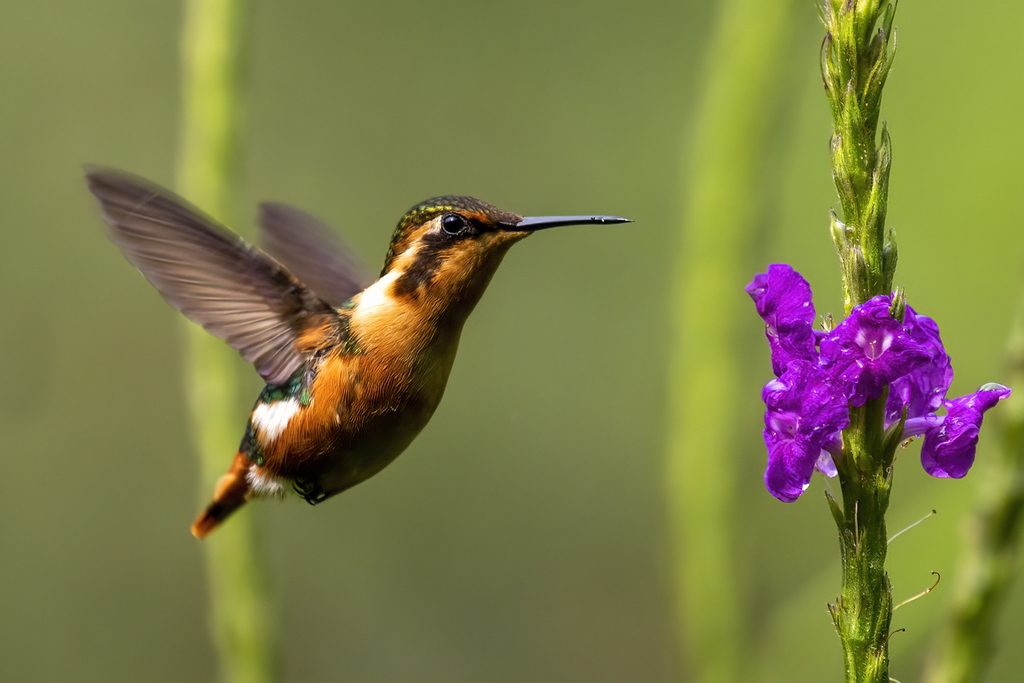
Gorgeted Woodstar
Photo © Dan Vickers
Photo © Dan Vickers — CC BY 4.0 — Source: iNaturalist photo #482270522Identification
The gorgeted woodstar is a tiny hummingbird measuring just 5.8 to 6.4 cm (2.3 to 2.5 inches) in length, making it the smallest woodstar species and among the world's tiniest birds. Both males and females have a distinctive straight black bill. The nominate male displays mostly dark metallic blue-green plumage with a striking pinkish-purple gorget extending across the neck, a grayish line behind the eye, grayish breast, and white spots on the flanks. Its forked tail features very short central feathers and outer feathers that are bare shafts. Females are quite different in appearance, with bronzy-green upperparts and a distinctive rufous rump. Their underparts are cinnamon-rufous, and their rounded tail is cinnamon-colored with a black bar near the tip. Males of the subspecies C. h. cleavesi are darker overall, with a less purplish gorget and shorter tail than their nominate relatives.
Range & Habitat
The gorgeted woodstar inhabits the Andes mountains across a range spanning Venezuela, Colombia, and Ecuador. The nominate subspecies is found from Venezuela's Mérida state southward through Colombia into western Ecuador, while C. h. cleavesi occupies the northeastern Ecuadorian Andes between Sucumbíos and Morona-Santiago provinces. This species prefers semi-open to open landscapes, including forest edges, coffee plantations, and areas with scattered trees and shrubs. It occasionally ventures into the lower reaches of páramo habitat. Elevation ranges from 1,200 to 3,000 meters (3,900 to 9,800 feet), placing these birds in montane regions where cooler temperatures and specialized vegetation create ideal conditions for this diminutive species.
Behaviour & Diet
The gorgeted woodstar forages for nectar throughout the middle and upper vegetation strata, with Inga tree flowers serving as a particularly important food source. Unlike many hummingbirds, this species does not defend feeding territories, and its small size combined with slow, bumblebee-like flight allows it to feed opportunistically within the territories of larger hummingbird species. Beyond nectar, the gorgeted woodstar supplements its diet by hawking small insects directly from perches. During breeding season—at least in parts of Colombia, extending from April to October—females construct delicate cup nests from soft plant material decorated externally with lichens, leaf pieces, and small twigs, securing them with spiderweb to vertical or horizontal branches. These birds vocalize with characteristic calls: a single dry 'chit', a doubled 'chichit', or a tripled 'chichichit', typically uttered while hovering or feeding.
Best Time & Places to See It
The gorgeted woodstar is considered rare to locally common throughout its range, though it may be more frequently present than records suggest due to its inconspicuous behavior and tiny size. Seasonal elevational movements are suspected but not well documented. The species is most reliably found in montane regions of the Colombian and Ecuadorian Andes between 1,200 and 3,000 meters elevation. Focusing your search on semi-open habitats, forest edges, and areas with flowering Inga trees will increase your chances of encounters. The breeding season from April to October in Colombia may offer enhanced visibility opportunities when birds are more active.
Photography Tips
Photographing the gorgeted woodstar presents unique challenges given its diminutive size and inconspicuous behavior. High shutter speeds are essential to freeze its rapid wing beats and hovering flight. Position yourself near flowering plants and Inga trees where the species forages, and look for males displaying their iridescent pinkish-purple gorget in good light—this gorget is a key identification feature that photographs beautifully when the angle is right. Because this hummingbird does not defend territories aggressively, you may find multiple individuals at productive flowering sites. Early morning hours often provide the best light for capturing the metallic blue-green plumage of males and the rufous-cinnamon tones of females. A fast lens and remote triggering system will maximize your success rate when photographing this challenging but rewarding subject.
Cotopaxi National Park
El Tamá National Park
Guácharos Cave National Natural Park
Natural Chingaza National Park
Natural Serranía de los Yariguíes National Park
Natural Sumapaz National Park
Sumaco Napo-Galeras National Park
Nothing matches these filters.
No community photos yet. Log in to add the first one.
No community observations of this species yet.