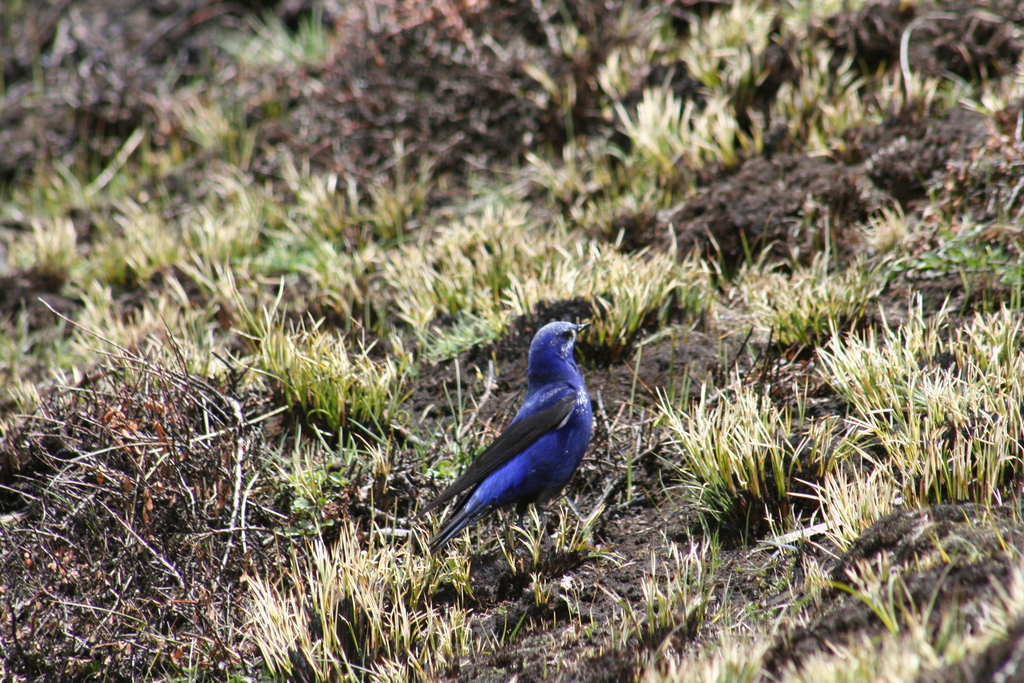
Grandala
Photo © Toby Holman
Photo © Toby Holman — CC0 1.0 — Source: iNaturalist #363738256Identification
The Grandala is a compact thrush measuring 19–23 cm in length and weighing 38–52 g. Sexual dimorphism is striking: males display intense dark blue plumage with blacker wings and tail, while females are greyish-brown with fine white streaks on the underparts, a greyish-blue rump, and white tips and undersides to their wing feathers. Immature birds resemble females but lack the bluish tint on the rump and upper tail. The species is highly vocal, producing distinctive calls described as "dew-ee" and "dewee."
Range & Habitat
The Grandala ranges across the northwestern and northeastern Indian subcontinent and northeast to western China, being the only species in its genus. It inhabits the Himalayas and Tibetan Plateau, found in Bhutan, India, Myanmar, Nepal, Tibet, and areas of China north to southeast Gansu. This is a partial altitudinal migrant: in summer it breeds in high alpine scrub and meadows between 3,900–5,500 m, descending in winter to 2,000–4,300 m where it frequents orchards. Despite being common throughout its range, it remains poorly studied scientifically.
Behaviour & Diet
The Grandala is a highly social bird, often seen in flocks. Its diet comprises both insects and small fruits, particularly Vaccinium berries, making it an adaptable forager across its varied altitudinal range. This combination of insectivorous and frugivorous feeding strategies allows it to exploit seasonal food availability as it migrates vertically through mountain ecosystems.
Best Time & Places to See It
The best opportunities to observe Grandala occur during the breeding season in high alpine regions where it inhabits scrub and meadows above 3,900 m. In winter, birds descend to lower elevations and orchards, making them more accessible to observers between 2,000–4,300 m. Throughout the Himalayan range—from Kashmir through Himachal Pradesh and Uttarakhand to Nepal, Sikkim, and Arunachal Pradesh—the species is common, though sighting probability increases in areas with suitable alpine habitat and fruit-bearing vegetation.
Photography Tips
The dramatic sexual dimorphism of the Grandala makes it an engaging photographic subject. Males in their intense blue plumage are striking against alpine backdrops, particularly in high-altitude meadows during breeding season. Females and immatures require careful exposure management to capture the subtle white streaking and rump coloration. The bird's social nature means flocking behavior photography is often possible. Winter sightings in orchards may provide closer approach opportunities than high alpine summer birds. Early morning light in mountain environments will best render the males' iridescent blue coloration.
Langtang National Park
Helambu, Nepal
+364 birds+14 mammals
Where the southern slopes of the Himalayan highlands descend toward the subtropical valleys of central Nepal, Langtang National Park sprawls across one of the subcontinent's most…
VIEW NATIONAL PARKGangotri National Park
Bhatwari, India
+119 birds+1 mammals
Where the Bhagirathi River carves through the western Himalayas in northern Uttarakhand, Gangotri National Park rises across steep alpine terrain that defines the boundary between temperate…
VIEW NATIONAL PARKSagarmatha National Park
Khumjung, Nepal
+219 birds+7 mammals
Soaring peaks and deep glacial valleys define this alpine wilderness in northeastern Nepal, where the terrain rises from forested foothills into a realm of high-altitude tundra…
VIEW NATIONAL PARKKhangchendzonga National Park
Sakkyong, India
+290 birds+1 mammals
Where the eastern Himalayas surge toward their crowning peaks, Khangchendzonga National Park embraces a landscape of almost overwhelming vertical drama. Rising from subtropical river valleys into…
VIEW NATIONAL PARKGiant Panda National Park
Mianyang, China
+447 birds+47 mammals
Where the eastern slopes of China's Sichuan plateau descend into cloud-wrapped valleys, one of Asia's most biodiverse landscapes unfolds across more than 350,000 square kilometres. This…
VIEW NATIONAL PARKJiuzhai Valley
Jiuzhaigou County, China
+226 birds+7 mammals
Where crystalline alpine streams cascade through limestone gorges and karst terrain rises in dramatic vertical walls, Jiuzhai Valley unfolds across nearly 1,300 square kilometers of southwestern…
VIEW NATURAL MONUMENTHuanglong Scenic and Historic Interest Area
Ngawa Tibetan and Qiang Autonomous Prefecture, China
+194 birds+7 mammals
Across the high plateau of northwestern Sichuan, a geological wonder unfolds where limestone terraces and mineral-rich springs have sculpted one of China's most distinctive natural monuments.…
VIEW NATURAL MONUMENTNanda Devi National Park
Garpak, India
+218 birds+5 mammals
Where the Himalayas surge into their most dramatic alpine amphitheater, a wilderness of raw geological power unfolds across 624 square kilometers of pristine terrain. Nanda Devi,…
VIEW NATIONAL PARKSanjiangyuan National Park
Nagqu, China
+187 birds+25 mammals
Where the headwaters of three great Asian rivers emerge from a high alpine plateau, the landscape unfolds in tundra and dwarf shrubland—a world of austere beauty…
VIEW NATIONAL PARKWolong National Nature Reserve
Wenchuan County, China
+333 birds+17 mammals
Where the Qingyi River cuts through the eastern flanks of the Minshan Range, a temperate montane forest cloaks steep valleys in dense canopy that thins dramatically…
VIEW NATURE RESERVEQinghai Lake National Nature Reserve
Hainan Tibetan Autonomous Prefecture, China
+243 birds+11 mammals
At 3,200 metres above sea level on the Tibetan plateau, where winter temperatures plunge far below freezing and snow blankets the landscape for half the year,…
VIEW NATURE RESERVEBaima Snow Mountain National Nature Reserve
Diqing Tibetan Autonomous Prefecture, China
+204 birds+3 mammals
High-altitude ridges and steep-sided valleys define this reserve in northwestern Yunnan, where elevations surge from around 3,000 metres to peaks above 4,100 metres. The terrain supports…
VIEW NATURE RESERVENo community photos yet. Log in to add the first one.
No community observations of this species yet.