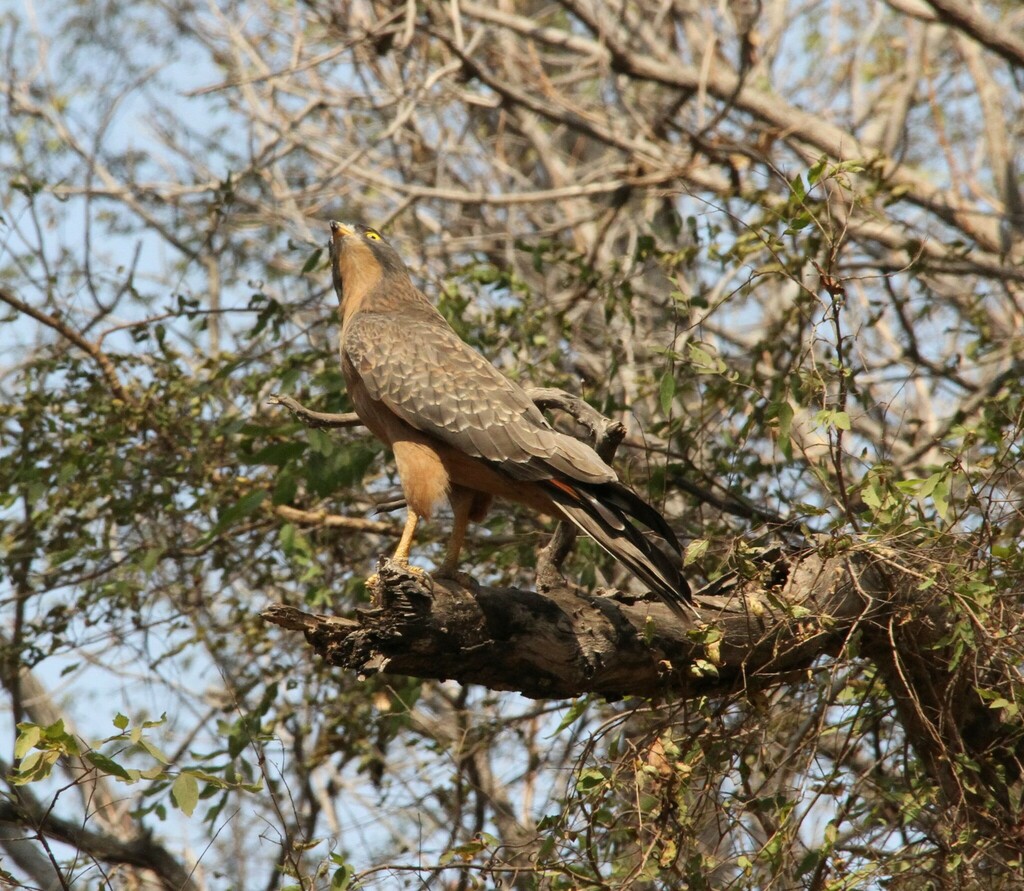
Grasshopper Buzzard
Photo © Lucy Keith-Diagne
Photo © Lucy Keith-Diagne — CC BY 4.0 — Source: iNaturalist #196137338Identification
The grasshopper buzzard is a compact raptor measuring 30–35 cm in length with a wingspan of 90 cm and weighing 310–380 g. Adults are grey-brown above with a darker head and dark shaft streaks throughout their plumage. The most distinctive feature in flight is a conspicuous reddish patch formed by the greater coverts and primary feathers, with primaries tipped in black. The tail is grey with faint brown bars. Below, the chin and throat are whitish with three black streaks on either side, while the breast and belly are rufous with narrow black shaft streaks on the breast only. The under-wing coverts and wing lining are white. Eyes, legs, and cere are yellow, with a black-tipped bill and yellow base. Females are slightly larger than males. Juveniles display a bright brownish-red head and nape that gradually darkens with age, eventually matching the back coloration.
Range & Habitat
This species is found in a narrow zone of sub-Saharan Africa north of the equator, ranging from Senegal and Gambia east to Ethiopia. The grasshopper buzzard is a partial migrant, moving south during the dry northern winter (September to March) and north again during summer rains (April to September) to breed. When breeding, the species generally ranges between 9–15° N, moving south to around 5° N during the dry season, with only eastern African populations occurring south of the equator. Distribution and abundance show considerable local and annual variation.
These birds prefer woodland and forest edges, arid acacia savannahs, marsh edges, and burnt areas. They are particularly attracted to recently burnt regions where insect emergences are abundant.
Behaviour & Diet
The grasshopper buzzard is notably sociable, frequently seen in groups of 50 to 100 birds, especially in burnt areas. It hunts from a low perch, scanning for large insects which comprise the bulk of its diet. It catches prey on the ground or sometimes pursues them briefly in the air. During the non-breeding season, grasshoppers dominate the diet—indeed, the species is a specialist grasshopper hunter at this time. When breeding, the diet diversifies to include various insects (grasshoppers and beetles), scorpions, sun spiders, frogs, rodents, small birds, and reptiles.
Breeding occurs between March and May in the northern range, with nests placed in tree forks or low trees, typically around 10 metres above ground. The stick nest features a central cup lined with green leaves; one to three bluish-white eggs with dark markings are laid. Fresh green leaves are added throughout the nesting period. Grasshopper buzzards breed at remarkably high densities—up to 3.3 nests per square kilometre—with neighboring territories separated by less than 100 metres in good habitat. Home ranges overlap extensively, and birds regularly forage over neighboring territories.
Best Time & Places to See It
The best opportunity to observe grasshopper buzzards is during the dry season (September to March) when they migrate south and concentrate in burnt areas where insect populations are emerging. Their sociable nature and tendency to gather in large flocks make them relatively conspicuous during this period. Visiting acacia savannahs, woodland edges, and recently burnt regions across their range from Senegal to Ethiopia—and south to Kenya and northern Tanzania—offers good chances of encounter.
Photography Tips
The reddish patch visible on the wings in flight is the key field mark to capture. Photograph grasshopper buzzards perched on low vantage points where they hunt, as they spend considerable time scanning from these positions. The high densities in suitable habitat mean multiple individuals may be visible simultaneously, offering opportunities for group shots. Visit burnt areas during the dry season for the best concentrations and activity levels. The striking yellow eyes, cere, and leg color provide excellent detail for close-up portraits.
Serengeti National Park
Tanzania
+558 birds+57 mammals
Across Tanzania's northern plateau, where volcanic soils meet acacia woodland and open grassland, unfolds one of Earth's most dynamic ecosystems. The Serengeti National Park sprawls across…
VIEW NATIONAL PARKArusha National Park
Tanzania
+555 birds+16 mammals
Where the slopes of Mount Mawenzi rise above the Arusha region, a compact yet ecologically rich national park unfolds across montane forest, moorland, and alpine zones.…
VIEW NATIONAL PARKKidepo Valley National Park
Uganda
+478 birds+24 mammals
Where the Narus and Kidepo rivers carve through northeastern Uganda's semi-arid lowlands, a landscape of sparse acacia woodland, grassland, and riverine thickets creates one of East…
VIEW NATIONAL PARKMurchison Falls National Park
Uganda
+608 birds+33 mammals
Where the Victoria Nile compresses through a narrow gorge and explodes across a 45-meter precipice, the landscape speaks in thunder. Murchison Falls National Park sprawls across…
VIEW NATIONAL PARKLake Mburo National Park
Uganda
+505 birds+24 mammals
Rolling acacia woodland and scattered lakes define this intimate savanna preserve in southwestern Uganda, where the rift valley's geological drama shapes every water source and grassland.…
VIEW NATIONAL PARKTsavo East National Park
Athi ward, Kenya
+468 birds+50 mammals
Across the semi-arid lowlands of southeastern Kenya, where acacia woodland fragments into scrubland and the landscape rolls toward the Indian Ocean horizon, lies one of Africa's…
VIEW NATIONAL PARKTsavo West National Park
Mwatate, Kenya
+513 birds+49 mammals
Where volcanic ridges and weathered lava flows meet the semi-arid lowlands of south-central Kenya, Tsavo West National Park unfolds across a landscape sculpted by fire and…
VIEW NATIONAL PARKAmboseli National Park
Etonet/Lenkism ward, Kenya
+501 birds+43 mammals
Where the Amboseli basin opens toward the Tanzanian frontier, a shallow alkaline lake mirrors vast skies across one of East Africa's most iconic savanna landscapes. The…
VIEW NATIONAL PARKTarangire National Park
Tanzania
+527 birds+50 mammals
Acacia woodland and grassland sweep across the Manyara Region where the Tarangire River carves through low hills and volcanic soils, creating one of East Africa's most…
VIEW NATIONAL PARKNgorongoro Conservation Area
Tanzania
+626 birds+55 mammals
Volcanic calderas and open grassland dominate this high plateau in northern Tanzania, where the landscape rises above 2,000 metres and ancient geological forces have shaped both…
VIEW WILDLIFE MANAGEMENT AREAZiwa Rhino and Wildlife Ranch
Nakasongola, Uganda
+359 birds+11 mammals
Where papyrus wetlands merge into sprawling savanna, Uganda's central landscape opens into one of East Africa's most vital rhino recovery zones. Ziwa Rhino and Wildlife Ranch…
VIEW WILDLIFE SANCTUARYAbijata-Shalla Lakes National Park
Ethiopia
+438 birds+7 mammals
Two crater lakes of contrasting chemistry define this remote corner of Ethiopia's Rift Valley, where soda lakes and freshwater basins create a mosaic of distinct aquatic…
VIEW NATIONAL PARKAwash National Park
Didiga, Ethiopia
+473 birds+23 mammals
Where the Ethiopian Rift Valley carves through volcanic plateaus, a ribbon of riverine forest winds through acacia scrubland and grassland, creating a mosaic of habitats that…
VIEW NATURAL PARKNairobi National Park
Nairobi, Kenya
+515 birds+35 mammals
Just minutes from Kenya's capital, where the Nairobi River winds through acacia woodland and open grassland, lies one of Africa's most paradoxical wildlife sanctuaries. The park's…
VIEW NATIONAL PARKLake Nakuru National Park
Nakuru West, Kenya
+494 birds+32 mammals
Alkaline waters ringed by acacia woodland and grassland create one of East Africa's most distinctive wetland ecosystems, where the interplay of geology and climate sustains a…
VIEW NATIONAL PARKMeru National Park
Igembe Central, Kenya
+408 birds+38 mammals
Granite outcrops and acacia woodland rise across the northern reaches of Meru, where semi-arid savanna transitions into drier scrubland under the fierce equatorial sun. The park's…
VIEW NATIONAL PARKSamburu National Reserve
Samburu, Kenya
+430 birds+42 mammals
Across the arid plains of northern Kenya, where scattered acacia woodland gives way to rocky outcrops and dry riverbeds, Samburu National Park unfolds as one of…
VIEW NATURE RESERVEArabuko Sokoke Forest Reserve
Kilifi, Kenya
+383 birds+29 mammals
Coastal forest rises from the Indian Ocean plains of Kilifi County, where sandy soils and seasonal rainfall have sculpted a woodland ecosystem unlike anywhere else on…
VIEW NATURE RESERVENo community photos yet. Log in to add the first one.
No community observations of this species yet.