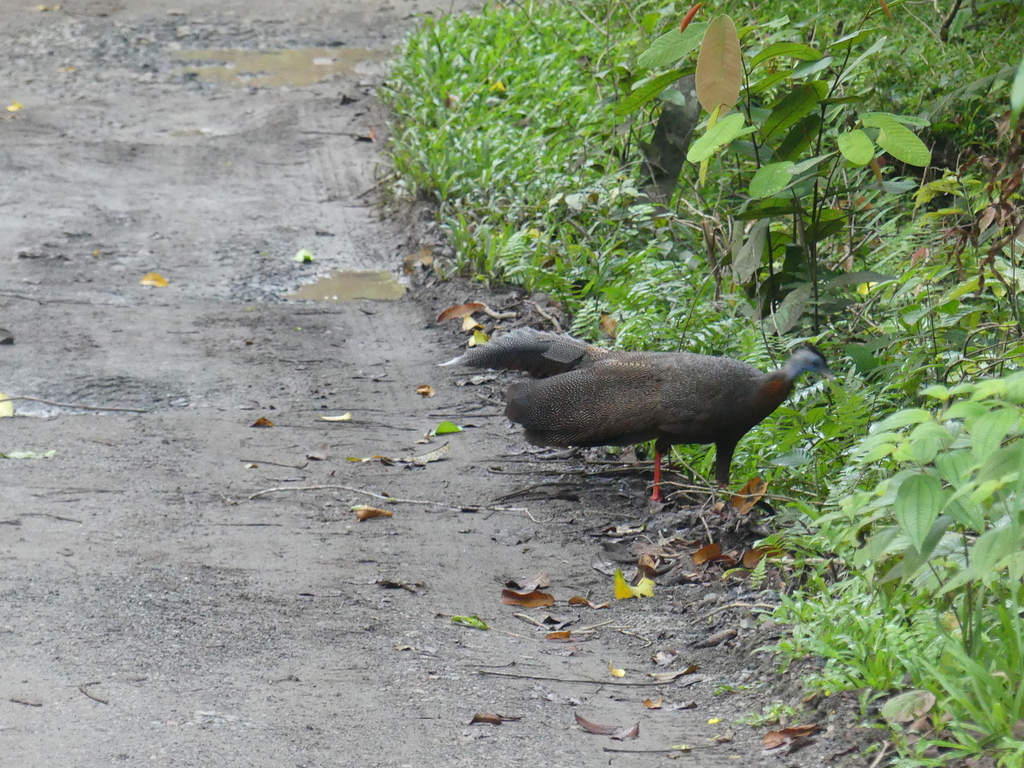
Great Argus
Photo © Daniel Z
Photo © Daniel Z — CC BY 4.0 — Source: iNaturalist #198186474Identification
The great argus is one of the largest pheasant species, with males reaching 160–200 cm in total length and weighing 2.04–2.72 kg. The most striking feature is the male's extremely long tail (105–143 cm) and greatly elongated secondary wing feathers decorated with hundreds of large eyespots—the source of its name, derived from Argus, the hundred-eyed giant of Greek mythology. Both sexes display a distinctive blue head and neck, rufous-red upper breast, and red legs. Males have black hair-like feathers on the crown and nape, while females are considerably smaller and duller, measuring only 72–76 cm with shorter tails and fewer eyespots. Young males do not acquire their spectacular adult plumage until their third year.
Range & Habitat
The great argus is native to the jungles of Borneo, Sumatra, and the Malay Peninsula in Southeast Asia. Two subspecies are recognized: the nominate argus inhabits the Malay Peninsula and Sumatra, while A. a. grayi is found in Borneo. This pheasant is strictly a forest bird, dependent on intact jungle habitat for survival.
Behaviour & Diet
The great argus feeds on the forest floor during early morning and evening hours. Males are renowned for their extraordinary courtship displays: they clear an open dancing ground in the forest and announce themselves with loud calls to attract females. During display, the male spreads his wings into two enormous fans, revealing hundreds of eye-like markings while bowing his head toward the ground, obscuring it beneath the display. Despite initial assumptions of polygamy, the great argus is actually monogamous, with females laying only two eggs per breeding season.
Best Time & Places to See It
Early morning and evening hours offer the best opportunities to observe this species, as this is when they feed on the forest floor. Active jungle habitat in Borneo, Sumatra, and the Malay Peninsula provides the most likely sighting locations. Travelers should note that the species prefers undisturbed forest environments and may be difficult to locate without expert guidance.
Photography Tips
Photographing the great argus requires patience and early-morning dedication. The male's display is the ultimate photographic prize, but patience near known display grounds during the mating season will be necessary. The extraordinary detail of the wing eyespots and the dramatic fan-like display posture offer spectacular compositional opportunities. The blue head, rufous breast, and red legs provide striking color contrasts against the forest backdrop. Long focal lengths are advisable given the bird's wariness and preference for dense forest cover. Capturing the intricate eyespot patterns on the secondary feathers demands careful attention to lighting and focus.
Gunung Mulu National Park
Kerinci Seblat National Park
Kuching Wetlands National Park
Taman Negara Bukit Lambir National Park
Taman Negara National Park
Way Kambas National Park
Nothing matches these filters.
No community photos yet. Log in to add the first one.
No community observations of this species yet.