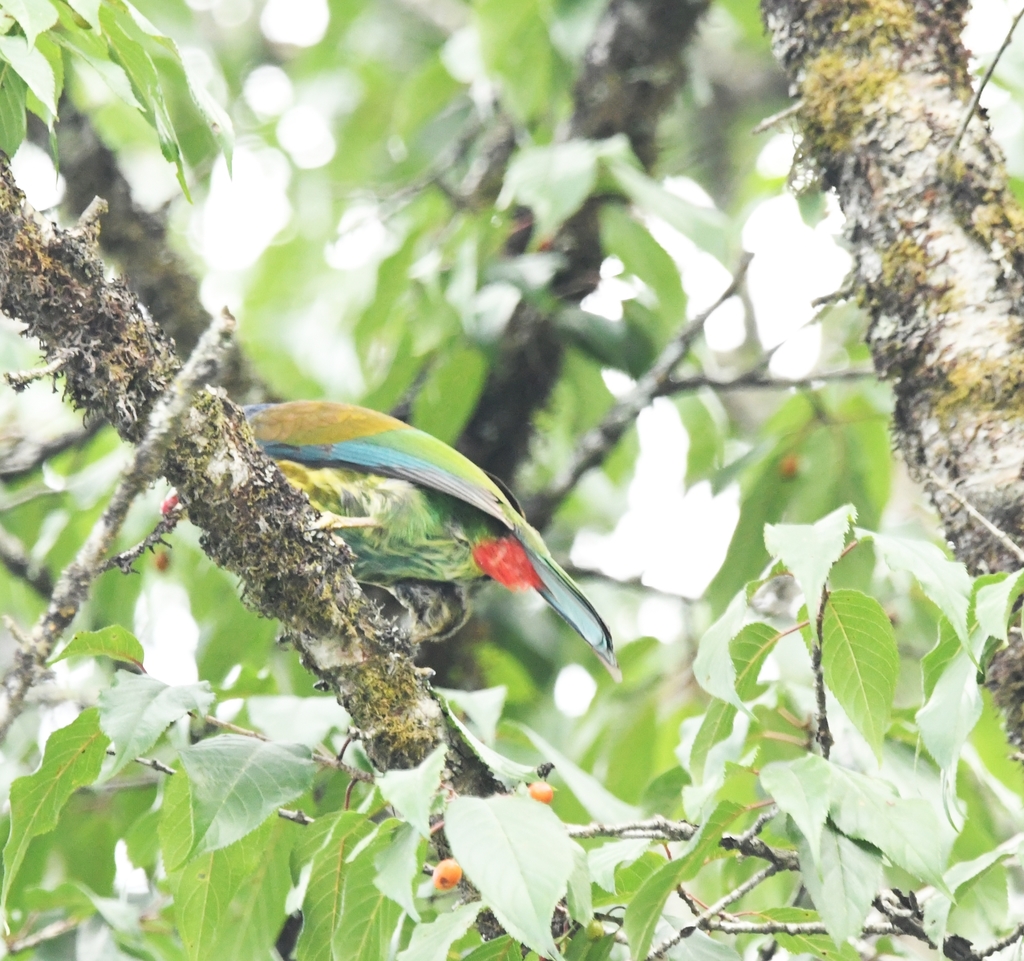
Great Barbet
Photo © Surabhi Srivastava
Photo © Surabhi Srivastava — CC BY 4.0 — Source: iNaturalist #120295695Identification
The great barbet is Asia's largest barbet species, measuring 32–35 cm in length and weighing 192–295 g. It is unmistakable in the field: a strikingly coloured bird with a brilliant blue head, prominent large yellow bill, and predominantly green plumage. The body and belly show brown and green streaking, while the undertail coverts are distinctively red. This combination of colours makes it one of the most visually striking barbets across its range.
Range & Habitat
Native to the Indian sub-continent and Southeast Asia, the great barbet is a resident breeder across the lower-to-middle altitudes of the Himalayas, ranging from northern Pakistan through India, Nepal, and Bhutan to Bangladesh. Its distribution extends into Southeast Asia, reaching as far as Laos. The species inhabits forests at elevations up to 3,000 m (9,800 ft), making it accessible to travellers exploring montane regions across much of Asia.
Behaviour & Diet
Great barbets are vocal and territorial birds, with males producing a very loud kay-oh call that serves to defend their territory. They also make a harsh keeab alarm call and a distinctive repetitive piou-piou-piou-piou vocalisation. The nesting season extends from April to July, during which both males and females participate in rearing young in tree holes—their preferred nesting sites. Their diet consists mainly of fruits and insects, making them important seed dispersers and insect controllers within their forest habitats.
Best Time & Places to See It
The breeding season from April to July offers the best opportunity to locate this species, as territorial males are most vocal during this period. The great barbet's wide distribution across the Himalayas and Southeast Asian forests means it can be encountered across numerous protected areas and forest reserves throughout its range. Its conspicuous coloration and loud calls make it more detectable than many other barbet species, though patience and early morning birding in suitable forest habitat remain essential.
Photography Tips
The great barbet's vibrant blue head, yellow bill, and red undertail coverts provide excellent photographic subjects against green forest foliage. Early mornings during the breeding season offer the best light and highest activity levels. When photographing near nest holes, maintain a respectful distance to avoid disturbing breeding birds. The bird's relatively large size compared to other barbets and its preference for calling from exposed branches make it more approachable than many congeners, but a telephoto lens remains essential for capturing frame-filling images of this spectacular species.
Bardiya National Park
Chitwan National Park
Gaoligong Mountain National Nature Reserve
Giant Panda National Park
Huanglong Scenic and Historic Interest Area
Kaeng Krachan National Park
Kaziranga National Park
Khangchendzonga National Park
Khaptad National Park
Nothing matches these filters.
No community photos yet. Log in to add the first one.
No community observations of this species yet.