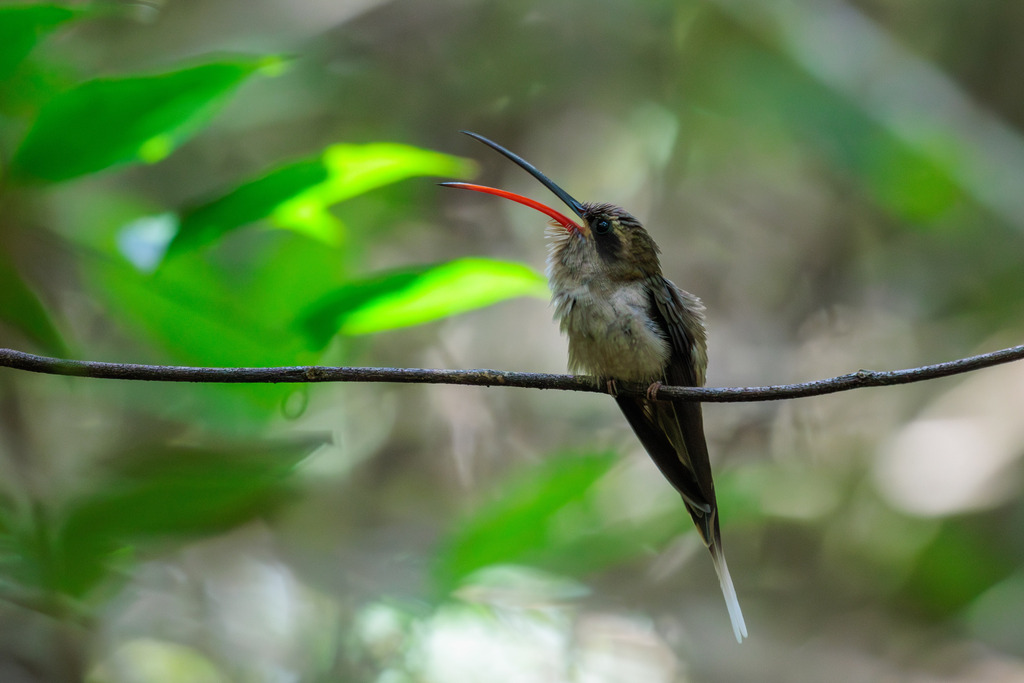
Great-billed Hermit
Photo © Thomaz de Carvalho Callado
Photo © Thomaz de Carvalho Callado — CC BY 4.0 — Source: iNaturalist photo #328985065Identification
The great-billed hermit is a small hummingbird measuring 13 to 17.5 cm in length, with males weighing 4.5 to 10 g and females 4 to 8 g. As its name suggests, the species is characterized by a long, distinctly decurved bill, with females having shorter but more curved bills than males. The nominate subspecies is the largest of the group.
Plumage varies across subspecies but generally features greenish-brown upperparts and brownish to grayish underparts. The uppertail coverts display dark and light ochre banding, while the long central tail feathers terminate in white tips. Subspecific variation is notable: P. m. moorei shows paler, grayer underparts; P. m. bolivianus and P. m. margarettae are among the smallest with orange-ochre bellies; and P. m. ochraceiventris displays a striking bright orange breast and belly.
Range & Habitat
The great-billed hermit is distributed across the Amazon Basin and adjacent regions, occurring in Bolivia, Brazil, Colombia, Ecuador, French Guiana, Peru, Suriname, and Venezuela. Six subspecies occupy distinct geographic ranges, from the Guiana Shield in the north to Bolivia in the south, with P. m. margarettae restricted to coastal eastern Brazil from Pernambuco to Espírito Santo.
This species inhabits the understory of diverse rainforest ecosystems, including terra firme, foothill, and higher elevation tropical forests, as well as transitional and secondary forests and bamboo thickets. Elevation preferences vary by location, typically below 600 m but reaching 1,500 m in Colombia and 2,400 m in Bolivia. Some populations also occupy igapó (flooded) forest.
Behaviour & Diet
Like other hermit hummingbirds, the great-billed hermit is a trap-line feeder, visiting a consistent circuit of flowering plants to extract nectar from species such as Heliconia and Pitcairnia. It supplements this diet with small arthropods. Breeding seasons vary geographically: August to December in French Guiana, June to September in Bolivia, and June to November in Peru.
This hermit constructs a distinctive cone-shaped nest from plant fibers and spider silk, suspended from the underside of a drooping leaf—a classic adaptation for hermit hummingbirds. Clutch size is typically two eggs. Vocalizations include a continuous series of single, bisyllabic rising and falling 'slee-up' notes that vary among subspecies, and a sharp 'skweep!' call usually given in flight.
Best Time & Places to See It
Timing varies by location. In French Guiana, target August through December; in Bolivia, June through September; and in Peru, June through November. The species is found throughout lowland and foothill rainforest regions across its range, making it accessible in protected areas and reserves across multiple countries.
Search the understory of mature and secondary rainforest, paying particular attention to flowering plants. The species' habit of visiting flowers along established trap-lines means patient observation at productive flowering trees can yield sightings. P. m. margarettae, restricted to threatened coastal Atlantic forest remnants in Brazil, requires careful planning and local guidance to locate.
Photography Tips
The great-billed hermit's small size and preference for understory habitats present challenges for photographers. Fast shutter speeds (at least 1/1000th second) are essential to freeze wing movement in the dim forest light. Position yourself near flowering plants, particularly Heliconia species, where the bird predictably returns. Early morning light filtering through the canopy provides the best conditions for capturing plumage detail.
The species' long, decurved bill is a key identifying feature worth emphasizing in images. The white tail tips and ochre banding on uppertail coverts are also diagnostic. Patience is crucial—hermits typically work a regular route, so remaining still near flowering plants increases encounter probability. The bird's relatively large bill relative to body size makes it distinctive even at distance, aiding identification in the field.
Amacayacu National Park
Anavilhanas National Park
Bahuaja Sonene National Park
Cordillera Azul National Park
Ichigkat Muja – Cordillera del Cóndor National Park
Jaú National Park
Manu National Park
Natural la Paya National Park
Natural Sierra de Chiribiquete National Park
Nothing matches these filters.
No community photos yet. Log in to add the first one.
No community observations of this species yet.