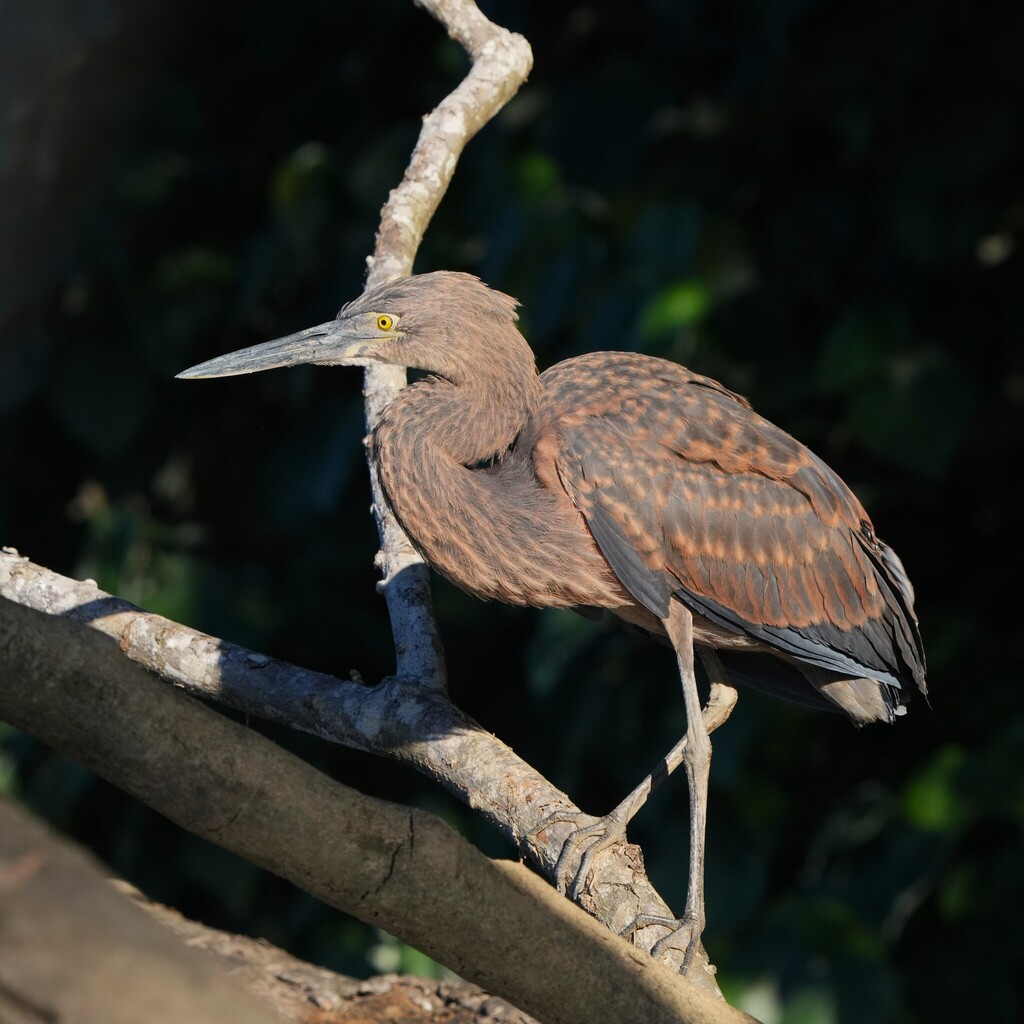
Great-billed Heron
Photo © themaskedlapwing
Photo © themaskedlapwing — CC0 1.0 — Source: iNaturalist #310125665Identification
The great-billed heron is a large wading bird, typically standing 115 cm (45 inches) tall and weighing up to 2.6 kg (5.7 pounds). Its most distinctive feature is its long, sharp bill, which it uses to spear fish with precision. The plumage is largely dark grey above, and in flight it displays a uniform dark grey upperwing. While it resembles the purple heron, the great-billed heron is noticeably larger and considerably darker. Like all herons and bitterns, it flies with its neck retracted—a characteristic that clearly distinguishes it from storks, cranes, and spoonbills, which extend their necks in flight.
Range & Habitat
This species has a very large range across coastal Southern Asia and Australasia, occurring in Australia, India, Indonesia, Malaysia, and the Philippines. Two subspecies exist: Ardea sumatrana sumatrana inhabits the coasts of southeastern Asia, Indonesia, the Philippines, and New Guinea, while Ardea sumatrana mathewsae is found on the coasts of tropical northern Australia, where it is considered native to Queensland.
The great-billed heron shows a strong preference for coastal and wetland habitats, including islands, coral reefs, mangroves, and large rivers. Although it is primarily a coastal species, it occasionally ventures inland to shallow ponds, making it adaptable to various aquatic environments throughout its range.
Behaviour & Diet
This is a specialist fish-eater that hunts in shallow water using a patient, deliberate approach. The great-billed heron employs two main hunting strategies: it will either wait motionless for prey to approach within striking distance, or slowly stalk its victim through the water with careful, measured steps. Once a fish comes within range, the bird strikes with its long, sharp bill, spearing its catch with impressive accuracy.
Best Time & Places to See It
The great-billed heron is a resident species throughout its range, meaning it does not migrate seasonally and can potentially be observed year-round. For the best chance of encountering this bird, focus on coastal habitats in its range—particularly mangrove forests, coral reef areas, river mouths, and coastal islands. In Australia, Queensland's coastal regions are reliable locations. Throughout the rest of its range in Southeast Asia and New Guinea, similar coastal and mangrove habitats offer the greatest likelihood of sightings.
Photography Tips
Photographing the great-billed heron requires patience and a slow approach, as the bird's hunting strategy depends on remaining undetected by prey. Early morning and late afternoon light are ideal for capturing the subtle details of its dark grey plumage. Position yourself at a distance and move slowly along the water's edge to avoid startling the bird. When the heron takes flight, be ready to capture its distinctive silhouette with its retracted neck—a characteristic pose that provides excellent identification in flight photography.
Kakadu National Park
Kakadu, Australia
+273 birds+46 mammals
Kakadu National Park is Australia’s largest national park and one of the world’s most remarkable protected areas, covering nearly 20,000 square kilometres in the tropical north…
VIEW NATIONAL PARKDaintree National Park
Dedin, Australia
+362 birds+37 mammals
Daintree National Park is one of the world’s oldest and most biologically diverse tropical rainforests, protecting an extraordinary landscape where ancient forests meet the Great Barrier…
VIEW NATIONAL PARKEndeavour River National Park
Philadelphia, Australia
+203 birds+1 mammals
Where the Endeavour River winds through northeastern Queensland's tropical lowlands, a compact mosaic of rainforest, open woodland, and riverine corridor creates one of Australia's most ecologically…
VIEW NATIONAL PARKRinyirru National Park
Lakefield, Australia
+258 birds+7 mammals
Where the savanna grasslands of far north Queensland meet seasonal wetlands and eucalypt woodlands, Rinyirru National Park sprawls across more than 12,500 square kilometres of rugged,…
VIEW NATIONAL PARKTaman Nasional Baluran
Situbondo, Indonesia
+189 birds+9 mammals
Across the northeastern tip of East Java, where monsoon winds sweep down from the Bali Strait, a landscape of contrasts unfolds within 374 square kilometres of…
VIEW NATIONAL PARKTaman Nasional Meru Betiri
Jember, Indonesia
+93 birds+1 mammals
Across East Java's southeastern coast, where the Indian Ocean meets a landscape of volcanic soils and monsoon-fed forests, sprawls a national park that epitomizes the ecological…
VIEW NATIONAL PARKAketajawe Lolobata National Park
Oba Tengah, Indonesia
+123 birds+2 mammals
Across the northeastern arm of Halmahera, where the Wallace Line once marked the boundary between Asian and Australasian fauna, lies a sprawling wilderness of over 13,800…
VIEW NATIONAL PARKSembilang National Park
Banyuasin, Indonesia
+56 birds+3 mammals
Where tidal mangroves grade into freshwater swamp forest and the Musi River delta spreads across more than 7,000 square kilometres, Sembilang National Park represents one of…
VIEW NATIONAL PARKWay Kambas National Park
Lampung Timur, Indonesia
+237 birds+20 mammals
Across the low swamplands of eastern Lampung, where freshwater wetlands merge into tidal mangrove forests along the Sunda Strait, sprawls one of Sumatra's most vital sanctuaries.…
VIEW NATIONAL PARKKomodo National Park
Komodo, Indonesia
+155 birds+14 mammals
Where volcanic peaks rise dramatically from turquoise waters, a primordial landscape unfolds across three main islands and countless smaller ones scattered throughout the Lesser Sunda archipelago.…
VIEW NATIONAL PARKNitmiluk National Park
Australia
+186 birds+27 mammals
Dramatic sandstone gorges carved by the Katherine River slice through the tropical savanna of Australia's Top End, creating a landscape where escarpments tower above crystalline pools…
VIEW NATIONAL PARKWooroonooran National Park
Australia
+240 birds+28 mammals
Where the Great Dividing Range rises sharply inland from Queensland's tropical coast, Wooroonooran National Park encompasses a landscape of steep, forested gorges and cascading waterways carved…
VIEW NATIONAL PARKNo community photos yet. Log in to add the first one.
No community observations of this species yet.