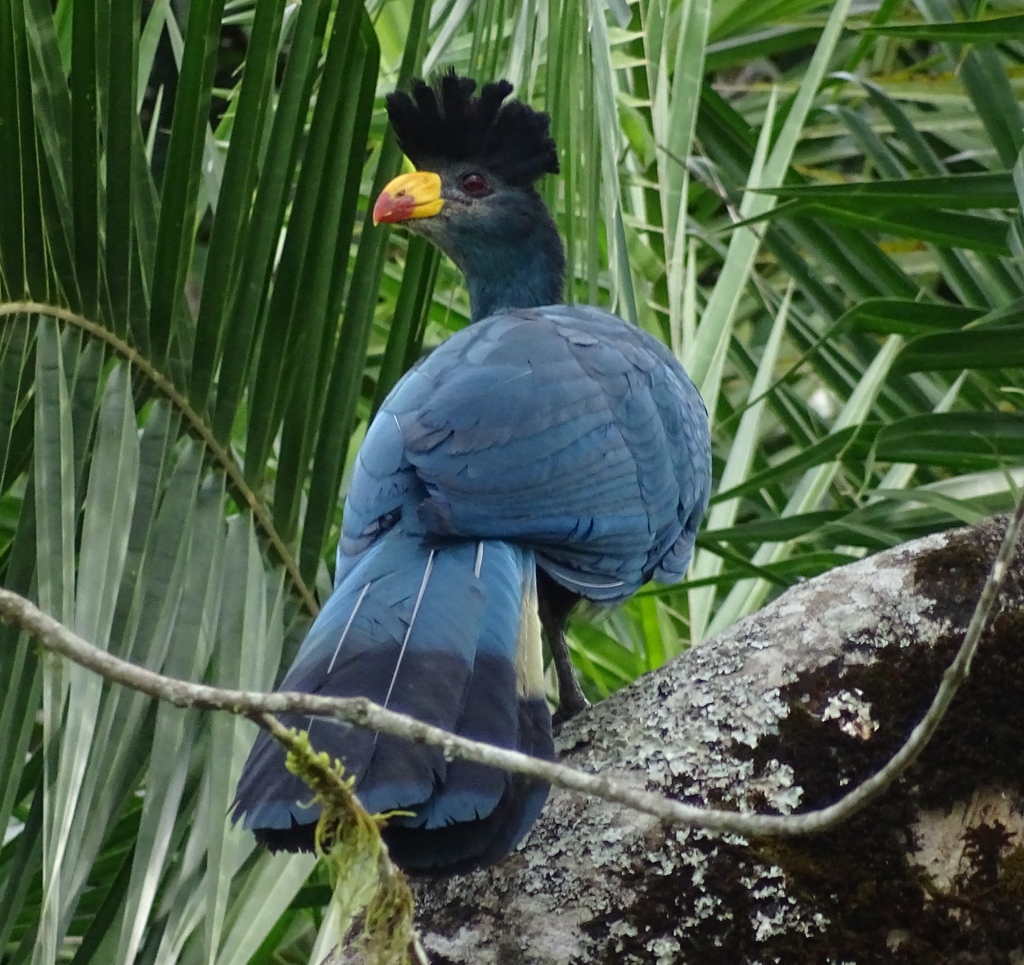
Great Blue Turaco
Photo © Sandra Keller
Photo © Sandra Keller — CC BY 4.0 — Source: iNaturalist photo #42545392Identification
The great blue turaco is the largest of all turaco species, measuring 70–76 cm in length. It is unmistakable in the field, with predominantly grey-blue plumage and a striking upright blue-black crest rising approximately 10 cm high. Adults display a white chin, yellow-green lower breast, and yellow belly that darkens to chestnut brown towards the rear. The undertail coverts are chestnut, while the undertail itself is black and yellowish. The yellow bill has a distinctive orange-red tip, and the eyes are brown, surrounded by a ring of black bare skin. The legs and feet are black with yellow soles. Males and females have similar plumage, making them indistinguishable in appearance.
Range & Habitat
The great blue turaco is widespread throughout sub-Saharan African tropical rainforests. Its range extends from Guinea in the west across to the Imatong Mountains in South Sudan, with populations also present in Uganda, Rwanda, Tanzania, western Kenya, the Democratic Republic of Congo, and Angola. The species primarily inhabits rainforests and gallery forests, showing a preference for densely vegetated woodland areas.
One of the species' notable strengths is its adaptability to human-modified landscapes. Beyond pristine forest, the great blue turaco has successfully colonized areas cleared by humans, demonstrating considerable flexibility in its habitat requirements and allowing it to persist in regions undergoing land-use change.
Behaviour & Diet
The great blue turaco is a highly gregarious species, typically forming small troops of approximately six or seven individuals. This social structure makes them relatively conspicuous and easier to locate within their forest habitat.
The species is an omnivorous frugivore with a diverse diet comprising leaves, flowers, and fruits from numerous plant species including figs, various tropical fruits, and seeds. Fieldwork in Rwanda has shown that leaves constitute around 25% of their diet, becoming increasingly important when fruit availability is lower. In Kenya, seasonal feeding records document consumption of specific fruits and foliage throughout the year. As they feed, great blue turacos play an important ecological role in seed dispersal, typically depositing seeds some distance from parent trees through their droppings.
Best Time & Places to See It
The great blue turaco's gregarious nature and preference for fruiting trees make it a rewarding species to seek. Early morning hours, when birds are most active and vocal, offer the best opportunities for observation. The species' presence in protected rainforests across its range—including national parks and reserves in Uganda, Rwanda, and the Democratic Republic of Congo—makes these locations prime destinations for encountering it. Look for birds in the mid to upper canopy, particularly around fruiting trees.
Photography Tips
The great blue turaco's large size and striking coloration make it a prized subject for wildlife photographers. Its predominantly blue plumage requires careful exposure metering to avoid blown highlights; shoot in overcast conditions or dappled forest light when possible. The prominent crest and contrasting white chin provide strong compositional elements. Positioning yourself to capture the distinctive orange-red bill tip and yellow belly markings will help showcase the bird's field marks. Since birds often feed in small troops in fruiting trees, patience and positioning near productive food sources increase encounter probability.
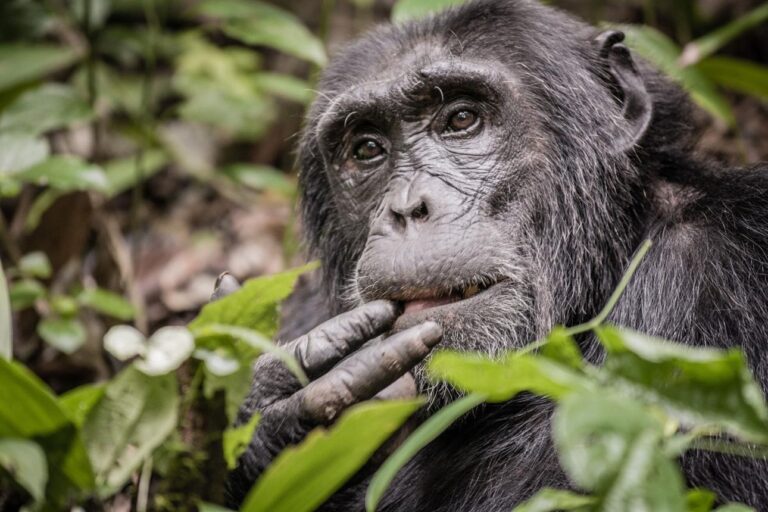
11 Days Safari to Uganda Including Gorilla Trekking.
Experience: This 11-day Uganda safari takes you through some of the country’s most spectacular wildlife destinations, including Murchison Falls National Park, Kibale Forest National Park, Queen Elizabeth National Park, Bwindi Impenetrable National Park, and Lake Mburo National Park. The journey includes rhino trekking at Ziwa Rhino Sanctuary, chimpanzee tracking in Kibale, the unforgettable experience of gorilla trekking in Bwindi, exciting game drives, boat cruises on the Nile River and the Kazinga Channel, and scenic countryside drives before returning to Entebbe. It is a well-rounded adventure combining wildlife, primates, and beautiful landscapes for a memorable Uganda safari experience.
Virunga National Park
Uganda
+418 birds+13 mammals
Where the Western Rift Valley fractures the landscape of North Kivu, Virunga National Park sprawls across terrain as geologically dramatic as it is ecologically vital. Volcanic…
VIEW NATIONAL PARKBwindi Impenetrable National Park
Kanyashogi, Uganda
+603 birds+26 mammals
Steep ridges cloaked in montane forest rise from Uganda's southwestern borderlands, where the landscape grows so dense and tangled that early explorers named it impenetrable. At…
VIEW NATIONAL PARKKidepo Valley National Park
Uganda
+478 birds+24 mammals
Where the Narus and Kidepo rivers carve through northeastern Uganda's semi-arid lowlands, a landscape of sparse acacia woodland, grassland, and riverine thickets creates one of East…
VIEW NATIONAL PARKMurchison Falls National Park
Uganda
+608 birds+33 mammals
Where the Victoria Nile compresses through a narrow gorge and explodes across a 45-meter precipice, the landscape speaks in thunder. Murchison Falls National Park sprawls across…
VIEW NATIONAL PARKMgahinga Gorilla National Park
Cyanika, Uganda
+429 birds+6 mammals
Where the Virunga Mountains rise steeply from the Uganda–Rwanda–Democratic Republic of Congo frontier, montane forest cloaks the volcanic slopes in a dense, moisture-laden embrace. Mgahinga Gorilla…
VIEW NATIONAL PARKLake Mburo National Park
Uganda
+505 birds+24 mammals
Rolling acacia woodland and scattered lakes define this intimate savanna preserve in southwestern Uganda, where the rift valley's geological drama shapes every water source and grassland.…
VIEW NATIONAL PARKToro-Semliki Proposed National Park
Uganda
+474 birds+5 mammals
Where the Albertine Rift's western escarpment rises above the Semliki River valley, a vast mosaic of forest, savanna and wetland converges to create one of East…
VIEW NATIONAL PARKQueen Elizabeth National Park
Uganda
+672 birds+30 mammals
Across the southwestern escarpment of Uganda, where the Western Rift Valley descends through ancient volcanic terrain, Queen Elizabeth National Park sprawls across more than 8,300 square…
VIEW NATIONAL PARKMabamba Swamp
Memere, Uganda
+464 birds+2 mammals
Across the Central Region of Uganda spreads one of Africa's most biodiverse freshwater wetlands, a sprawling nature reserve of roughly 283 square kilometres where papyrus swamps…
VIEW NATURE RESERVEZiwa Rhino and Wildlife Ranch
Nakasongola, Uganda
+359 birds+11 mammals
Where papyrus wetlands merge into sprawling savanna, Uganda's central landscape opens into one of East Africa's most vital rhino recovery zones. Ziwa Rhino and Wildlife Ranch…
VIEW WILDLIFE SANCTUARYNo community photos yet. Log in to add the first one.
No community observations of this species yet.