Identification
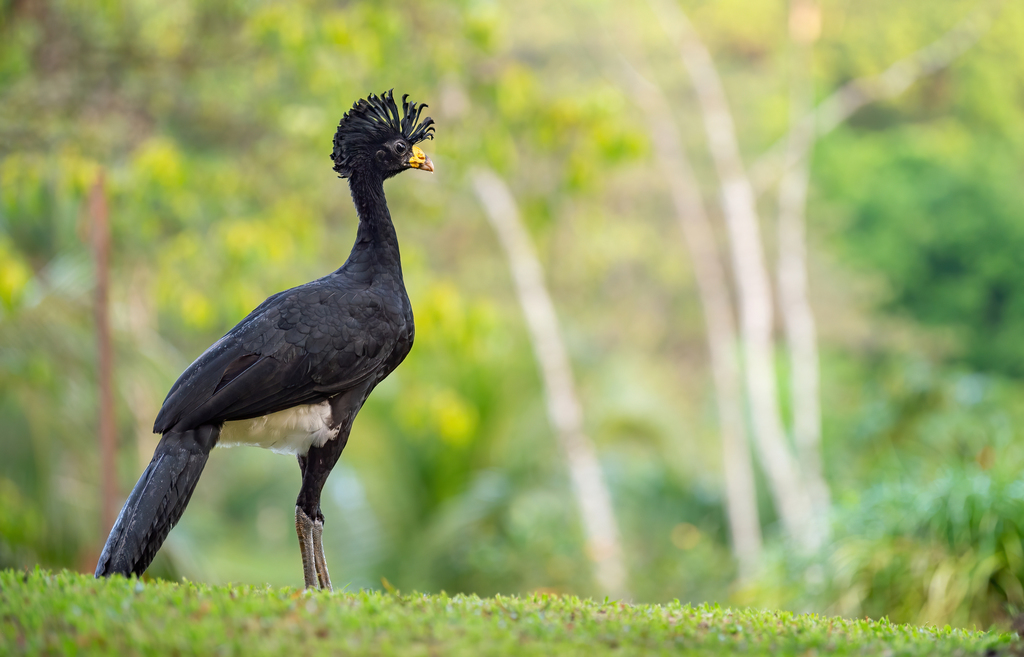
The great curassow is a massive, pheasant-like bird measuring 78–100 cm in length and weighing 3.1–4.8 kg, making it the heaviest species in its family. Males are unmistakable: entirely black plumage with a distinctive curly crest, white belly, and a striking yellow knob on the bill. Females are considerably smaller and display remarkable colour variation, occurring in three distinct morphs. The barred morph shows intricate barring across the neck, mantle, wings and tail; the rufous morph displays overall reddish-brown plumage with a barred tail; and the dark morph is predominantly blackish with some wing barring. Intermediate females blending characteristics of these morphs also occur across the species' range.
Range & Habitat
The great curassow inhabits Neotropical rainforests from eastern Mexico through Central America to western Colombia and northwestern Ecuador, representing the most northerly species of curassow. This distribution reflects an ancient evolutionary history: the species' ancestors have occupied northern South America for approximately 9 million years, with the uplift of the Colombian Andes around 6 million years ago eventually isolating populations that would diversify into different curassow species. These birds are strictly forest dwellers, depending on intact rainforest ecosystems for survival.
Behaviour & Diet
Great curassows are monogamous and highly terrestrial, foraging primarily on the ground for fallen fruits, figs, and arthropods, with occasional small vertebrates supplementing their diet. Unlike other members of their family, they prefer to feed on fruit that has fallen naturally rather than plucking it directly from trees. In specific regions, they show dietary preferences—in Tamaulipas they favour Spondias mombin fruit, while elsewhere they seek the red berries of Chione trees. These large birds roost and nest in trees despite their ground-feeding habits.
Great curassows are notably aggressive birds, a trait likely evolved to defend themselves and their offspring from natural predators including ocelots and ornate hawk-eagles. When threatened, they engage in distraction displays and feign injury. In captivity they have shown combative behaviour toward humans, leaping with fluttering flight and scratching, particularly around the face and eyes. Lifespan in captivity reaches at least 24 years.
Best Time & Places to See It
Great curassows are monogamous ground-foragers best observed in primary rainforest where fallen fruit is abundant. Males build small, leaf-constructed nests in trees where females lay two eggs. The breeding season would be the most rewarding time to locate birds, as males actively tend nests and are more visible. The subspecies C. r. griscomi on Cozumel Island is particularly rare, with only a few hundred individuals remaining and populations vulnerable to hurricanes. Management units in Mexico breed birds in captivity, providing alternative viewing opportunities where wild observation is challenging.
Photography Tips
The male's striking black plumage and yellow bill provide excellent contrast, but photographing these large, ground-feeding birds requires patience and positioning near fruiting trees in rainforest understory. Early morning sessions on the forest floor offer the best opportunities to capture their characteristic foraging behaviour. The remarkable colour polymorphism of females—particularly the rufous and barred morphs—makes documenting multiple individuals rewarding. Exercise caution when approaching: the species' documented aggressive temperament means sudden movements should be avoided to prevent defensive displays that may disrupt photography and compromise bird welfare.