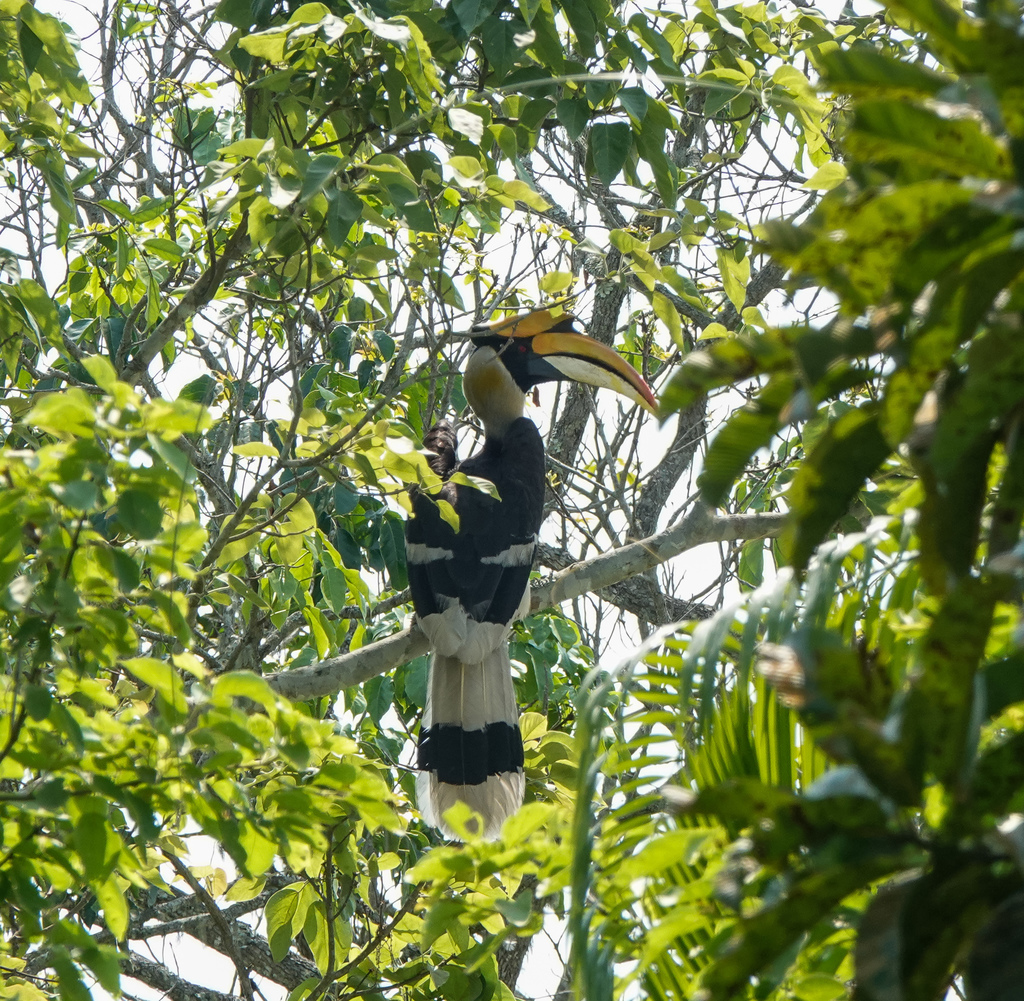
Great Hornbill
Photo © Rejoice Gassah
Photo © Rejoice Gassah — CC BY 4.0 — Source: iNaturalist #78434989Identification
The great hornbill is a massive bird, measuring 95–130 cm long with a 152 cm wingspan and weighing 2 to 4 kg, making it the heaviest of all typical hornbills. Males are larger and heavier than females, averaging 3 kg compared to females' 2.59 kg. The most striking feature is the prominent bright yellow and black casque—a hollow protrusion atop the massive bill that appears U-shaped from the front and concave on top, with two ridges forming points that give the species its Latin name "bicornis" (two-horned). Males display a black underside to the casque, while females have a reddish back to theirs. Females also have bluish-white eyes rather than the red eyes of males, though both sexes have distinctive prominent "eyelashes." The male spreads yellow preen gland secretion onto his primary feathers and bill to maintain the bright coloration. In flight, these birds produce loud, distinctive sounds likened to a steam locomotive, created by their heavy wing beats and characteristic stiff flaps followed by glides with splayed, upcurled wing tips.
Range & Habitat
Great hornbills are native to the forests of India, Bhutan, Nepal, mainland Southeast Asia, and Sumatra, though their distribution is fragmented, particularly in the Western Ghats and Himalayan foothills. Deforestation has significantly reduced their range across much of India over the past centuries. These birds have a strong preference for dense, old-growth unlogged forests in hilly regions and appear dependent on large stretches of rain forest for survival. Their home ranges vary seasonally: during breeding season, males occupy approximately 3.7 km, expanding to around 14.7 km during the non-breeding season.
Behaviour & Diet
Great hornbills are usually seen in small parties, though larger groups sometimes congregate at fruit trees—congregations of 150 to 200 birds have been recorded in southeastern Bhutan. They are predominantly frugivorous, with figs forming a particularly important food source alongside other lipid-rich fruits from families like Lauraceae and Myristicaceae. They obtain all their water from their fruit diet and play a vital role as dispersers of many forest tree species. These hornbills also supplement their diet with small mammals, birds, small reptiles, and insects, foraging along branches by hopping and examining bark for prey, which they catch, toss in the air, and swallow.
Best Time & Places to See It
Great hornbills become highly vocal during the breeding season from January to April, making them more detectable during this period. They prefer mature forests for nesting and roosting, so dense old-growth forest areas in the Indian subcontinent and Southeast Asia offer the best opportunities. The species has cultural significance as the official state bird of both Kerala and Arunachal Pradesh in India, where protected forest reserves may provide reliable viewing opportunities.
Photography Tips
The great hornbill's large size, distinctive casque, and bold yellow-and-black coloration make it a visually striking subject. Photographers should position themselves near fruit trees where congregations may gather, particularly during fruiting seasons. The bird's characteristic loud, locomotive-like flight sounds can help locate birds even in dense forest canopy. Early morning sessions in mature forest habitat offer the best lighting and activity levels for capturing these impressive birds in their natural behavior.
Valmiki National Park
Ramnagar, India
+66 birds+6 mammals
Along Bihar's western frontier, where the Gandak River winds through subtropical forest and grassland, Valmiki National Park sprawls across terrain shaped by monsoon rains and seasonal…
VIEW NATIONAL PARKHat Noppharat Thara-Mu Ko Phi Phi National Park
Ao Nang, Thailand
+253 birds+9 mammals
Where limestone karsts rise dramatically from turquoise waters, Hat Noppharat Thara-Mu Ko Phi Phi National Park unfolds across a mosaic of beach, mangrove forest, and island…
VIEW NATIONAL PARKKhao Yai National Park
Prachantakham District, Thailand
+377 birds+46 mammals
Evergreen dipterocarp forest blankets the rolling terrain of this national park in eastern Thailand, where limestone hills rise abruptly from the forest floor and seasonal streams…
VIEW NATIONAL PARKKhao Laem Ya-Mu Ko Samet National Park
Mueang Rayong District, Thailand
+159 birds+3 mammals
Where limestone hills meet the Gulf of Thailand, Khao Laem Ya–Mu Ko Samet National Park stitches together a mosaic of terrestrial and marine worlds that few…
VIEW NATIONAL PARKKhao Laem National Park
Sangkhla Buri District, Thailand
+197 birds
Where the Vajiralongkorn Reservoir sprawls across the forested valleys of Kanchanaburi's northern borderlands, Khao Laem National Park protects a landscape where limestone ridges rise dramatically from…
VIEW NATIONAL PARKKaziranga National Park
Kohora, India
+422 birds+26 mammals
Dawn breaks over the floodplains of the Brahmaputra, where tall grasslands stretch endlessly beneath monsoon-heavy skies. This sprawling wilderness of northeastern Assam is a mosaic of…
VIEW NATIONAL PARKPeriyar National Park
Mlappara, India
+232 birds+4 mammals
Dawn breaks over mist-shrouded ridges where the Western Ghats tumble toward Kerala's spice-scented lowlands. Here, ancient tropical forests envelope a glittering artificial lake, creating a mosaic…
VIEW NATIONAL PARKPampadum Shola National Park
Vattavada, India
+258 birds+14 mammals
Where misty shola forests cling to the high plateaus of the Nilgiri Mountains, ancient evergreen remnants create a world apart. This 2,316-hectare reserve protects one of…
VIEW NATIONAL PARKTaman Negara National Park
Kampong Samas, Malaysia
+393 birds+48 mammals
Where ancient rainforest meets limestone peaks, one of Southeast Asia's oldest protected wilderness preserves sprawls across 4,343 square kilometers of primordial landscape. Dipterocarp giants tower overhead,…
VIEW NATIONAL PARKWay Kambas National Park
Lampung Timur, Indonesia
+237 birds+20 mammals
Across the low swamplands of eastern Lampung, where freshwater wetlands merge into tidal mangrove forests along the Sunda Strait, sprawls one of Sumatra's most vital sanctuaries.…
VIEW NATIONAL PARKNo community photos yet. Log in to add the first one.
No community observations of this species yet.