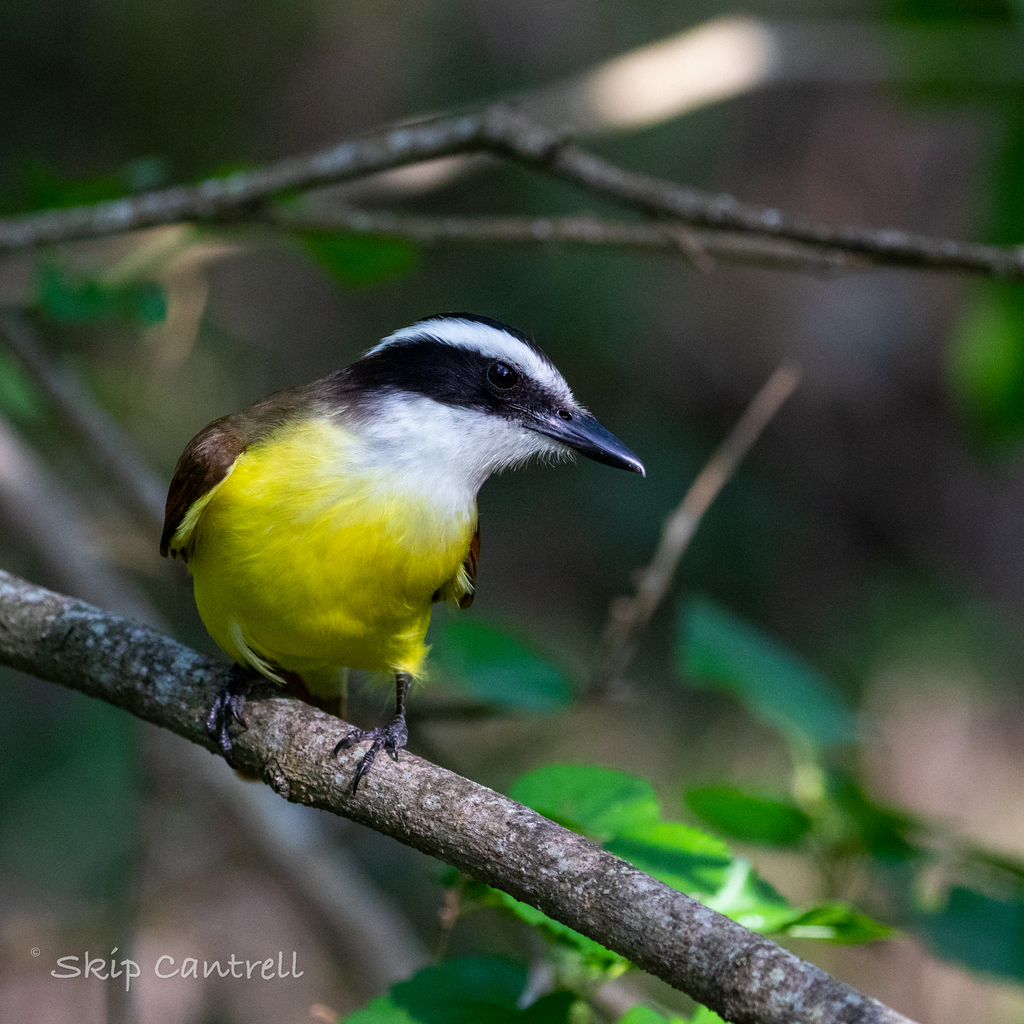
Great Kiskadee
Photo © tcantrell52
Photo © tcantrell52 — CC BY 4.0 — Source: iNaturalist #152451926Identification
The great kiskadee is one of the largest tyrant flycatchers, measuring 25 to 28 cm in length and weighing 53 to 71.5 grams. It is unmistakable in the field: the head is black with a striking white supercilium (eyebrow stripe) and a concealed yellow crown stripe visible when the bird is alert or agitated. The upperparts are brown, while the wings and tail are brown with usually strong rufous fringes, creating a warm, colorful appearance. The bill is short, thick, and black. While a few other tyrant flycatchers share a similar color pattern, they are markedly smaller and lack the great kiskadee's bold head markings and overall size.
The similar boat-billed flycatcher can be distinguished by its more massive black bill, olive-brown back, and very little rufous in the tail and wings. The great kiskadee's distinctive appearance makes it one of the easiest large flycatchers to identify across its range.
Range & Habitat
The great kiskadee is found from the Lower Rio Grande Valley in southern Texas south through Central America to southern Argentina, occupying a vast range across the Americas. It does not regularly occur in Chile. The species was introduced to Bermuda in 1957, where it successfully established a breeding population, and to Tobago around 1970. This widespread distribution reflects the bird's remarkable adaptability to different environments.
The great kiskadee inhabits a wide range of habitats, from open grassland with scattered trees to heavily urbanized areas. It breeds in open woodland with some tall trees, including cultivated land and around human habitation. This habitat flexibility has made it one of the most common birds in urban and suburban areas throughout Latin America, where its presence is unmistakable.
Behaviour & Diet
The great kiskadee is a common, noisy, and conspicuous bird with highly opportunistic feeding habits. It hunts like a shrike or flycatcher, waiting on an open perch high in a tree before sallying out to catch insects in flight or pouncing on rodents and small vertebrates such as bird chicks and bats. This omnivorous species also gleans prey from vegetation by jumping and hovering, taking small snakes, lizards, frogs, spiders, millipedes, and land snails. It occasionally dives into shallow water to catch freshwater snails, fish, or tadpoles, making it one of the few fishing passerines.
The bird's diet extends to seeds and fruit, and it readily visits human feeding stations for bread, dog food, bananas, and peanut butter seed mixtures. Kiskadees typically hunt alone or in pairs and do not regularly join mixed-species feeding flocks. Their exuberant call is a distinctive BEE-tee-WEE; the bird's name is onomatopoetic, with bem-te-vi in Brazil ("I saw you well") and bien-te-veo in Spanish-speaking countries ("I see you well"). This vocal and conspicuous behavior, combined with its flashy yellow belly, makes it highly visible and unmistakable in its habitat.
Best Time & Places to See It
The great kiskadee is a year-round resident throughout its range and can be seen at any time of year. Its loud call and conspicuous behavior make it easy to locate even in heavily urbanized areas. The bird is particularly common in open woodlands, parks, gardens, and agricultural areas with scattered tall trees, as well as in towns and cities throughout Latin America.
Look for the great kiskadee perched openly on high branches, telephone wires, or other prominent perches where it can scan for prey. Its noisy, exuberant call will often draw attention to its location. The species' adaptability to human-modified landscapes means that excellent viewing opportunities exist not only in natural habitats but also in parks, gardens, and suburban areas across its range.
Photography Tips
The great kiskadee's large size, bold plumage pattern, and conspicuous behavior make it relatively straightforward to photograph. Its preference for open perches provides clear, unobstructed views. Position yourself to photograph the bird from below or at eye level to capture the striking white supercilium and yellow crown stripe effectively. The strong rufous fringes on the wings and tail are particularly photogenic and should be highlighted by appropriate lighting.
The bird's active hunting behavior offers excellent opportunities for action shots as it sallies from perches to catch insects or dives toward water. Early morning and late afternoon light will enhance the warm rufous tones in the plumage. The great kiskadee's tameness in urban areas and its regular use of feeding stations and perches make it an accessible subject for photographers of varying skill levels.
Amacayacu National Park
Amazônia National Park
Anavilhanas National Park
Araucárias National Park
Arenal Volcano National Park
Arrecifes de Cozumel National Park
Bahuaja Sonene National Park
Barbilla National Park
Baritú National Park
Nothing matches these filters.
No community photos yet. Log in to add the first one.
No community observations of this species yet.