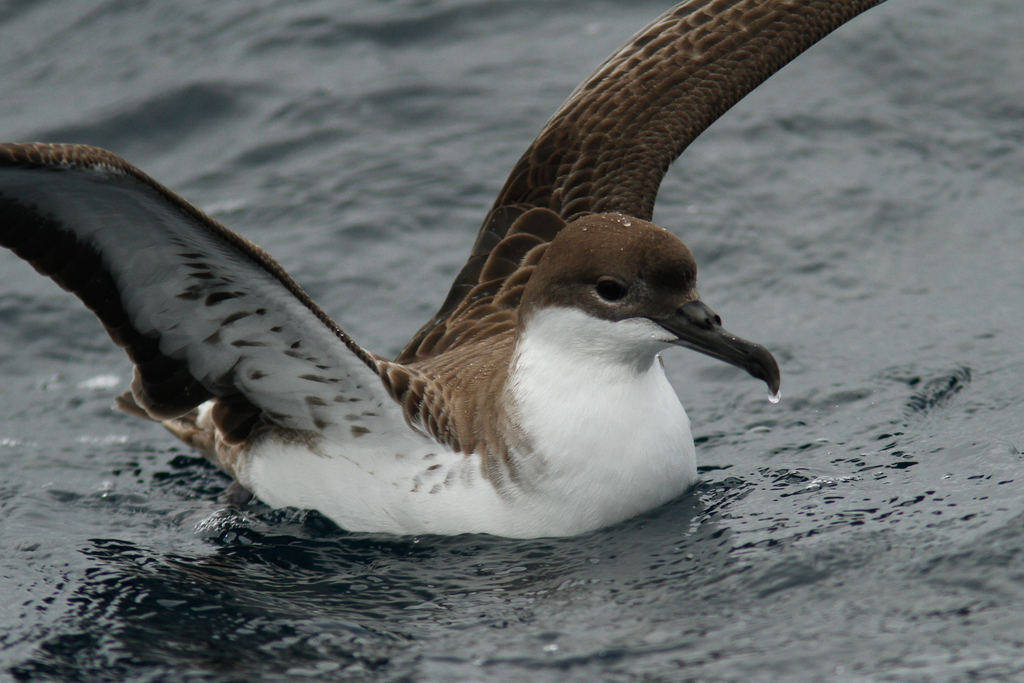
Great Shearwater
Photo © Julien Renoult
Photo © Julien Renoult — CC BY 4.0 — Source: iNaturalist photo #9765173Identification
The Great Shearwater is a large, powerfully built seabird measuring 43–51 cm in length with an impressive wingspan of 105–122 cm. Its plumage is distinctive and relatively easy to identify: dark upper parts contrast sharply with white underparts, though a diagnostic brown belly patch and dark shoulder markings break up the white below. Look for a black cap, black bill, and a striking white "horseshoe" marking at the base of the tail. The bird's stiff, direct flight style—with wings held straight and few wingbeats, skimming low over the water—is characteristic of shearwaters and helps distinguish it from other seabirds.
Within its range, the Great Shearwater may be confused with Cory's Shearwater or the all-dark Sooty Shearwater, but its size, white underparts, and distinctive markings separate it from these species. The flight pattern, reminiscent of a large Manx Shearwater, is also a useful identification feature for observers watching from ships or coastal vantage points.
Range & Habitat
The Great Shearwater follows a remarkable circular migration route spanning the Atlantic Ocean. It breeds colonially on rocky islands in the South Atlantic, including Nightingale Island, Inaccessible Island, Tristan da Cunha, and Gough Island. After breeding, these birds undertake an extraordinary transhemispheric migration, moving north along the eastern seaboards of South and North America before crossing the Atlantic in August.
During this northward passage, Great Shearwaters can be quite common off the southwestern coasts of Great Britain and Ireland. They then return south along the eastern Atlantic littoral, completing their circular route. This migration pattern is unusual among birds, as most species migrate from north to south rather than from Southern to Northern Hemisphere breeding grounds.
Behaviour & Diet
The Great Shearwater is highly gregarious and exhibits the characteristic "shearing" flight of its genus, dipping from side to side on stiff wings with wingtips nearly touching the water surface. Its flight is powerful and direct, covering vast oceanic distances with remarkable efficiency. These social birds gather in large numbers, often visible from ships or coastal headlands, and produce a distinctive piercing "eeyah" cry when resting in groups on the water.
This species feeds primarily on fish and squid, which it captures from the surface or through plunge-diving. It opportunistically consumes crustaceans, fish entrails, and other discards from fishing vessels, readily following boats and engaging in noisy feeding competitions. Great Shearwaters breed in large colonies, nesting in small burrows or open grass on their island breeding grounds, with breeding birds visiting nests only at night to avoid predation by large gulls. Notably, this species shows among the highest incidence of plastic ingestion among seabirds.
Best Time & Places to See It
August is the optimal month to observe Great Shearwaters, as this is when they cross the Atlantic during their northward migration. The southwestern coasts of Great Britain and Ireland offer excellent opportunities to see these birds in good numbers during this period. Seabird enthusiasts should position themselves on appropriate headlands or take boat trips offshore, where Great Shearwaters can be seen in large, sometimes spectacular gatherings.
The species is most reliably encountered during migration periods from ships or coastal observation points. Its gregarious nature means that when Great Shearwaters are present, multiple individuals are often visible together, creating rewarding viewing opportunities for patient observers.
Photography Tips
Photographing Great Shearwaters requires patience and positioning. Seabird photographers should focus on headlands or take boat trips during the August migration peak when birds are most numerous. The birds' low, skimming flight over water makes them challenging subjects, but their powerful, direct flight pattern offers dynamic photographic opportunities if you anticipate their movement.
Key identifying features to capture include the white "horseshoe" tail marking, the brown belly patch, dark shoulder markings, and the distinctive black cap and bill. Photographing birds while they're resting on the water allows for clearer detail shots showing plumage patterns. Early morning light on coastal headlands often provides the best conditions for capturing these striking seabirds against the Atlantic backdrop.
Tortuguero National Park
Roxana, Costa Rica
+420 birds+23 mammals
Canals and lagoons thread through a labyrinth of lowland rainforest where the Caribbean coast of Costa Rica meets the wetland frontier. This is terrain shaped by…
VIEW NATIONAL PARKPembrokeshire Coast National Park
Pembrokeshire, United Kingdom
+250 birds+41 mammals
Where the Cambrian coastline meets the Celtic Sea, cliff-top moorland and hidden coves define a landscape carved by 300 million years of geological drama. Pembrokeshire Coast…
VIEW NATIONAL PARKCape Dolphin
falskland islands, Falkland Islands
+54 birds+1 mammals
Where windswept grasslands meet dramatic coastal cliffs, the Falkland Islands' northern reaches reveal one of the Southern Hemisphere's most compelling seabird sanctuaries. The terrain here is…
VIEW NATURE RESERVEVolunteer Point
Stanley, Falkland Islands
+70 birds+3 mammals
Windswept grasslands meet volcanic black sand beaches where three penguin species converge in the South Atlantic's most theatrical wildlife theatre. This remote peninsula on East Falkland…
VIEW NATURE RESERVEWest Point Island
West Point, Falkland Islands
+67 birds+3 mammals
Windswept cliffs plunge dramatically into the South Atlantic, their rust-coloured rock faces sculpted by millennia of gales and spray. This northwestern outpost of the Falkland Islands…
VIEW ISLAND & ARCHIPELAGOCabo de Hornos National Park
Cape Horn, Chile
+88 birds+9 mammals
Where the Andes plunge into the Southern Ocean and the Drake Passage churns between two continents, Cabo de Hornos National Park sprawls across one of Earth's…
VIEW NATIONAL PARKEstrecho Natural Park
Pedro Valiente, Spain
+281 birds+20 mammals
Where Mediterranean pine forests meet wind-sculpted coastal cliffs, one of Europe's most dynamic ecological crossroads unfolds across the Strait of Gibraltar. Spanning 686 square kilometers of…
VIEW NATURAL PARKSalisbury Plain
South Georgia, South Georgia and the South Sandwich Islands
+33 birds+4 mammals
Where tussock grasses bow to relentless Antarctic winds and glacial meltwater carves braided channels through obsidian volcanic soil, one of Earth's most remote wildlife sanctuaries reveals…
VIEW PROTECTED LANDSCAPESt. Andrews Bay
South Georgia, South Georgia and the South Sandwich Islands
+34 birds+6 mammals
Where windswept tundra dissolves into obsidian beaches, one of the planet's most extraordinary wildlife theaters unfolds across St. Andrews Bay. This remote corner of South Georgia…
VIEW PROTECTED LANDSCAPEFortuna Bay
Stromness, South Georgia and the South Sandwich Islands
+37 birds+5 mammals
Where tussock grasslands sweep down to black-sand beaches and elephant seals haul out in thunderous colonies, the raw sub-Antarctic landscape reveals itself in its most dramatic…
VIEW PROTECTED LANDSCAPEPrion Island
Prince Olav Harbour, South Georgia and the South Sandwich Islands
+36 birds+2 mammals
Windswept tussock grasslands rise sharply from boulder-strewn beaches where the Southern Ocean hurls its grey swells against black volcanic rock. This remote speck in South Georgia's…
VIEW ISLAND & ARCHIPELAGONuuk Fjord System
Nuuk, Greenland
+54 birds+3 mammals
Where granite peaks plunge directly into the Arctic Ocean, a labyrinth of deep fjords carves through Greenland's southwestern coast, their waters eternally shadowed by towering rock…
VIEW PROTECTED LANDSCAPEAcadia National Park
Bar Harbor, United States
+291 birds+27 mammals
Where the Maine coast rises in granite cliffs and spruce-clad headlands, Acadia National Park unfolds across Mount Desert Island and its surrounding waters, a landscape carved…
VIEW NATIONAL PARKBiscayne National Park
Miami-Dade County, United States
+263 birds+7 mammals
Coral reefs and mangrove shallows dominate this marine sanctuary where the Florida Keys meet the Atlantic, creating a mosaic of shallow seagrass meadows, patch reefs, and…
VIEW NATIONAL PARKAlaska Maritime National Wildlife Refuge
Alaska, United States
+391 birds+58 mammals
Where the North Pacific collides with Alaska's rugged coastline, a sprawling archipelago of islands, rocky outcrops, and coastal headlands forms one of North America's most remote…
VIEW WILDLIFE SANCTUARYMerritt Island National Wildlife Refuge
Brevard County, United States
+341 birds+19 mammals
Brackish marshes and palmetto scrub define this wildlife sanctuary spanning the coastal lowlands of central Florida, where the Atlantic tide meets freshwater systems in a dynamic…
VIEW WILDLIFE SANCTUARYChincoteague National Wildlife Refuge
Chincoteague, United States
+362 birds+16 mammals
Across the barrier islands and salt marshes of Virginia's Eastern Shore, where Atlantic tides sculpt an intricate mosaic of sandy spits and tidal flats, lies one…
VIEW WILDLIFE SANCTUARYLaguna Atascosa National Wildlife Refuge
Cameron County, United States
+365 birds+19 mammals
Where coastal prairie meets shallow lagoon along the southernmost tip of Texas, Laguna Atascosa National Wildlife Sanctuary sprawls across a landscape sculpted by salt spray and…
VIEW WILDLIFE SANCTUARYPea Island National Wildlife Refuge
Dare County, United States
+356 birds+15 mammals
Where the Outer Banks taper toward the Atlantic, a sliver of barrier island creates a microcosm of coastal ecology. Pea Island National Wildlife Sanctuary spans over…
VIEW WILDLIFE SANCTUARYSt. Marks National Wildlife Refuge
Saint Marks, United States
+324 birds+16 mammals
Where the Apalachee Bay begins to define the Florida coastline, salt marshes and freshwater impoundments merge into one of the southeastern United States' most productive wildlife…
VIEW WILDLIFE SANCTUARYNo community photos yet. Log in to add the first one.
No community observations of this species yet.