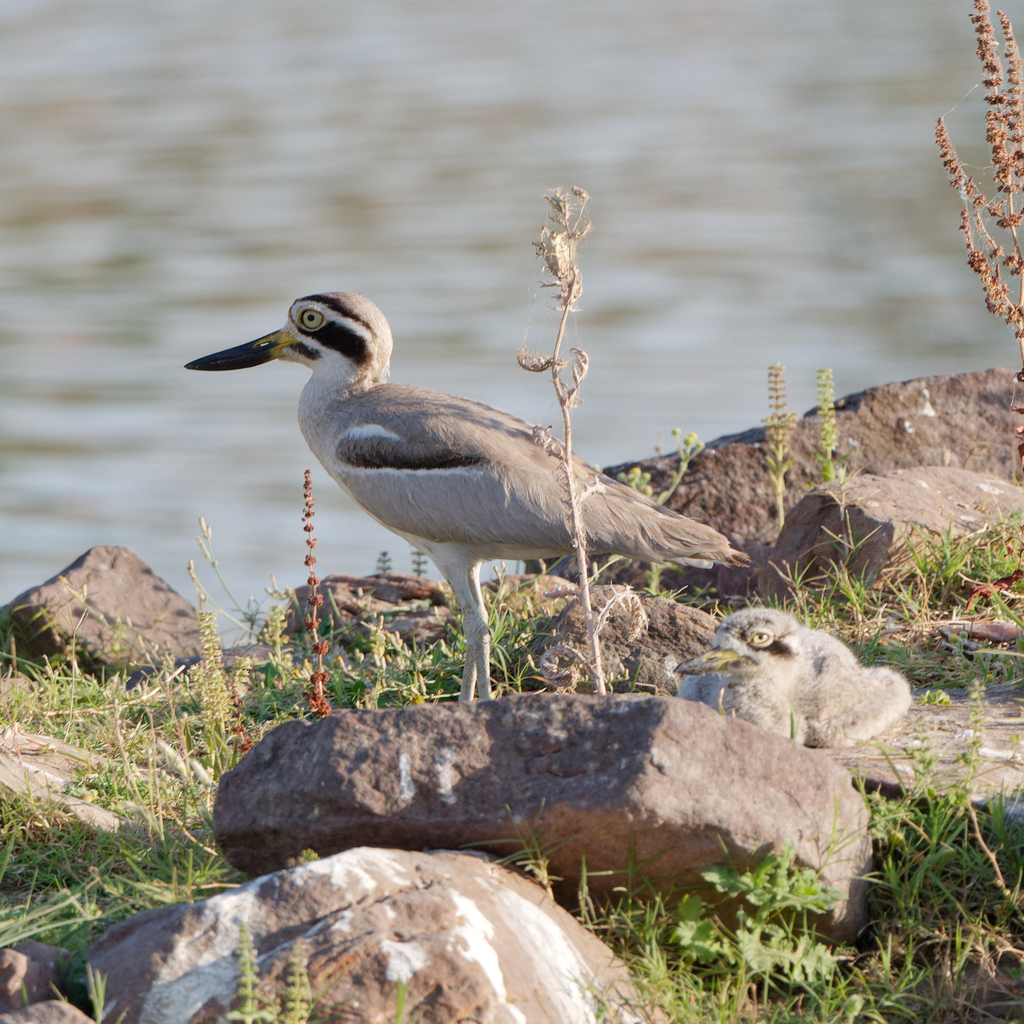
Great Stone-curlew
Photo © Rich Agar
Photo © Rich Agar — CC BY 4.0 — Source: iNaturalist #289082835Identification
The Great Stone-curlew is a large wader, measuring 49–55 cm in length, with a distinctive massive bill that sets it apart from most other birds. The most striking feature is its 7 cm bill with a sharp angle on the lower mandible, giving it a characteristically upturned appearance. The specific name recurvirostris literally refers to this "bent backwards" bill.
The plumage is unstreaked grey-brown on the upperparts and breast, contrasting with whitish underparts. The face bears a striking black and white pattern that adds to its distinctive appearance. The bill is black with a yellow base, while the bright yellow eyes are particularly prominent. The legs are a duller greenish-yellow. In flight, look for the striking black and white flight feathers on the upperwing and the mainly white underwing. Sexes are similar in appearance, though young birds are slightly paler than adults.
Range & Habitat
The Great Stone-curlew is a resident breeder across tropical southern Asia, with its range extending from India, Pakistan, and Sri Lanka eastward into South-east Asia and Bangladesh. Being a resident breeder, populations maintain year-round presence throughout their range rather than undertaking major migrations.
This species shows a clear preference for specific habitats, favouring gravel banks along rivers and large lakes, as well as beaches. These open, exposed environments provide the habitat conditions this wader requires for feeding and breeding.
Behaviour & Diet
Like other stone-curlews, the Great Stone-curlew is primarily nocturnal or crepuscular, becoming most active during twilight hours and at night. However, it can frequently be observed foraging during the day, moving slowly and deliberately across its preferred habitats with occasional short runs. The species tends to be wary, and when disturbed will typically fly off into the distance with powerful, rather stiff wingbeats that are characteristic of its flight style.
The diet consists of crabs, large insects, and other animal prey hunted opportunistically. The call is a distinctive wailing whistle, primarily given at night. Breeding is minimal and efficient: a single egg is laid in a bare scrape on open shingle, requiring little nest preparation.
Best Time & Places to See It
The Great Stone-curlew's primarily nocturnal and crepuscular habits make early morning and late evening the best times for observation, when the birds are most active. However, daytime foraging opportunities do occur, particularly in less-disturbed locations. Being a resident breeder throughout its range, the species is present year-round across southern Asia from India, Pakistan, and Sri Lanka through to South-east Asia and Bangladesh.
Focus your search on gravel banks along rivers and large lakes, as well as suitable beach habitats where these birds naturally congregate and breed.
Photography Tips
The Great Stone-curlew's wary nature means patience and careful approach are essential. Early morning and evening light will best capture the striking facial patterns and the bright yellow eyes that characterize this species. The contrast between the black and white facial markings provides excellent compositional opportunities.
When photographing birds in flight, be prepared for their powerful, stiff wingbeats. Include perched birds to showcase the distinctive upturned bill and overall posture. The contrast between the grey-brown upperparts and whitish underparts, combined with the black and yellow bill, makes this a photogenic subject when properly lit.
Lunugamvehera National Park
Sri Lanka
+204 birds+14 mammals
Dry scrubland and shallow wetlands converge in Sri Lanka's southeastern lowlands, where Lunugamvehera National Park anchors one of the island's most ecologically vital landscapes. The park's…
VIEW NATIONAL PARKMinneriya National Park
Sri Lanka
+158 birds+9 mammals
Across the dry zone of Sri Lanka's North Central Province spreads a landscape of shallow tanks, grassland margins, and scattered dry forest—a mosaic of water and…
VIEW NATIONAL PARKWasgamuwa National Park
Sri Lanka
+156 birds+8 mammals
Dry deciduous forest and open grassland sweep across the North Central lowlands where Wasgamuwa National Park protects one of Sri Lanka's largest remaining tracts of this…
VIEW NATIONAL PARKOrang National Park
Rangagarapathar, India
+298 birds+1 mammals
Where the Brahmaputra's floodplains meet the foothills of Assam, Orang National Park unfolds across a mosaic of riverine grasslands, forests and wetlands that pulse with the…
VIEW NATIONAL PARKRanthambhore National Park
Sawai Madhopur, India
+294 birds+20 mammals
Granite ridges and ravines carved through the Aravalli Range frame this protected landscape in eastern Rajasthan, where deciduous forest mingles with open scrubland and seasonal water…
VIEW NATIONAL PARKPhou Xieng Thong National Protected Area
Khong Chiam District, Thailand
+2 birds
Where the Mekong River defines the border between Thailand and Laos, the forested plateaus of Phou Xieng Thong rise in rippling waves of limestone and sandstone,…
VIEW NATIONAL PARKKanha Tiger Reserve
Kanha Kisli F.V., India
+321 birds+23 mammals
Where sal forests give way to emerald meadows and crystalline streams carve through ancient valleys, one of India's finest wilderness reserves unfolds across the Maikal Range.…
VIEW NATIONAL PARKBandhavgarh National Park
Garhpuri, India
+285 birds+17 mammals
Where granite ridges rise dramatically above sal and bamboo forests, one of India's most pristine tiger reserves unfolds across the Vindhyan plateau. Ancient rock formations tower…
VIEW NATIONAL PARKPanna National Park
Badgadi Kalan, India
+271 birds+17 mammals
Where granite gorges slice through central India's Vindhyan plateau, a landscape of stark beauty unfolds across nearly six hundred square kilometers. The Ken River carves through…
VIEW NATIONAL PARKKaziranga National Park
Kohora, India
+422 birds+26 mammals
Dawn breaks over the floodplains of the Brahmaputra, where tall grasslands stretch endlessly beneath monsoon-heavy skies. This sprawling wilderness of northeastern Assam is a mosaic of…
VIEW NATIONAL PARKKeoladeo National Park
Shreenagar Rural, India
+326 birds+14 mammals
Where shallow wetlands shimmer beneath vast Rajasthani skies, one of Asia's finest bird sanctuaries pulses with extraordinary life. This former maharaja's hunting reserve, now spanning 29…
VIEW NATIONAL PARKNagarahole Tiger Reserve
Nalkeri Forest, India
+323 birds+23 mammals
Where granite escarpments rise above dense deciduous forests and the Kabini River carves through pristine wilderness, one of India's most biodiverse landscapes unfolds across the Western…
VIEW NATIONAL PARKGir National Park
Asundrali, India
+258 birds+13 mammals
Dry deciduous forests cloak the rolling hills of western Gujarat where the Gir landscape rises as a final sanctuary for one of the world's rarest felids:…
VIEW NATIONAL PARKNo community photos yet. Log in to add the first one.
No community observations of this species yet.