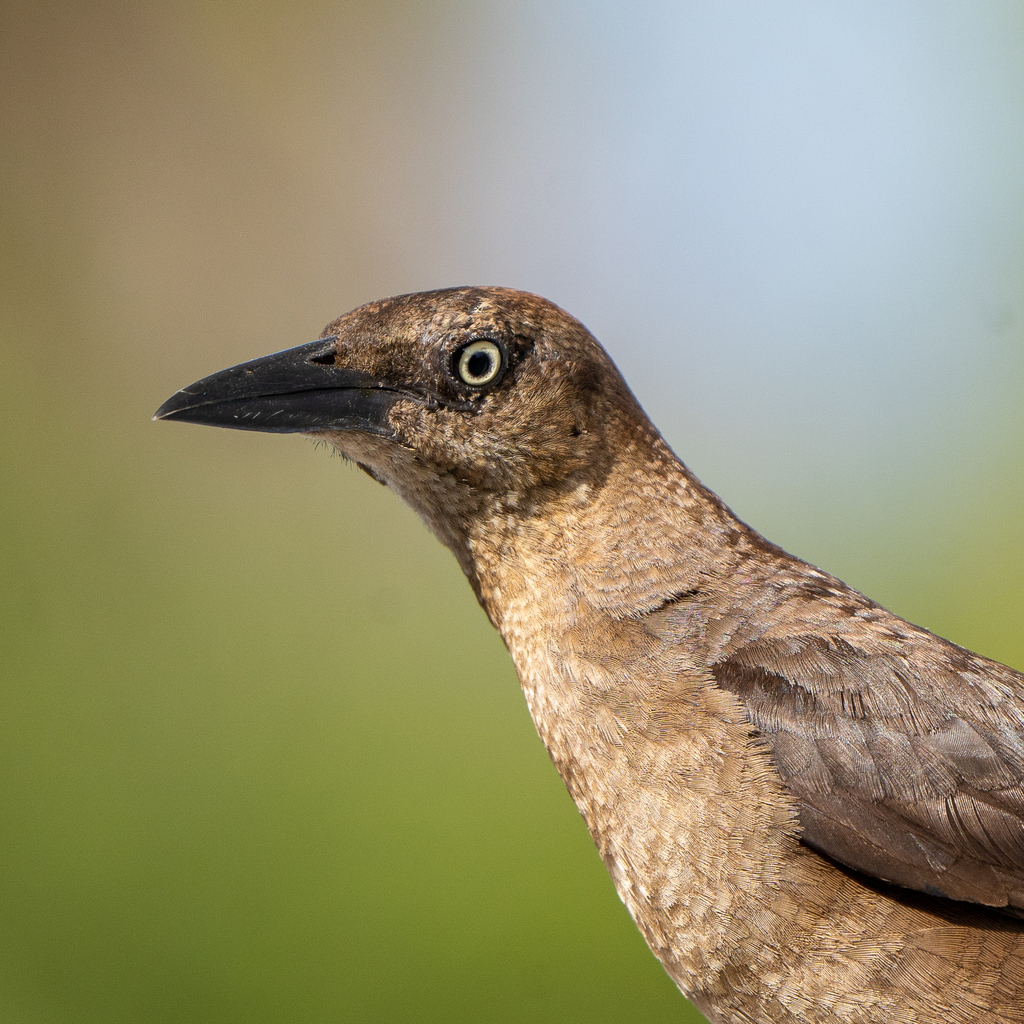
Great-tailed Grackle
Photo © Anthony Batista
Photo © Anthony Batista — CC BY 4.0 — Source: iNaturalist #127407647Identification
Great-tailed grackles are medium-sized passerines, larger than starlings but smaller than crows, measuring 38–46 cm in length with a wingspan of 48–58 cm. The most striking difference between sexes is their plumage: males display iridescent black feathers with a distinctive purple-blue sheen on the head and upper body, while females are brown with darker wings and tail. Both adults have bright yellow eyes, a key field mark. Juveniles resemble females but display streaks on the breast and have brown eyes. Perhaps their most characteristic feature is the keel-shaped tail, which males can fold vertically by aligning the two halves—a dramatic display visible in the field.
Great-tailed grackles are sometimes mistaken for crows due to their glossy black plumage, but they belong to the family Icteridae and are most closely related to boat-tailed grackles. Brewer's blackbird is superficially similar but belongs to a different genus within the same family.
Range & Habitat
Originally native to the tropical lowlands of Central and South America, great-tailed grackles have dramatically expanded their range northward since 1880, extending from northwestern Venezuela and Colombia in the south to Minnesota in the north, and from Oregon and California in the west to Florida in the east. Vagrants have been recorded as far north as southern Canada. This expansion followed agricultural and urban corridors, making them increasingly common in human-modified landscapes.
Great-tailed grackles forage on open ground in pastures, wetlands, mangroves, and chaparral. They communally roost in trees and wetland reeds at night, gathering in large, conspicuous flocks that make them unmistakable in suitable habitat.
Behaviour & Diet
These highly social birds have complex breeding systems with multiple mating strategies: territorial males defend areas where females nest and raise young, resident males live within colonies without defending territory or securing mates, and transient males remain briefly before moving to other colonies. Resident and transient males father offspring through extra-pair copulations. Territorial males tend to be heavier with longer tails, traits that correlate with higher reproductive success.
Great-tailed grackles are renowned for their loud, year-round vocalizations ranging from sweet, tinkling notes to harsh, rusty sounds. Males employ a wider variety of calls than females, who primarily use chatter, though females occasionally perform territorial songs. Their vocal repertoire and social roosting habits sometimes label them as pest species. Remarkably, these birds can solve complex problems, including the famous Crow and the Pitcher puzzle.
Best Time & Places to See It
Great-tailed grackles are present year-round throughout most of their range, making them accessible to wildlife travelers and photographers at any season. Look for large, noisy flocks in urban parks, agricultural areas, wetlands, and near human settlements across their range from the southwestern United States through Central America to northern South America. Dawn and dusk are ideal times to observe their communal roosting behavior when flocks gather conspicuously in trees and reeds.
Photography Tips
The striking sexual dimorphism makes great-tailed grackles rewarding photographic subjects. Males' iridescent plumage requires careful exposure and lighting to capture the purple-blue sheen on the head and body; side-lighting or backlighting often brings out this iridescence effectively. The distinctive yellow eyes of adults should be in sharp focus. Males' folded tail posture is a characteristic behavior worth capturing, showing the vertical keel-shape.
Females present a subtler photographic challenge with their brown plumage; ensure adequate contrast against foliage backgrounds. Communal roosting sites offer opportunities for dramatic flock photography, and their vocal behavior can be captured alongside images. Wide-angle shots at breeding colonies convey their highly social nature, while close-ups reveal the eye color and plumage details that distinguish them from similar species.
Arches National Park
Arenal Volcano National Park
Arrecifes de Cozumel National Park
Badlands National Park
Barbilla National Park
Barra del Colorado National Wildlife Refuge
Baru Volcano National Park
Bear River Migratory Bird Refuge
Big Bend National Park
Nothing matches these filters.
No community photos yet. Log in to add the first one.
No community observations of this species yet.