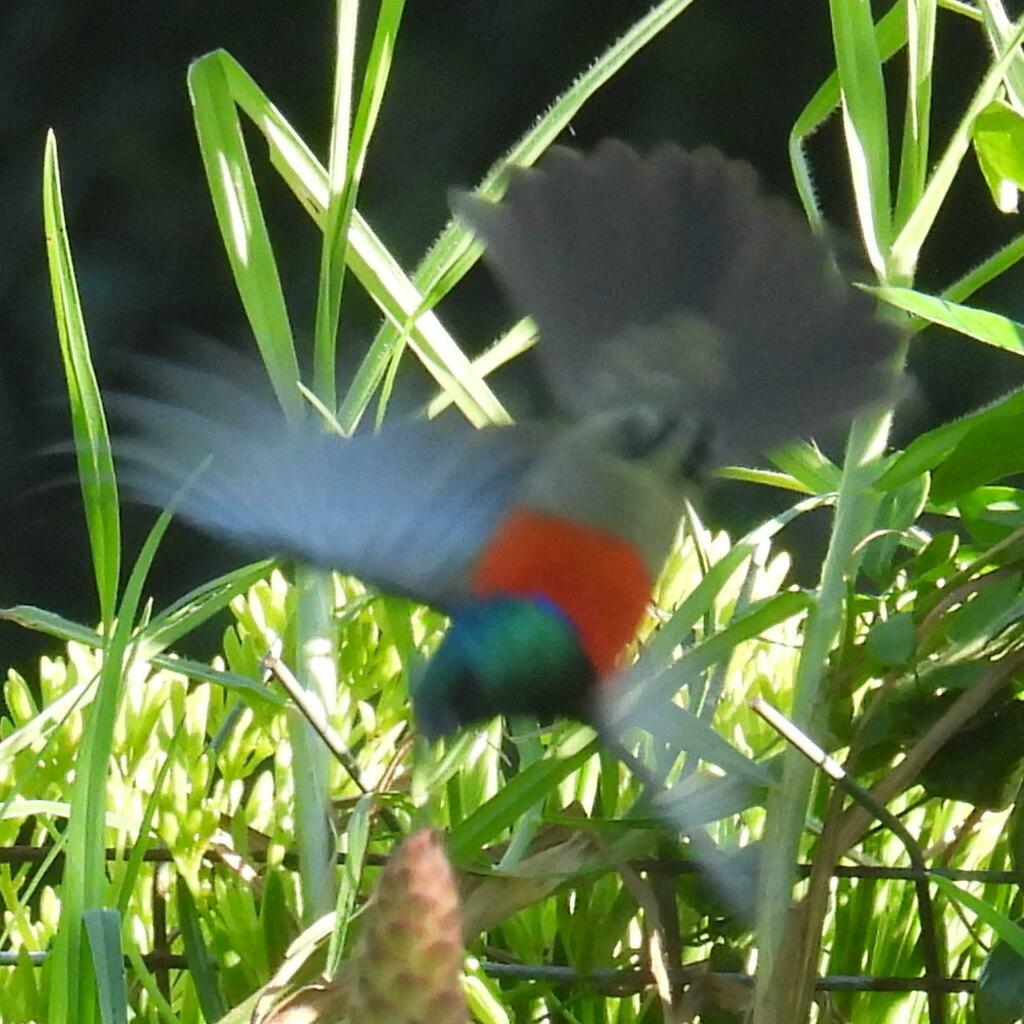
Greater Double-collared Sunbird
Photo © Henry de Lange
Photo © Henry de Lange — CC BY 4.0 — Source: iNaturalist #258451572Identification
The greater double-collared sunbird is a small bird measuring 14 cm in length, with a distinctly decurved black bill characteristic of the sunbird family. The species exhibits striking sexual dimorphism. Males are unmistakable, displaying a glossy metallic green head, throat, upper breast and back, with a broad brilliant red band across the chest separated from the green breast by a narrow metallic blue band. The rest of the male's underparts are pale grey, and when displaying, yellow feather tufts become visible on the shoulders. Females are considerably duller, with pale grey plumage that is darker in the wings and lacks the bold red and blue markings of males.
The greater double-collared sunbird can be distinguished from the similar lesser double-collared sunbird by its larger size, broader red chest band, and longer bill. The voice is diagnostic: the call is a hard chut-chut-chut, while the song is a high-pitched jumble of tweets and twitters, notably richer than those of its smaller relative. Additionally, males produce a shrill whistle and click: wrew wrew wrew ch ch.
Range & Habitat
This sunbird breeds in southern, eastern and northeastern South Africa and Eswatini. While mainly resident throughout much of its range, populations in the northeast show partial migratory behaviour. The species is common in gardens, fynbos, forest edges and coastal scrub, making it relatively accessible to birdwatchers across diverse habitats.
Behaviour & Diet
Greater double-collared sunbirds are usually observed singly or in pairs, and possess characteristically fast, direct flight on short wings. They breed year-round with a peak breeding season from July to November. The closed oval nest is meticulously constructed from grass, lichen and other plant material, bound together with spider webs; the entrance is positioned at the side and sometimes features a porch, with the interior lined with feathers.
The species lives primarily on nectar from flowers but supplements its diet with fruit and, particularly when feeding young, insects and spiders. Notably, these sunbirds exhibit a distinctive feeding behaviour of hovering in front of spider webs to extract prey. While capable of hovering like hummingbirds to take nectar, they typically perch while feeding.
Best Time & Places to See It
The species' year-round breeding presence and resident status in much of southern Africa make it viewable throughout the year. However, the peak breeding season from July to November offers heightened activity and the best opportunity to observe breeding behaviour and male displays. Look for the greater double-collared sunbird in gardens, fynbos, forest edges and coastal scrub habitats throughout its range in South Africa and Eswatini.
Photography Tips
The male's brilliant metallic plumage and contrasting red and blue chest bands photograph beautifully in strong light that emphasizes the iridescent quality of the green and blue feathers. Position yourself to capture the characteristic yellow shoulder tufts during display. The bird's hovering behaviour while feeding on flowers presents dynamic photography opportunities, though perching birds may be easier to photograph sharply. The small size and fast movements require a good telephoto lens and fast shutter speed.
Garden Route National Park
George, South Africa
+353 birds+54 mammals
Sweeping across the Western Cape's coastal and mountainous terrain, this sprawling national park encompasses over five thousand square kilometers of extraordinarily diverse landscape—from coastal limestone cliffs…
VIEW NATIONAL PARKPilanesberg National Park
Moses Kotane Local Municipality, South Africa
+364 birds+49 mammals
Granite peaks and volcanic ridges rise unexpectedly from the savanna floor across this 734-square-kilometre expanse in the North West province, creating a landscape of profound ecological…
VIEW NATIONAL PARKKruger National Park
Ba-Phalaborwa Local Municipality, South Africa
+540 birds+91 mammals
Across the low-lying savanna of northeastern South Africa unfolds one of Africa's largest and most ecologically intact protected areas, where acacia woodlands merge into mopane scrub…
VIEW NATIONAL PARKAgulhas National Park
Cape Agulhas Local Municipality, South Africa
+224 birds+13 mammals
Where the Atlantic and Indian Oceans meet at Africa's southernmost tip, Agulhas National Park stretches across 892 square kilometres of windswept coastal landscape and rugged limestone…
VIEW NATIONAL PARKSehlabathebe National Park
South Africa
+60 birds+1 mammals
Where the Drakensberg escarpment rises to meet the sky, Sehlabathebe National Park unfolds across a landscape of dramatic basalt cliffs, rolling alpine grassland, and crystal-clear mountain…
VIEW NATIONAL PARKBontebok National Park
Swellendam Local Municipality, South Africa
+204 birds+11 mammals
Where the Cape Fold Mountains give way to coastal lowlands, a landscape of rolling sandstone hills and fynbos heathland creates one of South Africa's most compact…
VIEW NATIONAL PARKAddo Elephant National Park
Sundays River Valley Local Municipality, South Africa
+388 birds+55 mammals
Where the Eastern Cape's semi-arid scrublands meet transitional woodland, Addo sprawls across 13,478 square kilometres of one of southern Africa's most biodiverse landscapes. The terrain rises…
VIEW NATIONAL PARKIthala Game Reserve
uPhongolo Local Municipality, South Africa
+328 birds+26 mammals
Rolling thornbush savanna and acacia woodland dominate the landscape of this 494-square-kilometre national park in KwaZulu-Natal's uPhongolo Local Municipality, where granite outcrops punctuate grassland plateaus and…
VIEW NATIONAL PARKNo community photos yet. Log in to add the first one.
No community observations of this species yet.