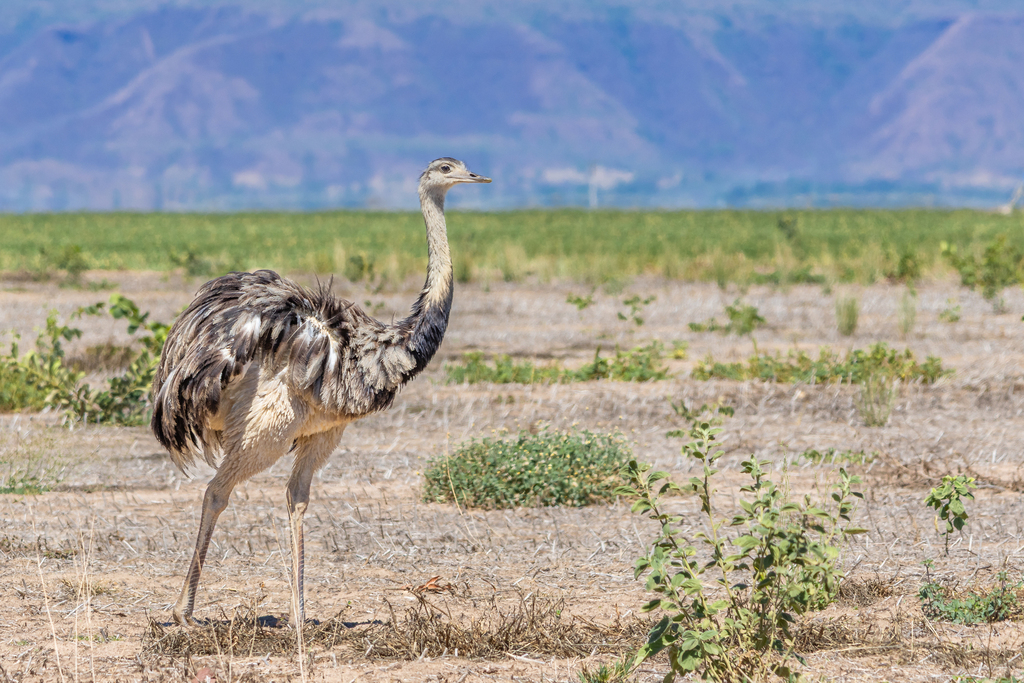
Greater Rhea
Photo © Francisco V. Bezerra Neto
Photo © Francisco V. Bezerra Neto — CC BY-SA 4.0 — Source: iNaturalist photo #585023818Identification
The greater rhea is the largest native bird in the Americas, an unmistakable flightless giant standing 1.4 to 1.7 metres tall, with some exceptional males reaching nearly 1.83 metres. Adults weigh 20–27 kilograms on average, though large males can exceed 35 kilograms. The bird's most striking features are its long, strong legs with three forward-facing toes, elongated neck, and relatively small head and bill. Males are noticeably larger and darker than females.
Plumage is fluffy and tattered-looking, typically grey or brown with considerable individual variation. The head, neck, rump, and thighs are fully feathered. Males display darker colouration overall, while females are lighter. Interestingly, leucistic individuals with white plumage and blue eyes, as well as albinos, occur in the wild, particularly in Argentina. Young birds are grey with dark lengthwise stripes. During courtship and running, the bird uses its rather long wings to maintain balance during tight turns.
Range & Habitat
The greater rhea is native to eastern South America, with populations across Argentina, Bolivia, Brazil, Paraguay, and Uruguay. The species inhabits a variety of open landscapes including grasslands dominated by satintail and bahiagrass, savanna, scrub forest, chaparral, and even desert and palustrine wetlands, though it favours areas with at least some tall vegetation. It is absent from humid tropical forests and typically prefers lower elevations, seldom exceeding 1,200 metres.
Remarkably, a feral population has established itself in Northern Germany since the 2000s. This population began when one male and five females escaped from a farm in Schleswig-Holstein in August 2000 and survived the winter in a sufficiently similar habitat. The population has grown substantially, reaching approximately 250 birds by late 2017, and these birds are now considered permanently settled in the Nordwestmecklenburg region.
Behaviour & Diet
The greater rhea is notable for its distinctive reproductive habits, which set it apart from many other bird species. During the breeding season in spring and summer, birds stay near water sources. The species is highly adapted to running, using its wings for balance during rapid turns and for elaborate courtship displays. In the wild, the greater rhea has a life expectancy of 10.5 years.
Best Time & Places to See It
For the best viewing opportunities, visit the grasslands, savannas, and open wetlands of Argentina, Bolivia, Brazil, Paraguay, or Uruguay where the species is native. The breeding season in spring and summer offers the best chance to observe birds near water, when they are most active and engaged in breeding behaviour. Birds prefer open areas with at least some tall vegetation rather than densely forested regions.
Photography Tips
The greater rhea's large size and preference for open habitats make it a rewarding subject for wildlife photographers. The bird's impressive height and long legs create striking compositional opportunities, especially when photographed against expansive grassland or savanna backdrops. Male birds' darker plumage contrasts well in bright conditions, while the variation in individual colouration—including the rare leucistic and albino individuals—offers unique photographic subjects. Capture the birds' distinctive running posture and wing movements during locomotion for dynamic images, and watch for their elaborate courtship displays during the breeding season.
Emas National Park
Brazil
+333 birds+23 mammals
Across the high plateaux of central Brazil, where the cerrado grasslands roll toward distant horizons under an immense sky, Emas National Park anchors one of South…
VIEW NATIONAL PARKSerra do Cipó National Park
Brazil
+379 birds+5 mammals
Where granite escarpments rise above the Atlantic Forest transition zone in southeastern Brazil, Serra do Cipó National Park unfolds across a landscape of dramatic ridges, cascading…
VIEW NATIONAL PARKPeixe National Park Lagoon
Brazil
+293 birds+4 mammals
Where the coastal plains of Rio Grande do Sul meet the Atlantic, Peixe National Park Lagoon sprawls across nearly 2,200 square kilometres of shallow waters, reed…
VIEW NATIONAL PARKChapada dos Guimarães National Park
Brazil
+450 birds+1 mammals
Where weathered sandstone plateaus rise above the cerrado grasslands of central Brazil, Chapada dos Guimarães National Park protects 624 square kilometres of ecological transition zone that…
VIEW NATIONAL PARKChapada dos Veadeiros National Park
Brazil
+324 birds+6 mammals
Where granite plateaus rise above the cerrado savanna in central Brazil, Chapada dos Veadeiros National Park unfolds across 6,665 square kilometres of some of the world's…
VIEW NATIONAL PARKPantanal Matogrossense National Park
Brazil
+322 birds+17 mammals
Where the flooded forests of central Brazil meet vast seasonally inundated grasslands, Pantanal Matogrossense National Park sprawls across nearly 2,900 square kilometers of one of the…
VIEW NATIONAL PARKBrasília National Park
Plano Piloto, Brazil
+338 birds+15 mammals
Cerrado grassland and scattered woodland sweep across the central Brazilian plateau where this national park sprawls across more than a thousand square kilometres of the Federal…
VIEW NATIONAL PARKEl Palmar National Park
Distrito Sexto, Argentina
+244 birds+14 mammals
Across the Paraná River floodplain in northeastern Argentina, palms rise from wetland and grassland in a landscape shaped by water and time. El Palmar National Park…
VIEW NATIONAL PARKCampos del Tuyú National Park
Argentina
+169 birds+5 mammals
Subtropical forest graces the borderlands where Misiones Province meets Paraguay, a landscape shaped by the Paraná Plateau's weathered topography and the warm, humid climate of northeastern…
VIEW NATIONAL PARKRío Pilcomayo National Park
Argentina
+271 birds+13 mammals
Where the Río Pilcomayo cuts through northeastern Argentina's subtropical lowlands, a sprawling mosaic of wetlands, grasslands, and seasonally flooded forests creates one of South America's most…
VIEW NATIONAL PARKEl Rey National Park
Municipio de Las Lajitas, Argentina
+317 birds+4 mammals
Where the eastern slopes of the Andes descend into northwestern Argentina's subtropical transition zone, El Rey National Park unfolds across 841 square kilometers of dramatically varied…
VIEW NATIONAL PARKSierra de las Quijadas National Park
Argentina
+168 birds+5 mammals
Sandstone cliffs and deeply incised canyons define this 1,137-square-kilometre expanse in San Luis Province, where the dry Chacoan landscape of central Argentina reveals an unexpected ecological…
VIEW NATIONAL PARKParque Provincial Pampa del Indio
Laguna Limpia, Argentina
+231 birds+4 mammals
Across the flat horizons of Chaco Province, where the Paraná River system spills into vast wetlands and grasslands, Parque Provincial Pampa del Indio protects one of…
VIEW NATURE RESERVEChaco National Park
Municipio de Presidencia de la Plaza, Argentina
+258 birds+7 mammals
Across the humid subtropical lowlands of northeastern Argentina, where the Paraná River basin feeds vast seasonal wetlands and gallery forests, Chaco National Park protects one of…
VIEW NATIONAL PARKNo community photos yet. Log in to add the first one.
No community observations of this species yet.