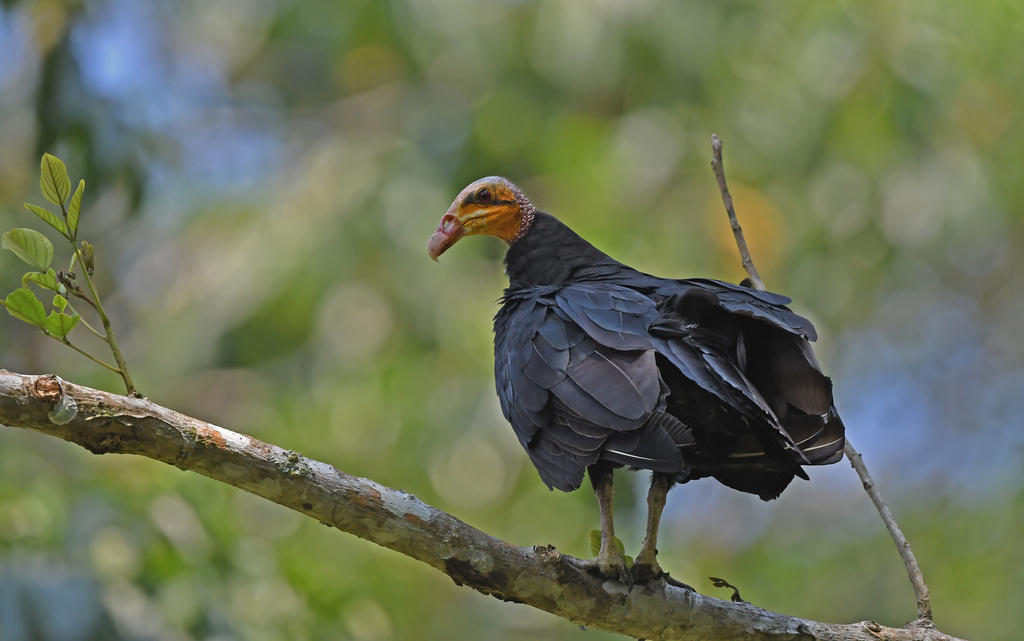
Greater Yellow-headed Vulture
Photo © Christoph Moning
Photo © Christoph Moning — CC BY 4.0 — Source: iNaturalist photo #332164545Identification
The greater yellow-headed vulture is a fairly large bird, measuring 64–75 centimetres in length with an impressive wingspan of 166–178 centimetres. Its most striking feature is its entirely black plumage with a distinctive green or purple sheen, contrasting sharply with its featherless head and neck, which range in color from deep yellow to pale orange with a blue crown. The nape and area near the nostrils are pale pinkish. Red-eyed and thick-beaked, this vulture has notably long primary feathers that appear white when viewed from above. The tail is rounded and relatively long for a vulture, extending to or slightly beyond the tip of the closed wing. Juveniles have a duller, greyish head but otherwise resemble adults.
When distinguishing this species from the similar lesser yellow-headed vulture, look for the greater bird's larger size, longer and broader tail, glosser black plumage, darker legs, and more intensely yellow head. The greater yellow-headed vulture also has broader wings and steadier flight, with relatively dark inner primaries that contrast with paler secondaries and outer primaries—a diagnostic feature of this species.
Range & Habitat
The greater yellow-headed vulture is found throughout the Amazon Basin of tropical South America, with a vast range spanning south-eastern Colombia, southern and eastern Venezuela, Guyana, French Guiana, Suriname, northern and western Brazil, northern Bolivia, eastern Peru, and eastern Ecuador. Its estimated global extent of occurrence covers 6,700,000 square kilometres. Notably, it is absent from the Andes, lowlands west or north of the mountains, relatively open regions of northern South America, eastern South America, and southern subtropical regions.
This species is strictly a bird of tropical moist lowland forests and is never found in high-altitude regions. It is common in heavily forested areas and may occasionally wander over grasslands, but it rarely strays far from forested regions, which provide essential shelter and nesting areas. The forest habitat is integral to its survival and distribution.
Behaviour & Diet
The greater yellow-headed vulture is a scavenger that feeds exclusively on carrion, locating carcasses through both sight and smell—a rare ability among birds. However, it is dependent on larger vultures, particularly the king vulture, to open the hides of large animal carcasses, as its own bill is not strong enough for this task. Like all New World vultures, it is a master of energy conservation, utilising thermals to remain aloft with minimal effort.
This vulture is notably quiet, lacking a syrinx and therefore unable to produce anything beyond grunts or low hisses. It lays its eggs on flat surfaces such as cave floors or in the hollows of tree stumps, and it feeds its young by regurgitation, a common practice among vultures.
Best Time & Places to See It
To observe the greater yellow-headed vulture, travel to the Amazon Basin, where it is common in heavily forested lowland regions. It can be found year-round throughout its range, which includes parts of Colombia, Venezuela, Guyana, Suriname, French Guiana, Brazil, Peru, Ecuador, and Bolivia. The bird's preference for pristine tropical moist lowland forests means that protected rainforest areas and national parks within these countries offer the best opportunities for sightings. Watch for it soaring above the forest canopy during the day, particularly in the morning when thermal activity begins.
Photography Tips
Photographing the greater yellow-headed vulture requires patience and binoculars, as it spends much of its time soaring high above the forest canopy. A telephoto lens of at least 400mm is essential for capturing details during flight. The most rewarding shots will show the bird's distinctive features: the bright yellow head against black plumage and the white quills visible on the upper side of the wings during flight. Early morning light is ideal for highlighting the colour contrasts on the head and the glossy sheen of its black plumage.
Since this vulture is dependent on thermals, plan your photography during warm daylight hours when thermals are strongest. Look skyward from clearings or river edges within forested areas where thermal activity is concentrated. Patience is essential, as sightings require scanning the sky systematically over extended periods. When the bird does come within range, its steady, broad-winged flight provides excellent opportunities for sharp photographs.
Yasuní National Park
Aguarico, Ecuador
+601 birds+43 mammals
Where the western Amazon basin converges with Ecuador's Orellana Province, lowland rainforest reaches toward the horizon in an unbroken canopy of staggering botanical density. Yasuní National…
VIEW NATIONAL PARKPodocarpus National Park
Zamora, Ecuador
+496 birds+6 mammals
Where the Andes descend toward the Amazon basin, Podocarpus National Park sprawls across nearly 2,800 square kilometres of the most biodiverse terrain in Ecuador's southern highlands.…
VIEW NATIONAL PARKLlanganates National Park
Tena, Ecuador
+239 birds+8 mammals
Where the eastern slopes of the Andes plunge toward the Amazon basin, Llanganates National Park sprawls across nearly 3,500 square kilometers of montane wilderness, its terrain…
VIEW NATIONAL PARKNatural Sierra de Chiribiquete National Park
Solano, Colombia
+359 birds+27 mammals
Massive table-top mountains rise abruptly from the lowland rainforest of southeastern Colombia, their sheer sandstone cliffs and isolated summits creating some of the most dramatic topography…
VIEW NATIONAL PARKNatural la Paya National Park
Puerto Leguízamo, Colombia
+262 birds+4 mammals
Where the Amazon's western reaches fold into the Andes foothills, La Paya National Park sprawls across more than 8,500 square kilometers of pristine Amazonian rainforest in…
VIEW NATIONAL PARKNatural Río Puré National Park
La Pedrera, Colombia
+40 birds+1 mammals
Where the Río Puré carves through northwestern Amazonia on the Colombia–Peru border, a landscape of flooded forests, terra firme ridges, and whitewater tributaries protects nearly 14,600…
VIEW NATIONAL PARKNatural Sierra de la Macarena National Park
Vista Hermosa, Colombia
+566 birds+15 mammals
Across nearly 20,000 square kilometres of Colombia's Meta Department, the terrain rises from lowland savanna into Andean foothills through a mosaic of gallery forests, palm-fringed wetlands,…
VIEW NATIONAL PARKAmacayacu National Park
Leticia, Colombia
+567 birds+25 mammals
Where the Rio Amazonas curves through the tri-border region where Colombia, Peru, and Brazil converge, Amacayacu National Park sprawls across more than 5,250 square kilometres of…
VIEW NATIONAL PARKViruá National Park
Brazil
+389 birds+6 mammals
Across the northern frontier of Roraima, where the forest canopy rises from ancient Amazonian lowlands, Viruá National Park protects nearly 3,700 square kilometres of terra firme…
VIEW NATIONAL PARKSerra do Pardo National Park
Brazil
+153 birds
Vast upland forests and weathered plateaus define this 7,129-square-kilometre protected expanse in the heart of Pará's remote interior, where ancient bedrock and swollen rivers have carved…
VIEW NATIONAL PARKMonte Roraima National Park
Brazil
+226 birds+1 mammals
Where the tepuis rise from the Amazon basin like islands in a sea of forest, Monte Roraima National Park sprawls across 3,714 square kilometres of one…
VIEW NATIONAL PARKChapada dos Guimarães National Park
Brazil
+450 birds+1 mammals
Where weathered sandstone plateaus rise above the cerrado grasslands of central Brazil, Chapada dos Guimarães National Park protects 624 square kilometres of ecological transition zone that…
VIEW NATIONAL PARKAmazônia National Park
Brazil
+439 birds+6 mammals
Where the Rio Amazonas and its tributaries weave through the heart of Pará state, a vast tapestry of rainforest stretches across 23,611 square kilometers of unbroken…
VIEW NATIONAL PARKMapinguari National Park
Brazil
+354 birds
Vast tracts of western Amazonian rainforest blanket the remote terrain of this 56,827 square kilometre national park in Amazonas state, where seasonal rivers wind through dense…
VIEW NATIONAL PARKJaú National Park
Brazil
+354 birds+3 mammals
Vast floodplain forests and blackwater rivers define this remote corner of western Amazonas, where the Rio Negro and its tributaries have carved an intricate mosaic of…
VIEW NATIONAL PARKPacaás Novos National Park
Brazil
+279 birds+1 mammals
Across the border between Rondônia and Amazonas, vast tracts of humid tropical forest rise and fall in gentle undulations, carved by clear-flowing rivers that feed into…
VIEW NATIONAL PARKAnavilhanas National Park
Brazil
+468 birds+8 mammals
Across the Rio Negro in central Amazonas, an archipelago of over a thousand islands rises from the world's largest rainforest river system, creating a labyrinth of…
VIEW NATIONAL PARKCampos Amazónicos National Park
Amazonas, Brazil
+434 birds+7 mammals
Sprawling across the southwestern Amazon basin in Amazonas state, this 27,263-square-kilometre national park encompasses some of the region's most pristine lowland rainforest, where terra firme forest…
VIEW NATIONAL PARKSerra do Divisor National Park
Brazil
+448 birds+10 mammals
Where the western Amazon meets the Andes foothills, Serra do Divisor National Park sprawls across one of South America's most biodiverse and least accessible frontiers. Spanning…
VIEW NATIONAL PARKPico da Neblina National Park
Brazil
+103 birds
Where the Amazon's western rampart rises into perpetual mist, Pico da Neblina National Park sprawls across more than 33,000 square kilometres of some of Earth's least…
VIEW NATIONAL PARKOtishi National Park
Río Tambo, Peru
+108 birds
Where the Andes descend toward the Amazon basin, vast cloud forests cloak the ridges and valleys of Peru's Río Tambo watershed, and this is where Otishi…
VIEW NATIONAL PARKYanachaga–chemillén National Park
Palcazu, Peru
+639 birds+6 mammals
Where the eastern slopes of Peru's central cordillera plunge into cloud forest, Yanachaga–Chemillén National Park protects nearly three thousand square kilometres of montane wilderness that few…
VIEW NATIONAL PARKManu National Park
Manu, Peru
+892 birds+26 mammals
Across the eastern slopes of the Peruvian Andes, tropical rainforest descends into the Amazon basin with a complexity that few terrestrial ecosystems match. Manu National Park…
VIEW NATIONAL PARKSierra del Divisor National Park
Alto Tapiche, Peru
+298 birds+2 mammals
Where the western Amazon meets the Andes foothills, nearly 41,000 square kilometres of pristine rainforest rise across Peru's Alto Tapiche region in a landscape of extraordinary…
VIEW NATIONAL PARKBahuaja Sonene National Park
San Pedro de Putina Punco, Peru
+602 birds+8 mammals
Where the Madre de Dios and Heath rivers converge in southeastern Peru rises one of South America's most biodiverse wilderness regions: a vast protected realm of…
VIEW NATIONAL PARKIchigkat Muja – Cordillera del Cóndor National Park
Río Santiago, Peru
+101 birds
Where the Andes descend into the western Amazon, the Río Santiago carves through a landscape of profound biological complexity. Ichigkat Muja – Cordillera del Cóndor National…
VIEW NATIONAL PARKTingo Maria National Park
Mariano Dámaso Beraún, Peru
+423 birds
Where the eastern slopes of the Peruvian Andes descend toward the Amazon basin, the landscape fractures into a maze of limestone ridges, humid gorges, and cloud-wrapped…
VIEW NATIONAL PARKNo community photos yet. Log in to add the first one.
No community observations of this species yet.