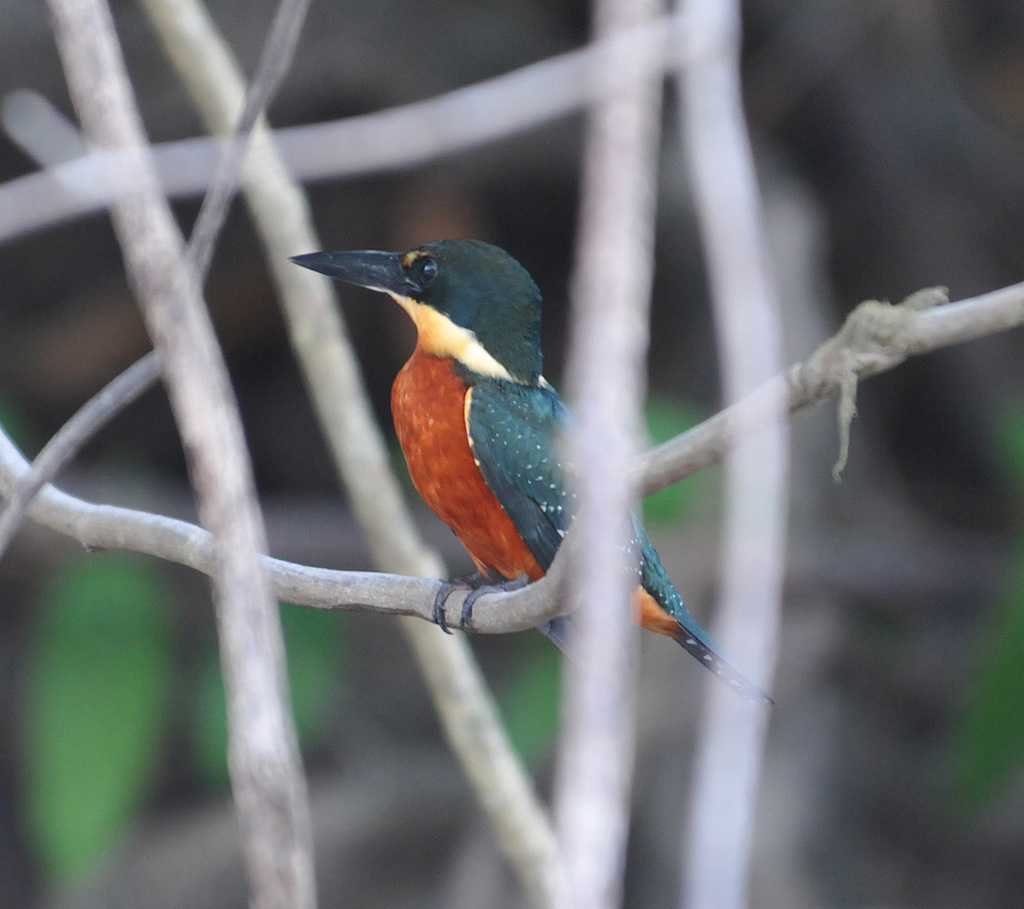
Green-and-rufous Kingfisher
Photo © Todd Boland
Photo © Todd Boland — CC BY 4.0 — Source: iNaturalist #20538556Identification
The green-and-rufous kingfisher is a medium-sized kingfisher, about 24 cm (9.4 in) long, with the characteristic compact body shape and substantial bill typical of its family. Males weigh 40 to 60 g, while females are slightly heavier at 53 to 62 g. The species displays a somewhat shaggy crest and a long, heavy bill that is black with pale yellow at its base. Legs and feet range from pinkish to dark gray.
Males feature glossy green upperparts with a pale yellowish collar, white-tipped upperwing coverts, and small white spots on the secondaries, tertials, and tail. The chin is yellow-buff, the throat buffy rufous, and the underparts are a rich dark rufous. Females are similar but sport a distinctive wide band of green with white speckles across the upper breast and more pale spotting on the upperparts. Juveniles resemble females with even heavier spotting and a green breastband in both sexes, though the male's band is notably thinner.
Range & Habitat
The green-and-rufous kingfisher ranges throughout the American tropics from southeastern Nicaragua through Central America and across the Caribbean slopes of Costa Rica and Panama. Its range extends through Colombia, Venezuela, and the Guianas into eastern Brazil, and southward through most of Amazonian Brazil, Ecuador, Peru, Bolivia, and Paraguay. A separate population occurs along the southeastern Brazilian coast from Bahia to Santa Catarina. The species is absent from Argentina, Chile, and Uruguay.
This kingfisher is a specialist of densely vegetated waterways, inhabiting streams, rivers, forested swamps, and mangroves where it favors heavily vegetated banks. It actively avoids open shorelines and ranges from sea level up to 400 m (1,300 ft) in elevation. The species is believed to be sedentary but disperses locally into flooded forests when water levels rise.
Behaviour & Diet
The green-and-rufous kingfisher hunts by perching low over water, favoring shaded spots rather than exposed positions. Unlike some kingfisher species, it does not hover while hunting but instead dives directly from its perch to capture prey. Its diet comprises small fish from families including Characidae, Cichlidae, and Cyprinodontidae, as well as crabs, shrimp, and aquatic insects.
Breeding seasons vary geographically, spanning July to November in northern Brazil and extending into February in Panama. The species excavates tunnel nests in earthen stream and river banks, laying clutches of three to five eggs, though incubation and fledging periods remain undocumented. Vocally, it produces thin, high-pitched "week week week" songs alongside various calls including "chip-chip-chip," a hard rolling "drrrt," a crackling "trit-trit-trit," and a distinctive twitter followed by rapidly repeated low "too-too-too-too" notes.
Best Time & Places to See It
The green-and-rufous kingfisher can be found year-round throughout its range, though breeding activity peaks in specific seasons depending on location. Northern Brazil offers the most reliable viewing opportunities from July to November, while Panama provides possibilities in the breeding season extending into February. The species is most easily encountered during the wet season when flooded forests create abundant foraging habitat.
Target densely vegetated streams and rivers with good vegetative cover along their banks; the kingfisher will avoid exposed, open shorelines. Early mornings and late afternoons, when the bird is most active, offer the best viewing chances. Patience and quiet observation near suitable waterways in Central and South American tropical regions will reward attentive birdwatchers and nature travelers.
Photography Tips
Photograph the green-and-rufous kingfisher from a low angle, positioning yourself below the bird's typical perch height to capture its characteristic hunting posture. The species' preference for shaded perches means you will need fast film speeds or high ISO settings to compensate for low light conditions in forested stream environments. Early morning light filtering through forest canopy provides excellent opportunities for capturing the glossy green plumage and rich rufous underparts.
Use a telephoto lens to maintain distance and avoid disturbing the bird from its hunting perch. Focus on capturing the diagnostic field marks: the pale yellowish collar on males, the white spots on flight feathers, and in females, the distinctive green breastband with white speckles. The bird's shaggy crest and heavy bill profile make excellent portrait subjects when perched between feeding dives.
Tortuguero National Park
Roxana, Costa Rica
+420 birds+23 mammals
Canals and lagoons thread through a labyrinth of lowland rainforest where the Caribbean coast of Costa Rica meets the wetland frontier. This is terrain shaped by…
VIEW NATIONAL PARKYasuní National Park
Aguarico, Ecuador
+601 birds+43 mammals
Where the western Amazon basin converges with Ecuador's Orellana Province, lowland rainforest reaches toward the horizon in an unbroken canopy of staggering botanical density. Yasuní National…
VIEW NATIONAL PARKNatural Sierra de Chiribiquete National Park
Solano, Colombia
+359 birds+27 mammals
Massive table-top mountains rise abruptly from the lowland rainforest of southeastern Colombia, their sheer sandstone cliffs and isolated summits creating some of the most dramatic topography…
VIEW NATIONAL PARKNatural Utría National Park
Alto Baudó (Pie de Pató), Colombia
+372 birds+11 mammals
Where the Chocó's coastal mountains plunge toward the Pacific, Utría National Park preserves one of Colombia's most biodiverse and least-visited wilderness expanses. Sprawling across 1,287 square…
VIEW NATIONAL PARKNatural la Paya National Park
Puerto Leguízamo, Colombia
+262 birds+4 mammals
Where the Amazon's western reaches fold into the Andes foothills, La Paya National Park sprawls across more than 8,500 square kilometers of pristine Amazonian rainforest in…
VIEW NATIONAL PARKNatural Farallones de Cali National Park
Buenaventura, Colombia
+733 birds+27 mammals
Where the Pacific coastal plain meets the western slopes of the Andes, Farallones de Cali National Park sprawls across nearly 3,500 square kilometers of dramatic topography…
VIEW NATIONAL PARKNatural Uramba Bahía Málaga National Park
Buenaventura, Colombia
+308 birds+15 mammals
Where the Pacific coastal rainforest descends to mangrove estuaries and rocky headlands, Uramba Bahía Málaga National Park unfolds across nearly 1,000 square kilometres of Colombia's Valle…
VIEW NATIONAL PARKNatural Sierra de la Macarena National Park
Vista Hermosa, Colombia
+566 birds+15 mammals
Across nearly 20,000 square kilometres of Colombia's Meta Department, the terrain rises from lowland savanna into Andean foothills through a mosaic of gallery forests, palm-fringed wetlands,…
VIEW NATIONAL PARKAmacayacu National Park
Leticia, Colombia
+567 birds+25 mammals
Where the Rio Amazonas curves through the tri-border region where Colombia, Peru, and Brazil converge, Amacayacu National Park sprawls across more than 5,250 square kilometres of…
VIEW NATIONAL PARKViruá National Park
Brazil
+389 birds+6 mammals
Across the northern frontier of Roraima, where the forest canopy rises from ancient Amazonian lowlands, Viruá National Park protects nearly 3,700 square kilometres of terra firme…
VIEW NATIONAL PARKChapada dos Guimarães National Park
Brazil
+450 birds+1 mammals
Where weathered sandstone plateaus rise above the cerrado grasslands of central Brazil, Chapada dos Guimarães National Park protects 624 square kilometres of ecological transition zone that…
VIEW NATIONAL PARKPantanal Matogrossense National Park
Brazil
+322 birds+17 mammals
Where the flooded forests of central Brazil meet vast seasonally inundated grasslands, Pantanal Matogrossense National Park sprawls across nearly 2,900 square kilometers of one of the…
VIEW NATIONAL PARKAmazônia National Park
Brazil
+439 birds+6 mammals
Where the Rio Amazonas and its tributaries weave through the heart of Pará state, a vast tapestry of rainforest stretches across 23,611 square kilometers of unbroken…
VIEW NATIONAL PARKMapinguari National Park
Brazil
+354 birds
Vast tracts of western Amazonian rainforest blanket the remote terrain of this 56,827 square kilometre national park in Amazonas state, where seasonal rivers wind through dense…
VIEW NATIONAL PARKJaú National Park
Brazil
+354 birds+3 mammals
Vast floodplain forests and blackwater rivers define this remote corner of western Amazonas, where the Rio Negro and its tributaries have carved an intricate mosaic of…
VIEW NATIONAL PARKAnavilhanas National Park
Brazil
+468 birds+8 mammals
Across the Rio Negro in central Amazonas, an archipelago of over a thousand islands rises from the world's largest rainforest river system, creating a labyrinth of…
VIEW NATIONAL PARKCampos Amazónicos National Park
Amazonas, Brazil
+434 birds+7 mammals
Sprawling across the southwestern Amazon basin in Amazonas state, this 27,263-square-kilometre national park encompasses some of the region's most pristine lowland rainforest, where terra firme forest…
VIEW NATIONAL PARKSerra do Divisor National Park
Brazil
+448 birds+10 mammals
Where the western Amazon meets the Andes foothills, Serra do Divisor National Park sprawls across one of South America's most biodiverse and least accessible frontiers. Spanning…
VIEW NATIONAL PARKManu National Park
Manu, Peru
+892 birds+26 mammals
Across the eastern slopes of the Peruvian Andes, tropical rainforest descends into the Amazon basin with a complexity that few terrestrial ecosystems match. Manu National Park…
VIEW NATIONAL PARKSierra del Divisor National Park
Alto Tapiche, Peru
+298 birds+2 mammals
Where the western Amazon meets the Andes foothills, nearly 41,000 square kilometres of pristine rainforest rise across Peru's Alto Tapiche region in a landscape of extraordinary…
VIEW NATIONAL PARKBahuaja Sonene National Park
San Pedro de Putina Punco, Peru
+602 birds+8 mammals
Where the Madre de Dios and Heath rivers converge in southeastern Peru rises one of South America's most biodiverse wilderness regions: a vast protected realm of…
VIEW NATIONAL PARKChagres National Park
Caimitillo, Panama
+486 birds+19 mammals
Where the Chagres River carves through the humid tropics of central Panama, a vast montane and lowland forest sprawls across more than 2,300 square kilometers, anchoring…
VIEW NATIONAL PARKDarién National Park
Tucutí, Panama
+534 birds+13 mammals
Where the spine of Central America crumbles into wetland and rainforest, Darién National Park sprawls across more than 20,000 square kilometres of some of the tropics'…
VIEW NATIONAL PARKCahuita National Park
Talamanca, Costa Rica
+359 birds+15 mammals
Where the Caribbean shoreline dissolves into mangrove creeks and coral gardens, Cahuita's mosaic of habitats unfolds across the Limón coast. The park's signature feature—a living coral…
VIEW NATIONAL PARKLa Amistad International Park
Crorina, Costa Rica
+532 birds+20 mammals
Where the Caribbean slopes of Costa Rica's Talamanca Mountains rise steeply inland from Limón, the boundary between two nations dissolves into an unbroken expanse of rainforest.…
VIEW NATIONAL PARKCaño Negro National Wildlife Refuge
Caño Negro District, Costa Rica
+486 birds+16 mammals
Where the San Juan River's seasonal floodplain opens into expansive wetlands, Caño Negro Wildlife Sanctuary sprawls across one of Central America's most productive freshwater ecosystems. This…
VIEW WILDLIFE SANCTUARYGandoca-Manzanillo National Wildlife Refuge
Manzanillo, Costa Rica
+394 birds+18 mammals
Where the Caribbean coastal plain surrenders to water-logged forest and mangrove tangles, Gandoca-Manzanillo Wildlife Sanctuary shelters one of Costa Rica's most biodiverse lowland wetland ecosystems. The…
VIEW WILDLIFE SANCTUARYBarra del Colorado National Wildlife Refuge
Tortuguero, Costa Rica
+462 birds+36 mammals
Where the Caribbean's restless waters meet the Limón Province coastline, Barra del Colorado National Wildlife Sanctuary unfolds across a landscape of extraordinary ecological complexity. This equatorial…
VIEW WILDLIFE SANCTUARYNo community photos yet. Log in to add the first one.
No community observations of this species yet.