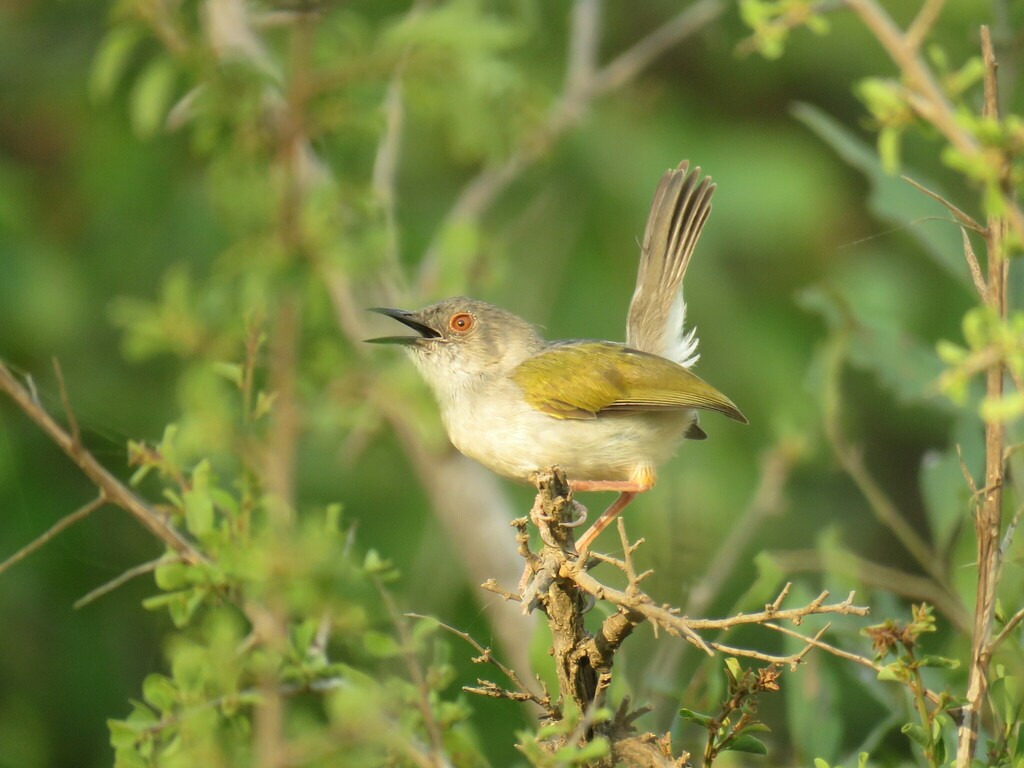
Green-backed Camaroptera
Photo © Christiaan Viljoen
Photo © Christiaan Viljoen — CC BY 4.0 — Source: iNaturalist photo #348850681Identification
The green-backed camaroptera is a small warbler, measuring just 11.5 cm in length. As its name suggests, it is distinguished by green upperparts, while the wings are olive and the underparts whitish grey. The sexes are similar in appearance, making field identification straightforward for birders. Juveniles can be distinguished from adults by their paler yellow breast coloration.
Range & Habitat
This species is a resident breeder found across Africa south of the Sahara Desert, with five recognized subspecies distributed throughout eastern and southern Africa, from southeast Kenya south to South Africa. The green-backed camaroptera is a skulking bird that typically remains low in dense cover, where it is often heard before it is seen. It favours bushes and thick vegetation where it can forage and nest under shelter.
Behaviour & Diet
The green-backed camaroptera is insectivorous, feeding on small invertebrates found within dense vegetation. It is a skulking species that stays close to cover, making observation challenging for wildlife watchers. The bird has a distinctive breeding behaviour: it binds large leaves together low in a bush and constructs a grass nest within this sheltered pocket of foliage. A normal clutch consists of two or three eggs, typical of small warblers in this family.
Best Time & Places to See It
As a resident breeder throughout its range, the green-backed camaroptera is present year-round in suitable habitat across eastern and southern Africa. The species occurs from southeast Kenya and Tanzania in the north, through Malawi and Zambia, to Zimbabwe, Mozambique, and South Africa in the south. Your best chance of encountering this elusive bird is to search dense, low vegetation in woodland and bush habitats, where patience and a keen ear will reward you with sightings or at least audio confirmation of its presence.
Photography Tips
Photographing the green-backed camaroptera presents a genuine challenge due to its skulking nature and preference for dense cover. Success requires patience and a willingness to spend time quietly observing likely habitat. Early morning often yields the best results, when the bird may be more active. Since this species stays low in thick vegetation, a telephoto lens combined with fast shutter speeds will help you capture clear images despite the dim lighting conditions typical of dense bush. Listen for the bird's calls to locate it, then position yourself carefully to avoid disturbing it while waiting for photographic opportunities.
Bwindi Impenetrable National Park
Mabamba Swamp
Murchison Falls National Park
Aberdare National Park
Abijata-Shalla Lakes National Park
Addo Elephant National Park
Amboseli National Park
Arabuko Sokoke Forest Reserve
Arusha National Park
Nothing matches these filters.
No community photos yet. Log in to add the first one.
No community observations of this species yet.