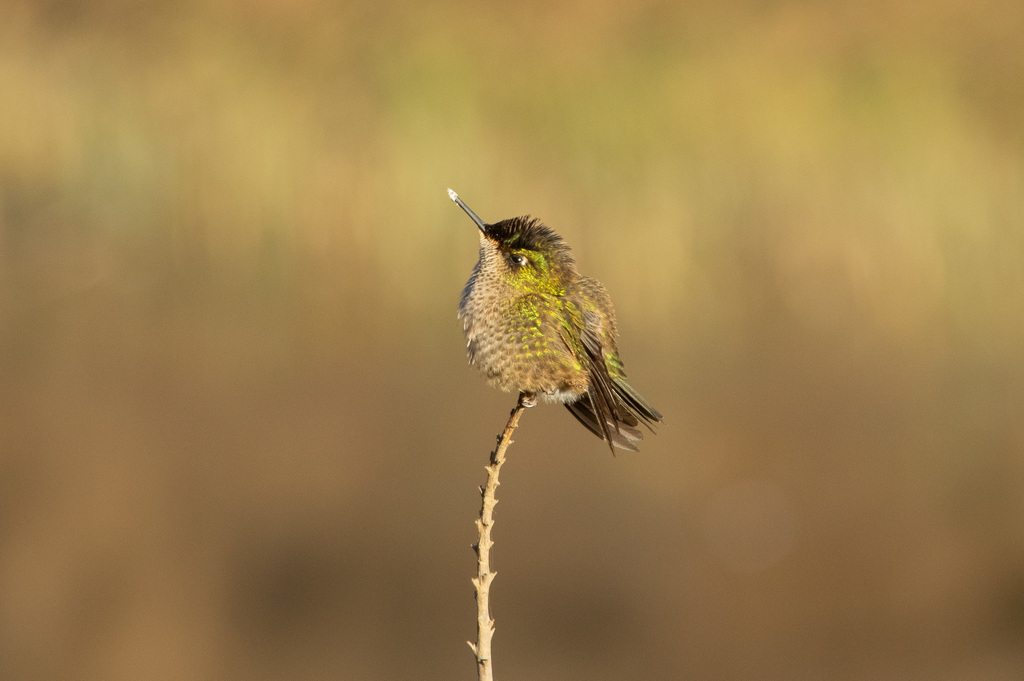
Green-backed Firecrown
Photo © Jorge Herreros de Lartundo
Photo © Jorge Herreros de Lartundo — CC BY 4.0 — Source: iNaturalist photo #145690864Identification
The green-backed firecrown is a tiny hummingbird measuring 10 to 10.5 cm in length, with males weighing about 5.5 g and females slightly less at 5 g. Both sexes display bronzy-green upperparts, slaty-green wings and tail, and pale buff underparts with black and green spotting. The most distinctive feature is the adult male's iridescent red-yellow crown, which gives the species its name. Females are smaller with notably longer bills than males. Juveniles of both sexes are harder to sex, showing rusty feather edges on the head and cinnamon-toned underparts.
Range & Habitat
This species is found across a vast range in southern South America, inhabiting Chile from south of the Atacama Region to the southern tip of the continent, adjoining areas of southern Argentina, and eastward across central Argentina to the Atlantic coast. An isolated population exists on Robinson Crusoe and Alejandro Selkirk Islands in the Juan Fernández group, approximately 770 km offshore. The green-backed firecrown favours forest edges, eucalyptus plantations, clearings, thickets, and gardens, ranging from sea level to above 2,000 m elevation. It plays an important pollinator role in temperate rainforest regions.
Behaviour & Diet
The species exhibits complex migratory patterns: mainland populations are largely resident in the Chilean matorral and breed from Los Lagos to the southern tip, but winter in the lowlands of central Argentina as far east as the Atlantic coast. The Juan Fernández population is sedentary. Green-backed firecrests feed on nectar from native and introduced flowers, particularly favouring Abutilon, Embothrium, and Fuchsia genera, and unusually, sometimes perch to feed rather than hover. They demonstrate remarkable cognitive abilities, recalling not only flower locations but also which flowers offer the most rewarding nectar. Intensely territorial, they have been observed chasing birds as large as caracaras. Their typical song comprises high-pitched notes interspersed with gravelly trills and squeaky notes.
Best Time & Places to See It
The breeding season on mainland Chile and Argentina runs from September to November, with sightings most likely in suitable habitat during these months. The Juan Fernández population breeds slightly later, through December. Look for this species in gardens, parks, forest edges, and flowering areas throughout its range in southern Chile and Argentina. It is locally common and adapts well to human-altered landscapes, making city parks and cultivated gardens reliable locations. The Juan Fernández Islands support an isolated population of approximately 5,000 birds.
Photography Tips
The firecrown's small size and rapid movement present significant challenges. Fast shutter speeds (1/2000 second or faster) are essential to freeze wing beats and capture sharp images. Position yourself near flowering plants, particularly fuchsias and other favoured nectar sources, and wait for birds to approach. The male's iridescent red-yellow crown is best photographed with side or backlighting to reveal its brilliance. Early morning and late afternoon light will enhance the metallic plumage. The bird's territorial nature means it will return to the same feeding areas repeatedly, allowing for patient observation and multiple shooting opportunities.
Alerce Costero National Park
Archipiélago Juan Fernández National Park
Cabo de Hornos National Park
Cerro Castillo National Park
Chiloé National Park
Corcovado National Park
Lago Puelo National Park
Laja National Park Lagoon
Lanín National Park
Nothing matches these filters.
No community photos yet. Log in to add the first one.
No community observations of this species yet.