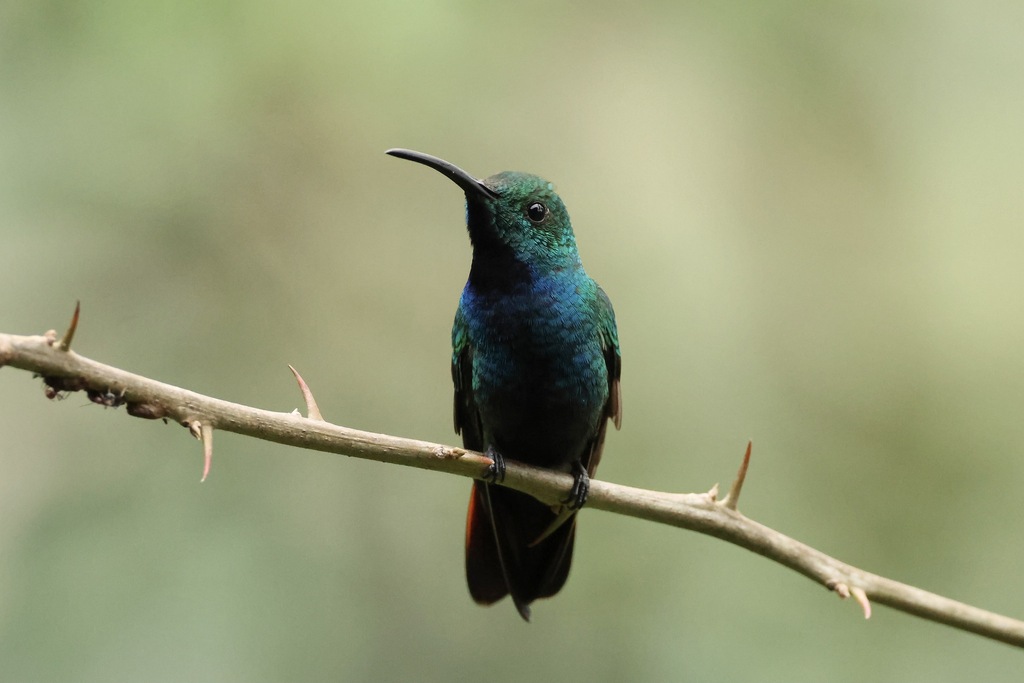
Green-breasted Mango
CC BY 4.0
CC BY 4.0 — Source: iNaturalist photo #265846178Identification
The green-breasted mango is a small hummingbird measuring 10.3 to 12.1 cm long and weighing 5.7 to 7.0 g. Both sexes sport a slightly decurved dull black bill. Adult males of the nominate subspecies display a striking metallic bronze-green crown, nape, and upperparts, with a velvety black stripe running down the chin, throat, and chest bordered by metallic bluish-green. Their tail feathers show purple tones with a metallic gloss on the outer pairs, while their wings are dusky brownish-slate. Females are similar but less bronzy overall, with blue-black outer tail feathers tipped in white and a distinctive white border to their throat stripe. Juveniles resemble females but feature white on the chin, throat, and breast center with some chestnut markings.
Four subspecies exist, each with subtle variations. Subspecies gracilirostris has a shorter, thinner bill and a wider, more bluish-black underside stripe. Hendersoni also features a shorter bill and an ashy-tinged crown. Viridicordatus stands out with bright grass-green upperparts and darker undertail coverts. These distinctions allow experienced birders to identify subspecies in the field.
Range & Habitat
The green-breasted mango ranges from eastern Mexico south through most of Central America, including Colombia and Venezuela. The nominate subspecies occurs from San Luis Potosí and southern Tamaulipas in Mexico through Guatemala, Belize, and El Salvador. Subspecies gracilirostris spans from El Salvador through Honduras, Nicaragua, and Costa Rica into northwestern Panama. The species also occurs on the Caribbean islands of Providencia and San Andrés, and in the coastal regions of Colombia and Venezuela. Vagrants occasionally reach the United States, with at least 25 records in Texas since 1988, and occasional sightings as far north as Wisconsin, North Carolina, Georgia, and Louisiana.
These hummingbirds favor lowland tropical landscapes, typically from sea level to 500 m elevation, though they locally occur as high as 1,100 m in Central America. They inhabit semi-open to open environments including shrublands, savanna, secondary and gallery forests, mangroves, and forest edges. The species readily adapts to cultivated areas, parks, gardens, and suburban and urban settings, making them accessible to nature travelers in populated regions.
Behaviour & Diet
The green-breasted mango forages for nectar and arthropods at all vegetation levels, from understory to canopy. It feeds on nectar from a diverse array of flowering trees, vines, bromeliads, shrubs, and herbaceous plants, and readily visits sugar-water feeders. The species shows no apparent preference for flowers of particular colors, taking nectar while hovering. It supplements its diet by hawking insects and spiders from perches and gleaning prey from vegetation and spider webs.
Breeding seasons vary geographically: March to June on the northern Caribbean slope, October to February in El Salvador, and year-round further south. The female constructs a delicate cup nest from soft plant fibers, tree bark, and lichens, typically bound together with spider silk and sometimes lined with feathers. Nests are usually placed on bare horizontal branches up to 30 m high, though females occasionally use human-made structures like wires, fences, and antennas. Clutches contain two eggs, which the female incubates and broods alone. The species often raises two broods annually. The green-breasted mango is not highly vocal, producing a buzzy, repetitive song and various calls.
Best Time & Places to See It
This species is easiest to observe in open and semi-open habitats where flowering plants are abundant. Gardens, parks, and suburban areas with flowering shrubs and feeders attract them regularly. The northern populations migrate seasonally between September and February, so timing your visit to match local breeding seasons will increase sightings. In the northern Caribbean slope, visit between March and June; in El Salvador, October through February offers the best opportunities. Further south in Central America, the species nests year-round, providing consistent viewing opportunities throughout the year.
Look for this mango in lowland regions from sea level to 500 m elevation, particularly in Mexico, Central America, Colombia, and Venezuela. Sugar-water feeders in gardens and parks are reliable locations, especially in cultivated and urban areas. Early morning visits when flowering plants and insect activity peak will maximize your chances of encountering this jewel.
Photography Tips
Photograph the green-breasted mango at flowers and feeders where you can anticipate their arrival and positioning. The males' metallic bronze-green plumage and striking black-and-green throat patches photograph beautifully with strong directional light that emphasizes their iridescence. Position yourself to capture the distinctive tail patterns, which differ markedly between sexes—males show purple-glossed outer feathers while females display blue-black feathers with white tips.
Since this species forages at all vegetation levels and frequents feeders, you have ample opportunities to compose varied shots. Early morning light will best reveal the metallic colors characteristic of both sexes. The species' relatively small size and rapid movements demand fast shutter speeds and careful focus techniques. Patient observation at flowering plants and feeders will reward you with portraits showcasing this hummingbird's vibrant plumage and acrobatic hovering abilities.
Manuel Antonio National Park
Quepos, Costa Rica
+426 birds+22 mammals
Where tropical rainforest descends steeply to a rocky Pacific coastline, Manuel Antonio National Park distills Central American biodiversity into one of Costa Rica's most compressed and…
VIEW NATIONAL PARKArenal Volcano National Park
Peñas Blancas, Costa Rica
+551 birds+21 mammals
Straddling the border between Alajuela and Guanacaste in northwestern Costa Rica, this national park rises dramatically around one of Central America's most active volcanic systems. The…
VIEW NATIONAL PARKTortuguero National Park
Roxana, Costa Rica
+420 birds+23 mammals
Canals and lagoons thread through a labyrinth of lowland rainforest where the Caribbean coast of Costa Rica meets the wetland frontier. This is terrain shaped by…
VIEW NATIONAL PARKBraulio Carrillo National Park
Las Horquetas, Costa Rica
+547 birds+18 mammals
Where the Caribbean slope descends from the central volcanic cordillera toward the humid lowlands of Heredia, Braulio Carrillo National Park preserves one of Costa Rica's most…
VIEW NATIONAL PARKSanta Rosa National Park
Santa Elena, Costa Rica
+359 birds+30 mammals
Where Pacific-facing slopes descend from volcanic uplands toward the Guanacaste lowlands, Santa Rosa National Park unfolds across a mosaic of tropical dry forest, gallery woodland, and…
VIEW NATIONAL PARKGuanacaste National Park
Santa Elena, Costa Rica
+461 birds+17 mammals
Where the Pacific slopes of northwestern Costa Rica rise toward the Continental Divide, dry tropical forest gives way to cloud-laden peaks and misty ridges—a landscape that…
VIEW NATIONAL PARKDzibilchantún National Park
Barcelona, Mexico
+144 birds+2 mammals
Across the limestone plains of Yucatán, where cenotes pierce the bedrock and tropical forest clings to shallow soils, lies Dzibilchantún—a modest yet ecologically vital national park…
VIEW NATIONAL PARKLagunas de Montebello National Park
Laguna de Montebello, Mexico
+360 birds+2 mammals
Where turquoise lagoons pierce the limestone plateau of southeastern Chiapas, the Lagunas de Montebello National Park unfolds across roughly 174 square kilometers of spectral water and…
VIEW NATIONAL PARKArrecifes de Cozumel National Park
San Miguel de Cozumel, Mexico
+112 birds+4 mammals
Beneath the turquoise shallows of the western Caribbean, Arrecifes de Cozumel National Park protects a sprawling marine realm across 484 square kilometres off the Quintana Roo…
VIEW NATIONAL PARKSian Ka’an
Chunyaxché, Mexico
+350 birds+16 mammals
Where the Yucatán Peninsula dissolves into wetland and mangrove, a vast mosaic of forest, lagoon, and coastal margin creates one of Mexico's most biodiverse strongholds. Across…
VIEW BIOSPHERE RESERVEMontes Azules
Candelaria, Mexico
+395 birds+47 mammals
Where jungle-clad limestone plateaus plunge into canyon systems carved by the Usumacinta River, Mexico's most pristine rainforest reserve unfolds across the Lacandón region of Chiapas. Montes…
VIEW BIOSPHERE RESERVETikal National Park
Tikal, Guatemala
+399 birds+16 mammals
Dense rainforest canopy rises above the limestone plateau of Petén, where archaeological wonder and ecological richness merge seamlessly across one of Central America's most biodiverse landscapes.…
VIEW NATIONAL PARKLaguna del Tigre National Park
Petén, Guatemala
+399 birds+29 mammals
Where the Petén lowlands dissolve into wetland and forest, Laguna del Tigre National Park protects one of Guatemala's most ecologically vital landscapes. This sprawling reserve encompasses…
VIEW NATIONAL PARKSierra del Lacandón National Park
Petén, Guatemala
+348 birds+7 mammals
Where the Petén rainforest rises into limestone ridges and deep ravines, Sierra del Lacandón National Park protects one of Central America's most intact tropical wilderness zones.…
VIEW NATIONAL PARKCarara National Park
Tárcoles, Costa Rica
+397 birds+19 mammals
Where the Pacific coastal plain meets transitional forest, Carara National Park straddles one of Central America's most dynamic ecological boundaries. The park's landscape encompasses lowland deciduous…
VIEW NATIONAL PARKPalo Verde National Park
Bagaces, Costa Rica
+318 birds+24 mammals
Dry forest spreads across Palo Verde's low-lying terrain in northwestern Guanacaste, where seasonal rivers and lagoons etch through deciduous woodland that sheds its canopy each winter.…
VIEW NATIONAL PARKCahuita National Park
Talamanca, Costa Rica
+359 birds+15 mammals
Where the Caribbean shoreline dissolves into mangrove creeks and coral gardens, Cahuita's mosaic of habitats unfolds across the Limón coast. The park's signature feature—a living coral…
VIEW NATIONAL PARKRincón de la Vieja National Park
Liberia, Costa Rica
+451 birds+30 mammals
Where volcanic slopes rise abruptly from the Guanacaste lowlands, Rincón de la Vieja National Park sprawls across a landscape shaped by geothermal drama and seasonal extremes.…
VIEW NATIONAL PARKTapantí Macizo de la Muerte National Park
Orosi, Costa Rica
+503 birds+18 mammals
Where montane cloud forest rises steeply from the Orosi Valley, Tapantí Macizo de la Muerte National Park enfolds a landscape of perpetual moisture and emerald complexity.…
VIEW NATIONAL PARKLa Amistad International Park
Crorina, Costa Rica
+532 birds+20 mammals
Where the Caribbean slopes of Costa Rica's Talamanca Mountains rise steeply inland from Limón, the boundary between two nations dissolves into an unbroken expanse of rainforest.…
VIEW NATIONAL PARKBarbilla National Park
Chirripó, Costa Rica
+226 birds
Where the Caribbean slope of Costa Rica's eastern cordillera plunges into perpetual moisture, Barbilla National Park rises as one of Central America's most water-rich ecosystems. Fed…
VIEW NATIONAL PARKVolcán Tenorio National Park
Guatuso, Costa Rica
+480 birds+12 mammals
Where volcanic slopes rise through Costa Rica's northwestern borderlands, Volcán Tenorio National Park sprawls across terrain shaped by ancient lava flows and mineral-rich springs. The park's…
VIEW NATIONAL PARKMarino Ballena National Park
Bahía Ballena, Costa Rica
+336 birds+8 mammals
Where mangrove forests meet coral-fringed shorelines along Costa Rica's southern Pacific coast, Marino Ballena National Park encompasses a marine and terrestrial mosaic that ranks among Central…
VIEW NATIONAL PARKMarino Las Baulas National Park
Santa Cruz, Costa Rica
+246 birds+9 mammals
Where the Pacific meets a mosaic of dry forest and mangrove estuary, this coastal national park protects one of Central America's most dynamic wildlife theatres. The…
VIEW NATIONAL PARKCaño Negro National Wildlife Refuge
Caño Negro District, Costa Rica
+486 birds+16 mammals
Where the San Juan River's seasonal floodplain opens into expansive wetlands, Caño Negro Wildlife Sanctuary sprawls across one of Central America's most productive freshwater ecosystems. This…
VIEW WILDLIFE SANCTUARYGandoca-Manzanillo National Wildlife Refuge
Manzanillo, Costa Rica
+394 birds+18 mammals
Where the Caribbean coastal plain surrenders to water-logged forest and mangrove tangles, Gandoca-Manzanillo Wildlife Sanctuary shelters one of Costa Rica's most biodiverse lowland wetland ecosystems. The…
VIEW WILDLIFE SANCTUARYBarra del Colorado National Wildlife Refuge
Tortuguero, Costa Rica
+462 birds+36 mammals
Where the Caribbean's restless waters meet the Limón Province coastline, Barra del Colorado National Wildlife Sanctuary unfolds across a landscape of extraordinary ecological complexity. This equatorial…
VIEW WILDLIFE SANCTUARYCurú National Wildlife Refuge
Paquera, Costa Rica
+249 birds+8 mammals
Where the Pacific coast of Puntarenas dissolves into dry deciduous forest and mangrove fringe, Curú Wildlife Sanctuary holds one of Costa Rica's most ecologically vital yet…
VIEW WILDLIFE SANCTUARYNo community photos yet. Log in to add the first one.
No community observations of this species yet.