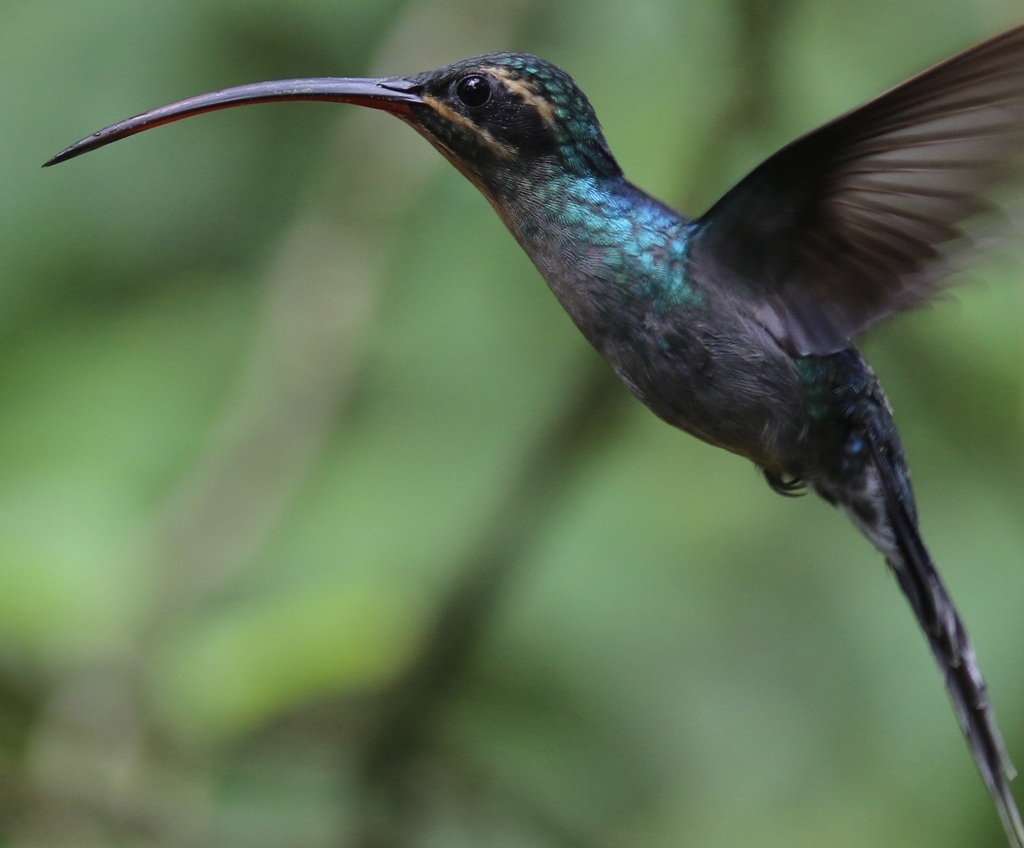
Green Hermit
Photo © Cricket Raspet
Photo © Cricket Raspet — CC BY 4.0 — Source: iNaturalist photo #402320796Identification
The Green Hermit is a large hummingbird measuring 13.5 cm in length and weighing 6.3 g. Males are predominantly dark green with a blue-green rump, distinctive dark mask through the eye bordered by buff stripes above, below, and down the centre of the throat. The long, decurved reddish bill and tapered tail with relatively short white-tipped central feathers are characteristic features. During courtship displays at leks, males wiggle their tail feathers while producing a repeated "swark" call. Females present a notably different appearance: sooty gray underparts, an even longer bill, and a considerably longer tail than males.
This species is vocal and easily identified by its loud "zurk" call, distinct from the males' lekking vocalizations. The pronounced sexual dimorphism—with females being duller and more heavily proportioned—helps separate them from other hermit species.
Range & Habitat
The Green Hermit is a resident breeder from southern Central America, including Costa Rica and Panama, southward through northern South America to north-eastern Venezuela, Trinidad, and the northern Andes of eastern Peru. Two subspecies are recognized: the nominate P. g. guy found in Venezuela and Trinidad, and the slightly smaller P. g. apicalis in the American Cordillera, where the sexes show greater similarity in plumage.
This species strongly favors primary rainforest and wet premontane forest undergrowth, typically near water sources and in hilly terrain. In the Colombian Cordillera Oriental, it occurs between 650–1,750 m elevation in forests with approximately 25 m canopy height, dominated by Elaeagia palms and similar vegetation with abundant undergrowth and epiphytes. While tolerant of some habitat modification such as subsistence farmland, it actively avoids secondary forest when primary habitat remains available.
Behaviour & Diet
The Green Hermit feeds exclusively on nectar supplemented with small insects, showing a marked preference for flowers measuring 30–50 mm in length and 2–7 mm in width, though it visits flowers ranging from 15 mm to 75 mm. At Monteverde, Costa Rica, favored food plants include yellow jacobinia, Razisea spicata, Pitcairnia brittoniana, spiral ginger, Drymonia species, Heliconia tortuosa, and Malvaviscus palmanus. Secondary food sources encompass various Gesneriaceae, Heliconiaceae, Acanthaceae, and other flowering families.
Males assemble at traditional leks for elaborate courtship displays, where they perform synchronized vocalizations and tail-wiggling displays. In the Colombian Cordillera Oriental, active leks occur distinctly between September and November, indicating a concentrated breeding season. The female lays a single egg in a conical nest suspended beneath a large leaf, typically positioned over water. Incubation lasts 17–18 days, with fledging occurring after 21–23 additional days.
Best Time & Places to See It
The Green Hermit is best observed during the breeding season from September through November in the Colombian Cordillera Oriental and other parts of its range. Primary rainforest and wet premontane forest undergrowth near water sources, particularly in hilly areas, offer the best opportunities for viewing. Monteverde in Costa Rica, mentioned frequently in ornithological literature, represents an accessible location for observing this species and studying its breeding ecology and floral preferences.
Early morning hours typically offer optimal viewing conditions when the bird is most active. Locating active lek sites significantly increases encounter probability, as males are most vocal and visible during their courtship assemblies.
Photography Tips
Capturing images of the Green Hermit requires patience and familiarity with its preferred habitats and behaviors. Position yourself near flowering plants known to attract this species, particularly those within the 30–50 mm length range. The male's distinctive dark mask and blue-green rump provide excellent diagnostic features for identification in photographs, while the female's sooty underparts and longer tail present contrasting subjects.
Lek sites offer predictable photography opportunities, as males return regularly to display perches. Early morning light illuminates the green plumage effectively, revealing the subtle iridescent qualities of the rump. A fast shutter speed is essential for capturing the rapid tail-wiggling displays and aerial courtship movements. The bird's preference for forest understory near water means photographers should be prepared for challenging low-light conditions typical of rainforest environments.
Guided Birding Tour
Corcovado National Park
Puerto Jiménez, Costa Rica
+444 birds+48 mammals
Where the Osa Peninsula juts into the Pacific, rainforest descends almost to the tide line, and Corcovado National Park protects one of Central America's most intact…
VIEW NATIONAL PARKManuel Antonio National Park
Quepos, Costa Rica
+426 birds+22 mammals
Where tropical rainforest descends steeply to a rocky Pacific coastline, Manuel Antonio National Park distills Central American biodiversity into one of Costa Rica's most compressed and…
VIEW NATIONAL PARKArenal Volcano National Park
Peñas Blancas, Costa Rica
+551 birds+21 mammals
Straddling the border between Alajuela and Guanacaste in northwestern Costa Rica, this national park rises dramatically around one of Central America's most active volcanic systems. The…
VIEW NATIONAL PARKChirripó National Park
Rivas, Costa Rica
+274 birds+6 mammals
Where the volcanic spine of Costa Rica's Central Cordillera reaches its apex, Chirripó National Park encompasses a landscape that shifts dramatically with elevation, from montane cloud…
VIEW NATIONAL PARKBraulio Carrillo National Park
Las Horquetas, Costa Rica
+547 birds+18 mammals
Where the Caribbean slope descends from the central volcanic cordillera toward the humid lowlands of Heredia, Braulio Carrillo National Park preserves one of Costa Rica's most…
VIEW NATIONAL PARKPiedras Blancas National Park
Golfito, Costa Rica
+386 birds+24 mammals
Where the Golfo Dulce meets the southwestern Pacific coast of Costa Rica, Piedras Blancas National Park protects a dramatic transition zone where lowland rainforest descends toward…
VIEW NATIONAL PARKGuanacaste National Park
Santa Elena, Costa Rica
+461 birds+17 mammals
Where the Pacific slopes of northwestern Costa Rica rise toward the Continental Divide, dry tropical forest gives way to cloud-laden peaks and misty ridges—a landscape that…
VIEW NATIONAL PARKVolcán Poás National Park
Toro Amarillo, Costa Rica
+237 birds+4 mammals
Where volcanic slopes rise sharply from the Central Valley floor, Volcán Poás National Park protects one of Costa Rica's most active and accessible volcanic systems. The…
VIEW NATIONAL PARKSangay National Park
Cebadas, Ecuador
+320 birds+10 mammals
High in Ecuador's Andean spine, where the Western Cordillera rises to touch perpetual snow, a landscape of volcanic drama and ecological intensity unfolds across Sangay National…
VIEW NATIONAL PARKPodocarpus National Park
Zamora, Ecuador
+496 birds+6 mammals
Where the Andes descend toward the Amazon basin, Podocarpus National Park sprawls across nearly 2,800 square kilometres of the most biodiverse terrain in Ecuador's southern highlands.…
VIEW NATIONAL PARKSumaco Napo-Galeras National Park
Loreto, Ecuador
+563 birds+4 mammals
Where Ecuador's Amazon transitions into cloud forest, a massive shield volcano rises from the emerald lowlands of Orellana Province, anchoring one of the continent's most biodiverse…
VIEW NATIONAL PARKAntisana National Park
Quijos, Ecuador
+432 birds+21 mammals
Where the eastern Andean slopes descend into the Amazon basin, Antisana National Park sprawls across roughly 2,500 square kilometers of some of South America's most dramatic…
VIEW NATIONAL PARKNatural Utría National Park
Alto Baudó (Pie de Pató), Colombia
+372 birds+11 mammals
Where the Chocó's coastal mountains plunge toward the Pacific, Utría National Park preserves one of Colombia's most biodiverse and least-visited wilderness expanses. Sprawling across 1,287 square…
VIEW NATIONAL PARKNatural Serranía de los Churumbelos National Park
Santa Rosa, Colombia
+70 birds+2 mammals
Where the western cordillera of Colombia rises toward the Pacific watershed, the Serranía de los Churumbelos unfolds across more than 3,200 square kilometers of some of…
VIEW NATIONAL PARKNatural Serranía de los Yariguíes National Park
El Carmen de Chucurí, Colombia
+320 birds+3 mammals
Where the northern cordilleras of Colombia rise toward cloud forest, the Serranía de los Yariguíes unfolds across nearly 1,820 square kilometers of some of the most…
VIEW NATIONAL PARKNatural Farallones de Cali National Park
Buenaventura, Colombia
+733 birds+27 mammals
Where the Pacific coastal plain meets the western slopes of the Andes, Farallones de Cali National Park sprawls across nearly 3,500 square kilometers of dramatic topography…
VIEW NATIONAL PARKGuácharos Cave National Natural Park
Acevedo, Colombia
+359 birds
High in the Andean foothills of southern Huila, where mist-laden slopes rise above 1,600 metres, lies a landscape carved by underground rivers and crowned by karst…
VIEW NATIONAL PARKNatural Sumapaz National Park
Cubarral, Colombia
+368 birds+1 mammals
Where the Andes descend toward the Amazon basin, the high páramo grasslands of Sumapaz National Park sprawl across more than five thousand square kilometers of Meta…
VIEW NATIONAL PARKEl Tamá National Park
Toledo, Colombia
+435 birds
Where the Andes descend toward the Caribbean coastal lowlands of northern Colombia, El Tamá National Park sprawls across nearly 3,800 square kilometres of montane forest, cloud…
VIEW NATIONAL PARKNatural Nevado del Huila National Park
Planadas, Colombia
+117 birds
Where the Colombian Andes rise above 5,000 metres, tropical cloud forest yields to páramo and glaciated peaks, and the Planadas region of Tolima contains one of…
VIEW NATIONAL PARKYanachaga–chemillén National Park
Palcazu, Peru
+639 birds+6 mammals
Where the eastern slopes of Peru's central cordillera plunge into cloud forest, Yanachaga–Chemillén National Park protects nearly three thousand square kilometres of montane wilderness that few…
VIEW NATIONAL PARKManu National Park
Manu, Peru
+892 birds+26 mammals
Across the eastern slopes of the Peruvian Andes, tropical rainforest descends into the Amazon basin with a complexity that few terrestrial ecosystems match. Manu National Park…
VIEW NATIONAL PARKTingo Maria National Park
Mariano Dámaso Beraún, Peru
+423 birds
Where the eastern slopes of the Peruvian Andes descend toward the Amazon basin, the landscape fractures into a maze of limestone ridges, humid gorges, and cloud-wrapped…
VIEW NATIONAL PARKCordillera Azul National Park
Pampa Hermosa, Peru
+322 birds+1 mammals
Where the eastern Andes descend into the western Amazon basin, Cordillera Azul National Park sprawls across nearly 38,000 square kilometres of some of Peru's most pristine…
VIEW NATIONAL PARKBaru Volcano National Park
Cerro Punta, Panama
+402 birds+6 mammals
Where the land rises sharply toward the Caribbean's western spine, Baru Volcano National Park sprawls across roughly 220 square kilometres of southwestern Panama, anchored by the…
VIEW NATIONAL PARKGeneral de División Omar Torrijos Herrera National Park
La Pintada, Panama
+401 birds+2 mammals
Across the highlands of central Panama, where the continental divide funnels moisture-laden trade winds into steep river valleys, the terrain rises and falls in a landscape…
VIEW NATIONAL PARKSoberanía National Park
Cristóbal, Panama
+495 birds+34 mammals
Rainforest and riverine woodland blanket the rolling terrain of this 714-square-kilometre national park in Colón Province, where the Caribbean watershed feeds a maze of streams and…
VIEW NATIONAL PARKChagres National Park
Caimitillo, Panama
+486 birds+19 mammals
Where the Chagres River carves through the humid tropics of central Panama, a vast montane and lowland forest sprawls across more than 2,300 square kilometers, anchoring…
VIEW NATIONAL PARKDarién National Park
Tucutí, Panama
+534 birds+13 mammals
Where the spine of Central America crumbles into wetland and rainforest, Darién National Park sprawls across more than 20,000 square kilometres of some of the tropics'…
VIEW NATIONAL PARKPortobelo National Park
Portobelo, Panama
+366 birds+9 mammals
Where the Caribbean's turquoise waters meet the Darién's verdant shore, Portobelo National Park sprawls across 570 square kilometers of coastal forest, mangrove wetland, and coral-fringed islands…
VIEW NATIONAL PARKParque Internacional la Amistad
Teribe, Panama
+325 birds+11 mammals
Where the continental divide rises between the Caribbean and Pacific watersheds, a wilderness of extraordinary biological richness unfolds across the Talamanca Range and into lowland rainforest—a…
VIEW NATIONAL PARKLos Quetzales National Park
Copey, Costa Rica
+232 birds+3 mammals
Cloud forest sweeps across the upper slopes of the Central Valley watershed, where elevation and persistent moisture forge an ecosystem unlike any other in Costa Rica.…
VIEW NATIONAL PARKCahuita National Park
Talamanca, Costa Rica
+359 birds+15 mammals
Where the Caribbean shoreline dissolves into mangrove creeks and coral gardens, Cahuita's mosaic of habitats unfolds across the Limón coast. The park's signature feature—a living coral…
VIEW NATIONAL PARKRincón de la Vieja National Park
Liberia, Costa Rica
+451 birds+30 mammals
Where volcanic slopes rise abruptly from the Guanacaste lowlands, Rincón de la Vieja National Park sprawls across a landscape shaped by geothermal drama and seasonal extremes.…
VIEW NATIONAL PARKTapantí Macizo de la Muerte National Park
Orosi, Costa Rica
+503 birds+18 mammals
Where montane cloud forest rises steeply from the Orosi Valley, Tapantí Macizo de la Muerte National Park enfolds a landscape of perpetual moisture and emerald complexity.…
VIEW NATIONAL PARKLa Amistad International Park
Crorina, Costa Rica
+532 birds+20 mammals
Where the Caribbean slopes of Costa Rica's Talamanca Mountains rise steeply inland from Limón, the boundary between two nations dissolves into an unbroken expanse of rainforest.…
VIEW NATIONAL PARKBarbilla National Park
Chirripó, Costa Rica
+226 birds
Where the Caribbean slope of Costa Rica's eastern cordillera plunges into perpetual moisture, Barbilla National Park rises as one of Central America's most water-rich ecosystems. Fed…
VIEW NATIONAL PARKVolcán Tenorio National Park
Guatuso, Costa Rica
+480 birds+12 mammals
Where volcanic slopes rise through Costa Rica's northwestern borderlands, Volcán Tenorio National Park sprawls across terrain shaped by ancient lava flows and mineral-rich springs. The park's…
VIEW NATIONAL PARKGandoca-Manzanillo National Wildlife Refuge
Manzanillo, Costa Rica
+394 birds+18 mammals
Where the Caribbean coastal plain surrenders to water-logged forest and mangrove tangles, Gandoca-Manzanillo Wildlife Sanctuary shelters one of Costa Rica's most biodiverse lowland wetland ecosystems. The…
VIEW WILDLIFE SANCTUARYBarra del Colorado National Wildlife Refuge
Tortuguero, Costa Rica
+462 birds+36 mammals
Where the Caribbean's restless waters meet the Limón Province coastline, Barra del Colorado National Wildlife Sanctuary unfolds across a landscape of extraordinary ecological complexity. This equatorial…
VIEW WILDLIFE SANCTUARYNo community photos yet. Log in to add the first one.
No community observations of this species yet.