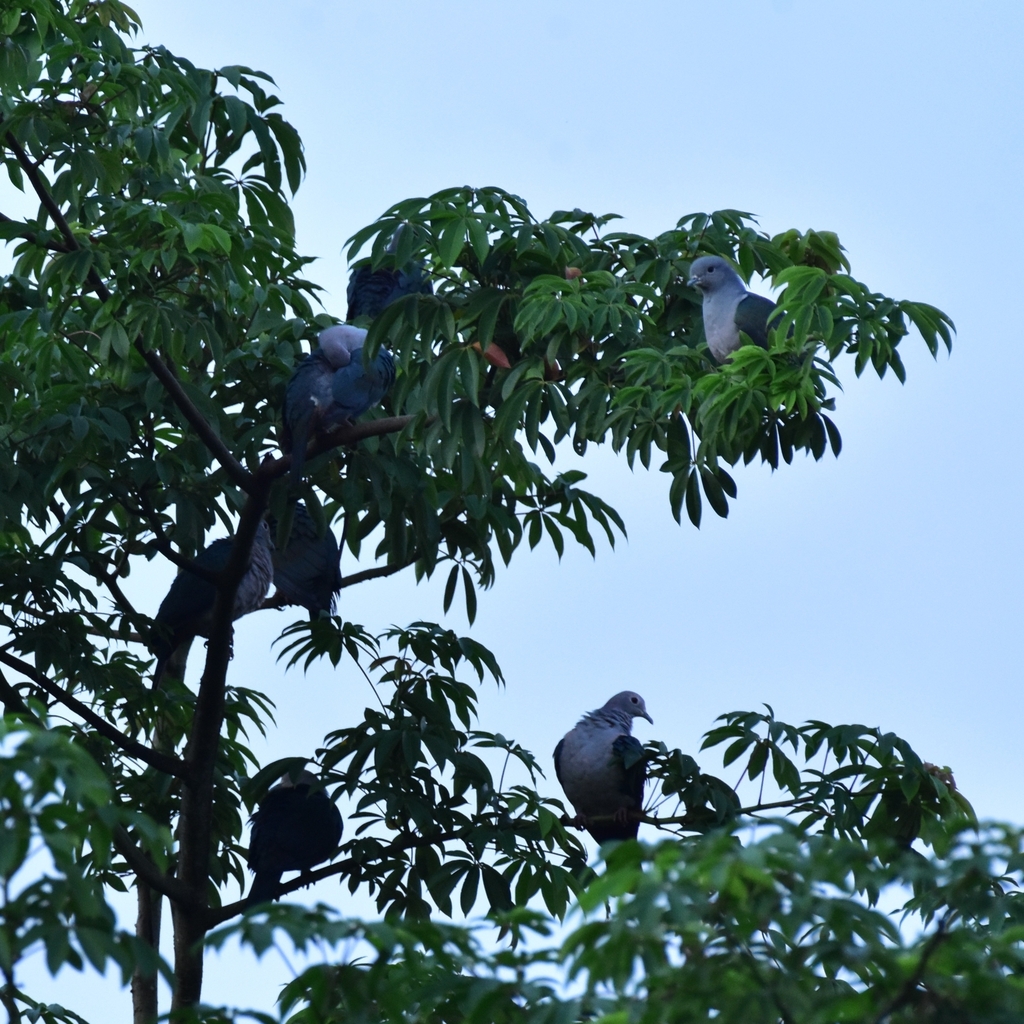
Green Imperial Pigeon
Photo © Renjith Jacob Mathews
Photo © Renjith Jacob Mathews — CC BY 4.0 — Source: iNaturalist #232938847Identification
The green imperial pigeon is a large, plump pigeon measuring 45 centimetres (18 inches) in length. Its most distinctive feature is the striking contrast between its metallic green back, wings, and tail, and its white head and underparts. A touch of maroon on the undertail coverts adds subtle colour variation. The sexes are similar in appearance, making identification straightforward. The bird's deep, resonant call is often the first clue to its presence, as this treetop species can be difficult to spot visually in the forest canopy.
Range & habitat
The green imperial pigeon has a large range extending from Nepal, southern India, and Sri Lanka eastwards to southern China, Indonesia, and the Philippines. Eleven recognized subspecies are distributed across this vast area, each adapted to their regional forests. The species is a widespread resident breeding bird in tropical southern Asia, showing particular diversity in the Indonesian archipelago, where subspecies such as the chestnut-naped imperial pigeon (found in Sulawesi and nearby islands) display distinctive regional variations.
As a forest specialist, this pigeon requires tropical woodland habitat. It is an arboreal species, spending most of its time in the tree canopy where it feeds and nests, making it a bird of tall, established forests rather than disturbed or open landscapes.
Behaviour & diet
The green imperial pigeon is an arboreal dove that feeds on plant material in the tree canopy. Its flight is fast and direct, characterized by regular wing beats punctuated by occasional sharp flicks—traits typical of pigeons generally. The bird is not very gregarious, though it will form small flocks occasionally.
Breeding birds construct a simple stick nest in a tree and lay a single white egg. This reproductive strategy, producing one chick per nesting attempt, is common among larger pigeon species.
Best time & places to see it
The green imperial pigeon is a resident species throughout its range, so it can be encountered year-round. Look for it in tropical forests from Nepal and India through Southeast Asia to Indonesia and the Philippines. The bird's presence is often betrayed by its distinctive deep, resonant call before the bird itself is seen. Early morning hours when birds are most vocal and active offer the best chance of detection.
Photography tips
Photographing this canopy-dwelling pigeon presents a challenge: patience and good listening skills are essential. Use the bird's characteristic call to locate individuals, then position yourself with a clear sightline into the canopy. The metallic green plumage requires careful exposure metering to capture both the vivid green colouration and the white head and underparts without losing detail. A telephoto lens is necessary given the bird's treetop habits and wariness. Early morning light filtering through the canopy can beautifully highlight the iridescent green of the wings and back.
Minneriya National Park
Angamedilla National Park
Bako National Park
Bandipur National Park
Berbak National Park
Bogani Nani Wartabone National Park
Gunung Mulu National Park
Hat Noppharat Thara-Mu Ko Phi Phi National Park
Kaziranga National Park
Nothing matches these filters.
No community photos yet. Log in to add the first one.
No community observations of this species yet.