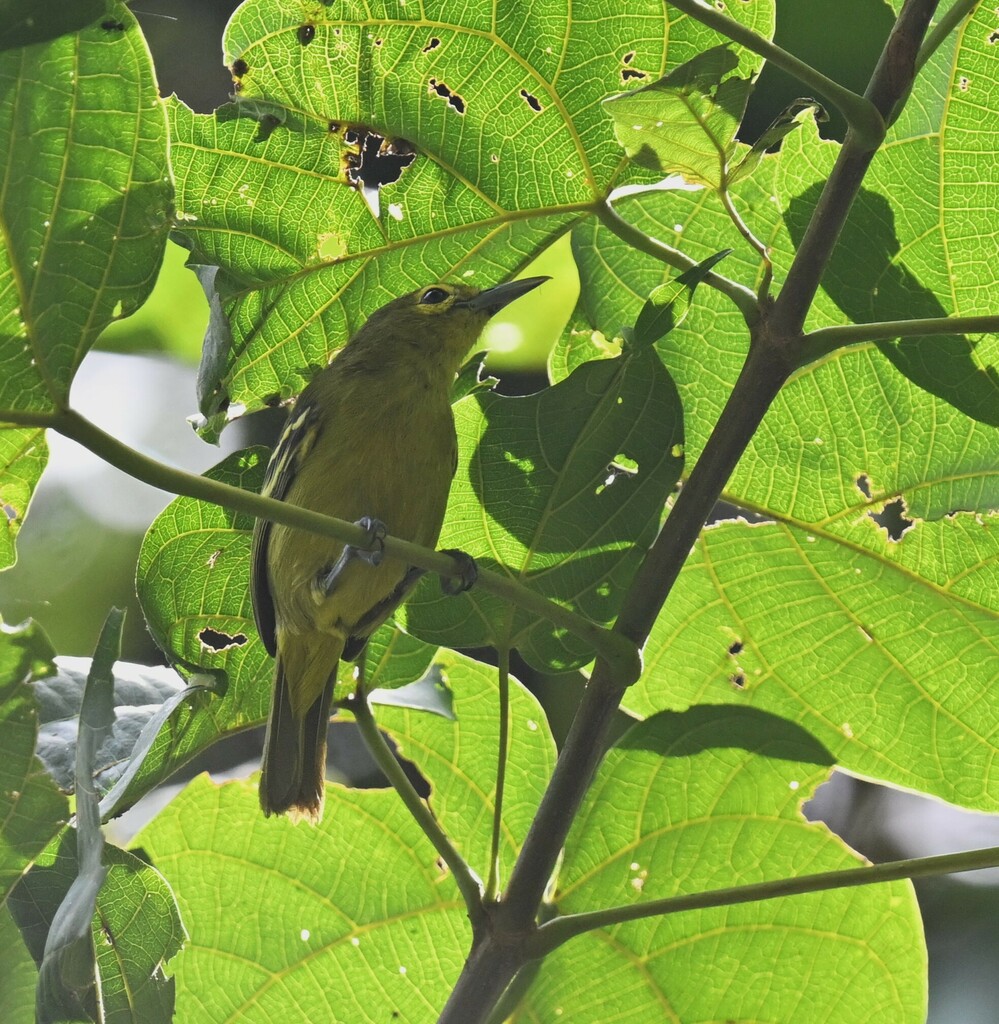
Green Iora
Photo © Chrissy McClarren and Andy Reago
Photo © Chrissy McClarren and Andy Reago — CC0 1.0 — Source: iNaturalist #254723441Identification
The green iora is a small passerine measuring 12–14 cm in length. Males are distinctive, with black lores contrasting sharply against bright yellow eye-rings, dark olive upperparts, and black wings marked by two white covert bars and olive-yellow flight feather edges. The underparts are dark olive with lighter flanks and a yellow belly centre, while the tail is black. The eyes are dark to red-brown, the bill grey-blue, and the feet slaty blue. Females are noticeably different, featuring yellow lores and a complete yellow eye-ring, medium olive upperparts and tail, and olive-washed wings with yellow (rather than white) wing-bars. The underparts are olive-green with a yellow tint on the belly. Juveniles resemble females but are paler overall.
Range & Habitat
This species is endemic to mainland Southeast Asia and the Greater Sundas, occurring across Tenasserim, the Thai-Malay Peninsula, Sumatra, and Borneo, with populations also found on some neighbouring small islands. It is now locally extinct in Singapore. The green iora is a canopy specialist, inhabiting lowland forests up to 820 metres elevation, and also frequents tall secondary forest, peat swamp forest, and mangrove forest.
Behaviour & Diet
Green ioras typically occur in pairs or small groups and are generally sociable birds, though intense fighting has been documented between individuals. They are primarily insectivorous, foraging actively in the canopy for invertebrates, and regularly join mixed-species feeding flocks. The contact call is a whining, descending ji-sheur or ji-wier, while a distinctive ji-jirijiri-jeh call has been recorded during courtship. Breeding occurs in April and May, with cup-shaped nests constructed on tree branches 8–12 metres above ground. Both parents incubate eggs and provide brooding during rain. Moulting is recorded in July and August.
Best Time & Places to See It
April and May offer the best opportunities to observe breeding behaviour and hear territorial calls. Look for green ioras in primary and secondary lowland forests, peat swamp forests, and mangrove habitats throughout the Thai-Malay Peninsula, Sumatra, and Borneo. Scanning the canopy of tall trees during early morning hours will increase your chances of encountering these canopy foragers, particularly where mixed-species flocks are active.
Photography Tips
The striking sexual dimorphism of this species makes it rewarding for comparative photography. Males offer high contrast with their black-and-yellow head pattern, while females present more subtle colouration. Position yourself beneath fruiting or flowering trees where mixed flocks gather, as the green iora's canopy habit demands a high angle of view. Early morning light will enhance the subtle olive tones and highlight the white and yellow wing-bars. Patience is essential; allow feeding flocks to come to you rather than pursuing individual birds through dense vegetation.
Bako National Park
Kuching, Malaysia
+210 birds+17 mammals
Weathered sandstone cliffs rise dramatically from the South China Sea, their ochre faces sculpted by millennia of wind and tide into a landscape of extraordinary geological…
VIEW NATIONAL PARKKuching Wetlands National Park
Kuching, Malaysia
+103 birds+4 mammals
Where brackish waters meet mangrove stilts and freshwater swamps blend into coastal mudflats, one of Southeast Asia's most dynamic wetland ecosystems unfolds across Sarawak's northwestern coast.…
VIEW NATIONAL PARKTaman Negara National Park
Kampong Samas, Malaysia
+393 birds+48 mammals
Where ancient rainforest meets limestone peaks, one of Southeast Asia's oldest protected wilderness preserves sprawls across 4,343 square kilometers of primordial landscape. Dipterocarp giants tower overhead,…
VIEW NATIONAL PARKPenang National Park
Balik Pulau, Malaysia
+107 birds+2 mammals
Granite peaks rise abruptly from the Andaman Sea where tropical rainforest clings to steep slopes in one of Malaysia's oldest protected landscapes. Mangrove forests fringe the…
VIEW NATIONAL PARKTaman Negara Bukit Lambir National Park
Miri, Malaysia
+153 birds+7 mammals
Rainforest cascades down sandstone ridges where crystal streams carve through ancient geology, creating a landscape of profound biological richness in Sarawak's interior. This 68-square-kilometre sanctuary protects…
VIEW NATIONAL PARKGunung Mulu National Park
Long Seridan, Malaysia
+280 birds+39 mammals
Where granite monoliths pierce the rainforest canopy of Sarawak, an ancient limestone karst landscape reveals one of Southeast Asia's most biodiverse strongholds. Soaring peaks cloaked in…
VIEW NATIONAL PARKKerinci Seblat National Park
Kerinci, Indonesia
+228 birds+16 mammals
Across nearly 67,000 square kilometres of Sumatra's spine, a mountainous realm of equatorial rainforest rises from steaming lowlands to volcanic peaks shrouded in cloud. Kerinci Seblat…
VIEW NATIONAL PARKWay Kambas National Park
Lampung Timur, Indonesia
+237 birds+20 mammals
Across the low swamplands of eastern Lampung, where freshwater wetlands merge into tidal mangrove forests along the Sunda Strait, sprawls one of Sumatra's most vital sanctuaries.…
VIEW NATIONAL PARKNo community photos yet. Log in to add the first one.
No community observations of this species yet.