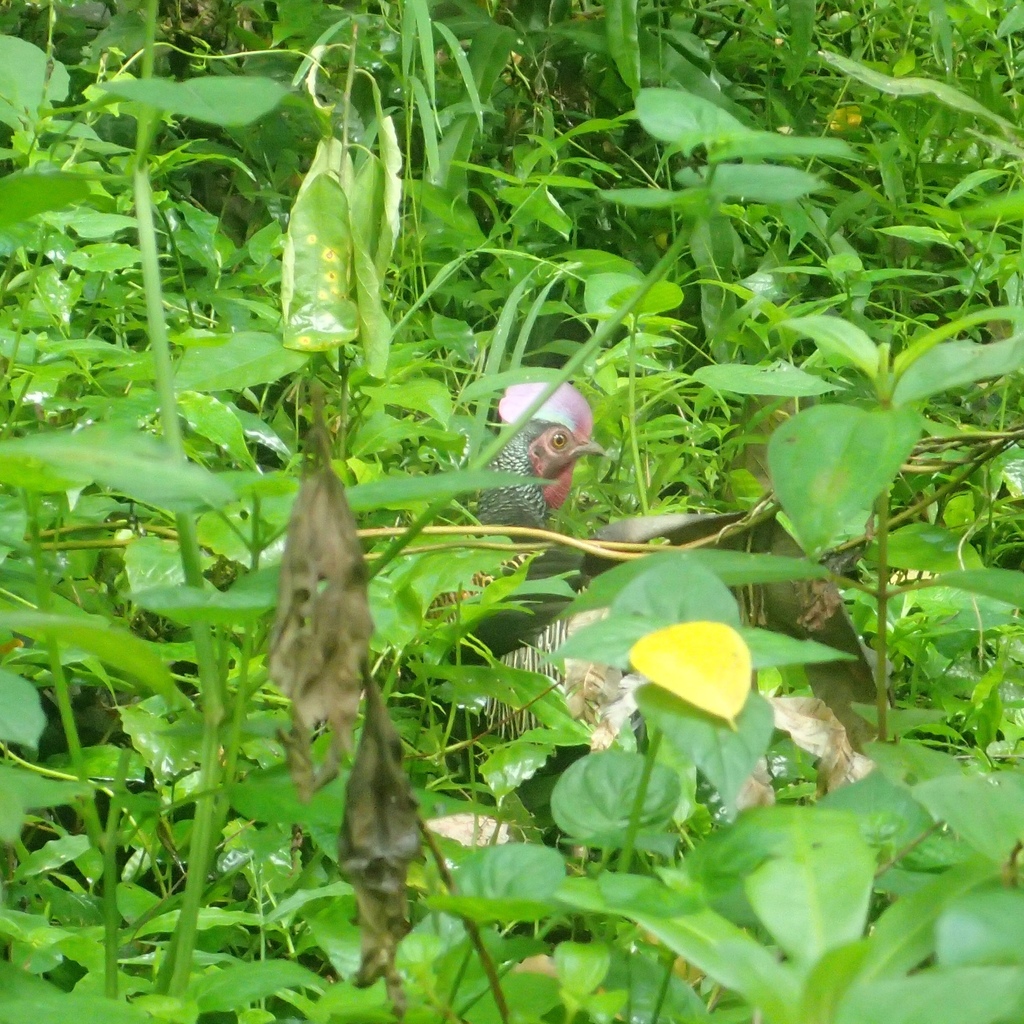
Green Junglefowl
Photo © JR Ferrer-Paris
Photo © JR Ferrer-Paris — CC BY 4.0 — Source: iNaturalist #333126815Identification
The green junglefowl is a medium-sized bird reaching up to 75 cm in length, belonging to the pheasant family. Sexual dimorphism is striking: males display one of the Galliformes' most spectacular plumages, while females are comparatively modest. The male's dark plumage at distance reveals, upon closer inspection, an extraordinary iridescent mantle of gleaming scales reminiscent of ocellated turkeys and green peafowl. Each scale is vivid blue at its base, transitioning through shades of gold and bronzed green. Specialized throat plumes are highly light-reflective, appearing violet at the proximal end and sky blue distally. The wing's lesser coverts are striking burnt orange with bronzed black centers, while the greater secondary coverts display vivid ocher distal edges. The breast and ventral regions are dense, light-absorbing black.
The male's head is particularly distinctive, featuring vivid 'windows' of bare facial skin contrasting against dark scarlet red. An ice-blue comb tops the head, turning purple or red toward the tip, while the wattle matches this coloration with blue edges and yellow near the throat. Electric yellow facial skin extends below each ear. In contrast, females are mostly brown with occasional green feathers and lack a comb entirely, making them far less conspicuous than their male counterparts.
Range & Habitat
The green junglefowl is endemic to the Indonesian islands of Java, Bali, Lombok, Komodo, Flores, Rinca, and small islands linking Java with Flores. A small introduced population also exists on the Cocos (Keeling) Islands. The species inhabits subtropical and tropical lowland moist forest, shrubland, and arable land from sea level to 2000 m altitude. Remarkably, these birds have been observed flying from island to island within their native range, demonstrating considerable mobility despite their forest-dwelling habits.
Green junglefowl prefer to live and breed along coastal areas, where they maintain close association with forest cover. This preference for accessible forest combined with open habitat makes them adaptable to varied landscape mosaics across their island range, though they remain dependent on adequate forest for roosting and shelter.
Behaviour & Diet
In the wild, green junglefowl typically live in small groups of two to five individuals led by a dominant male who directs the flock to feed and drink before leading them back into forest cover. At night, flocks roost in bamboo stands at 15–20 feet above the forest floor, providing safety from ground predators. During breeding season, dominant males are challenged by solitary males seeking to establish their own flocks. These confrontations are dramatic affairs: rival males clap their wings, crow loudly, and fight vigorously using their spurs.
The species feeds on grains, seeds, fruit, and insects—a generalist diet typical of junglefowl. This omnivorous approach allows them to exploit diverse food sources across their varied habitats, from disturbed agricultural areas to pristine forest floors.
Best Time & Places to See It
Green junglefowl are best sought in coastal lowland forests throughout their endemic Indonesian range, particularly on Java, Bali, Lombok, Komodo, and Flores. Early morning hours are optimal for encounters, as birds are most active while feeding before retreating into dense forest cover during the heat of the day. The breeding season, when dominant males engage in territorial displays and sparring matches, offers particularly rewarding viewing opportunities for patient observers, though the birds' shy nature requires careful, quiet approach.
The species' preference for forest edges and coastal areas means that transitions between forest and open ground provide the best observation points. However, their tendency to retreat quickly into cover demands both persistence and early starts to maximize chances of sightings.
Photography Tips
The male's iridescent plumage presents both opportunities and challenges for photographers. The gleaming scales of the mantle require careful attention to lighting angle—side-lighting often reveals the spectacular blue, gold, and bronzed-green coloration more effectively than direct frontal illumination. The throat plumes' violet and sky-blue hues are particularly light-sensitive and demand precise exposure management to render accurately.
Early morning light is ideal for capturing the iridescent qualities of the male's plumage. Patience and a long lens are essential given the species' shy, forest-dwelling nature. Position yourself near roosting or feeding areas during dawn, and allow the birds to approach rather than pursuing them into cover. The dramatic facial coloration—blue comb, scarlet face, and yellow skin patches—merits close-up shots when possible, as these features are among the species' most distinctive identifying characteristics.
Taman Nasional Baluran
Situbondo, Indonesia
+189 birds+9 mammals
Across the northeastern tip of East Java, where monsoon winds sweep down from the Bali Strait, a landscape of contrasts unfolds within 374 square kilometres of…
VIEW NATIONAL PARKTaman Nasional Meru Betiri
Jember, Indonesia
+93 birds+1 mammals
Across East Java's southeastern coast, where the Indian Ocean meets a landscape of volcanic soils and monsoon-fed forests, sprawls a national park that epitomizes the ecological…
VIEW NATIONAL PARKWest Bali National Park
Gerokgak, Indonesia
+240 birds+8 mammals
Across West Bali's northwestern reaches, where the Indian Ocean meets volcanic slopes and limestone cliffs plunge toward turquoise shallows, sprawls a protected realm of roughly 325…
VIEW NATIONAL PARKGunung Ciremai National Park
Majalengka, Indonesia
+116 birds+1 mammals
Volcanic slopes rise sharply from West Java's interior, where Gunung Ciremai's 3,078-metre summit dominates a landscape carved by geological upheaval and shaped by equatorial monsoon rainfall.…
VIEW NATIONAL PARKGunung Merbabu National Park
Magelang, Indonesia
+61 birds+2 mammals
Where volcanic slopes rise sharply from the plateau of Central Java, Gunung Merbabu National Park encompasses nearly 200 square kilometers of montane forest that transitions through…
VIEW NATIONAL PARKMount Merapi National Park
Hargobinangun, Indonesia
+150 birds+3 mammals
Where the volcanic slopes of central Java rise into mist and montane forest, Mount Merapi National Park guards one of Indonesia's most dynamic landscapes. Spanning roughly…
VIEW NATIONAL PARKKomodo National Park
Komodo, Indonesia
+155 birds+14 mammals
Where volcanic peaks rise dramatically from turquoise waters, a primordial landscape unfolds across three main islands and countless smaller ones scattered throughout the Lesser Sunda archipelago.…
VIEW NATIONAL PARKNo community photos yet. Log in to add the first one.
No community observations of this species yet.