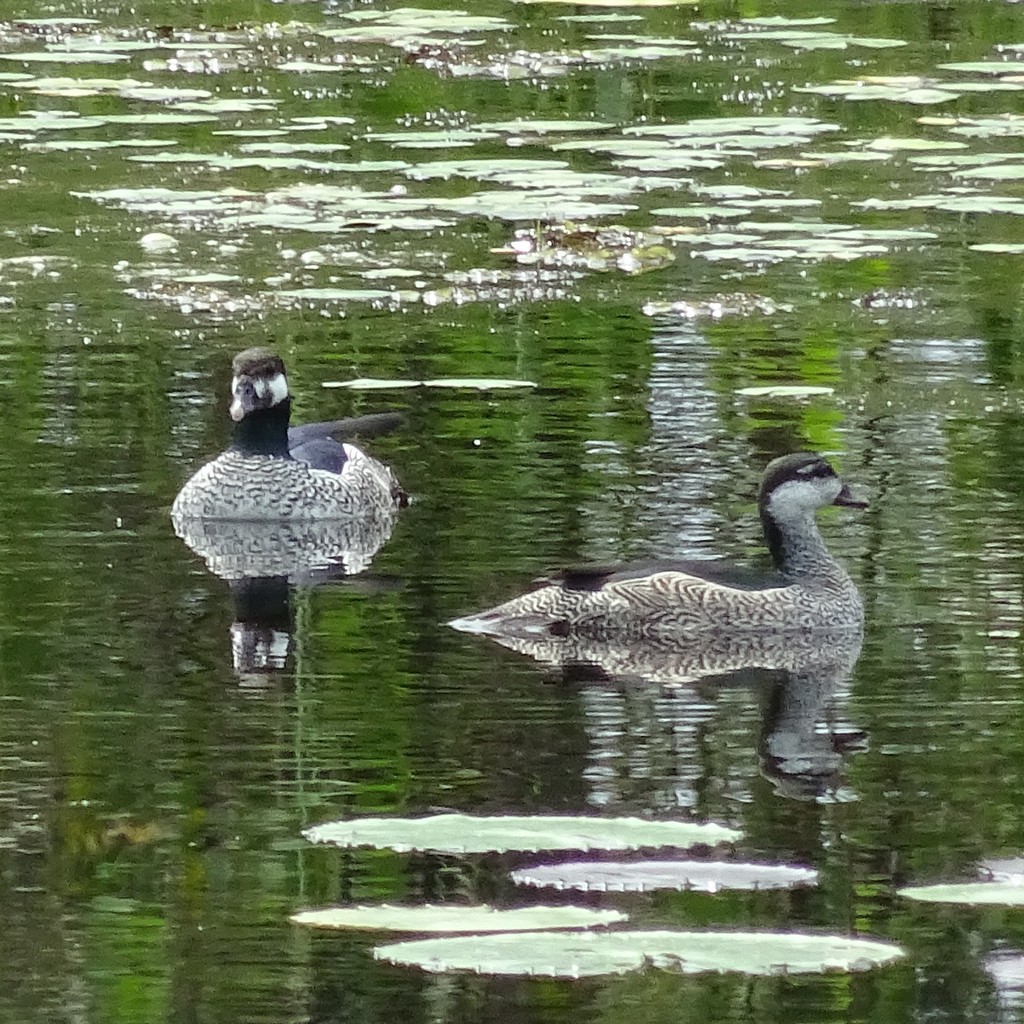
Green Pygmy Goose
Photo © Mark Bolnik
Photo © Mark Bolnik — CC BY 4.0 — Source: iNaturalist #99670451Identification
The green pygmy goose is one of the smallest duck species, measuring just 30 to 36 cm in length with a wingspan of 48 to 60 cm. It has a distinctive compact form and small bill. The breeding male is particularly striking, with a predominantly dark green back and neck contrasted by a dark gray crown and white cheeks. The underparts are pale grey and white with scalloped markings, while the tail and primary flight feathers are black. The secondary flight feathers are white, and the secondary coverts display a dark iridescent green that catches the light beautifully. Outside the breeding season, males lose this iridescence and their plumage becomes duller. Females show sexual dimorphism, with a barred rather than green neck but otherwise resembling the non-breeding male. Immature birds are less brightly coloured with mottled dark brown heads. Males have a distinctive high-pitched whistle, while females produce a lower-pitched call.
Range & Habitat
This species is found in southern New Guinea and across northern Australia, from Western Australia through the Northern Territory and into Queensland. It commonly reaches Timor-Leste, where it possibly breeds at Lake Iralalara. The green pygmy goose favours well-vegetated lowland lagoons and other permanent fresh waters, where aquatic vegetation provides both shelter and food resources.
The species is largely resident throughout its range, though it disperses during the wet season when water becomes more widely available across the landscape.
Behaviour & Diet
The green pygmy goose is a perching duck, reflecting its adaptation to life around vegetated waterways. It nests in tree hollows, a behaviour uncommon among many duck species. Females typically lay eight to twelve eggs, with an incubation period of 26 days. This nesting strategy allows the species to utilise habitats where suitable hollow trees are available near permanent water.
Best Time & Places to See It
To observe green pygmy geese, focus on well-vegetated lowland lagoons and permanent freshwater bodies in northern Australia and southern New Guinea. The wet season is particularly rewarding, as birds disperse more widely across the landscape during this period. Queensland, the Northern Territory, and Western Australia all offer opportunities, as does Timor-Leste for those travelling to that region.
Photography Tips
The striking plumage of breeding males makes them rewarding photographic subjects, particularly the iridescent green of the secondary coverts which requires good lighting to capture effectively. Focus on the contrasting white cheeks and dark green back of breeding males for the most visually striking images. Early morning light often best reveals the iridescent qualities of the plumage. As these are small ducks frequenting vegetated waterways, approach slowly and quietly to avoid disturbance, and consider longer telephoto lenses to maintain distance while capturing detail.
Kakadu National Park
Kakadu, Australia
+273 birds+46 mammals
Kakadu National Park is Australia’s largest national park and one of the world’s most remarkable protected areas, covering nearly 20,000 square kilometres in the tropical north…
VIEW NATIONAL PARKDaintree National Park
Dedin, Australia
+362 birds+37 mammals
Daintree National Park is one of the world’s oldest and most biologically diverse tropical rainforests, protecting an extraordinary landscape where ancient forests meet the Great Barrier…
VIEW NATIONAL PARKRinyirru National Park
Lakefield, Australia
+258 birds+7 mammals
Where the savanna grasslands of far north Queensland meet seasonal wetlands and eucalypt woodlands, Rinyirru National Park sprawls across more than 12,500 square kilometres of rugged,…
VIEW NATIONAL PARKLitchfield National Park
Australia
+175 birds+15 mammals
Where weathered sandstone plateaus rise above the savanna woodlands of Australia's Top End, Litchfield National Park unfolds as a landscape of dramatic contrasts shaped by a…
VIEW NATIONAL PARKNitmiluk National Park
Australia
+186 birds+27 mammals
Dramatic sandstone gorges carved by the Katherine River slice through the tropical savanna of Australia's Top End, creating a landscape where escarpments tower above crystalline pools…
VIEW NATIONAL PARKGirringun National Park
Australia
+231 birds+10 mammals
Where granite gorges cleave through subtropical woodland in North Queensland, Girringun National Park unfolds across rugged terrain shaped by millions of years of weathering and erosion.…
VIEW NATIONAL PARKBoodjamulla National Park
Australia
+142 birds+3 mammals
Where red sandstone gorges carve through the semi-arid interior of far north Queensland, Boodjamulla National Park reveals a landscape shaped by seasonal water availability and ancient…
VIEW NATIONAL PARKNo community photos yet. Log in to add the first one.
No community observations of this species yet.