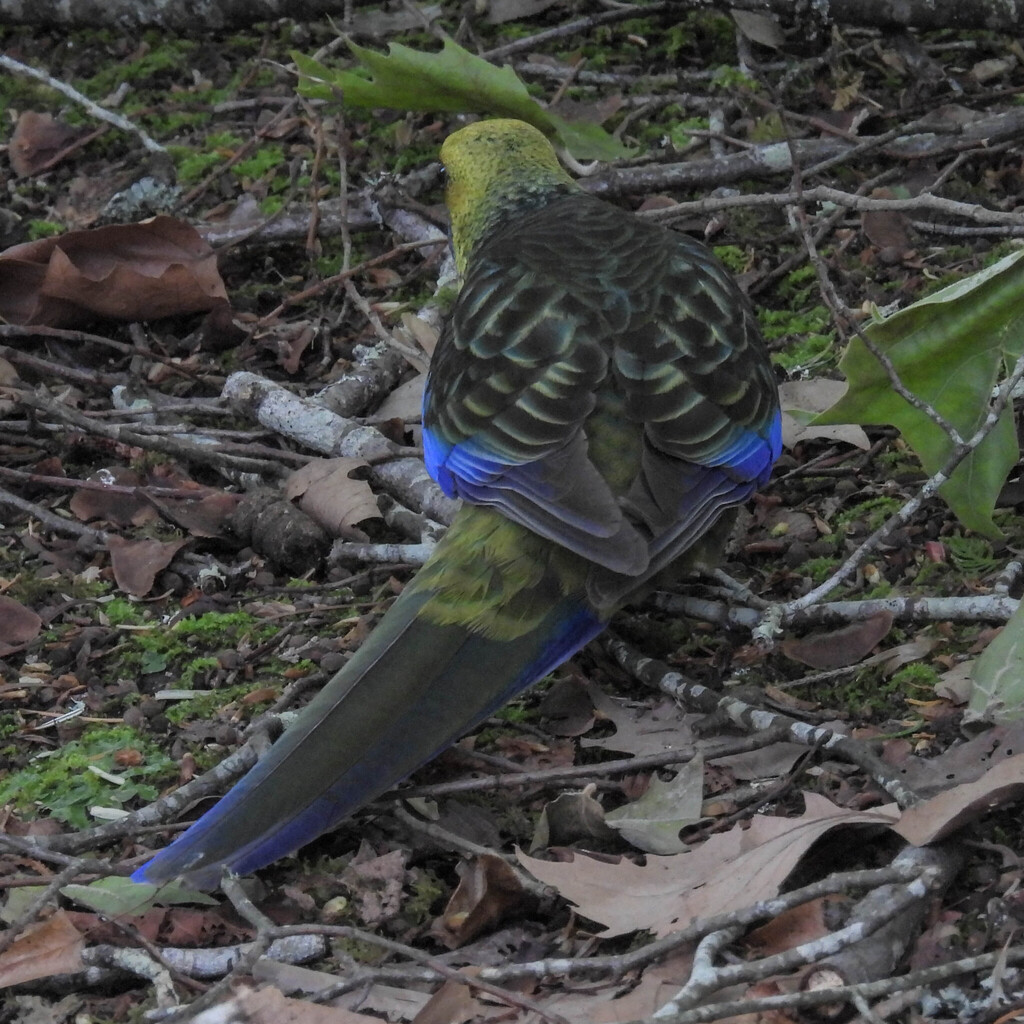
Green Rosella
Photo © Erik Schiff
Photo © Erik Schiff — CC0 1.0 — Source: iNaturalist #334100181The green rosella or Tasmanian rosella (Platycercus caledonicus) is a species of parrot native to Tasmania and Bass Strait islands. It was described by the German naturalist Johann Friedrich Gmelin in 1788, and named on the mistaken assumption it came from New Caledonia. At 14.5 in (37 cm) long it is the largest species of the rosella genus, Platycercus. Two subspecies are recognised. The green rosella's underparts, neck and head are yellow, with a red band above the beak and violet-blue cheeks. The back is mostly black and green, and its long tail blue and green. The sexes have similar plumage, except the female has duller yellow plumage and more prominent red markings, as well as a smaller beak. Juvenile and immature birds have predominantly green plumage. Found in a wide range of habitats with some form of tree cover, the green rosella is predominantly herbivorous, consuming seeds, berries, nuts and fruit, as well as flowers, but may also eat insect larvae and insects such as psyllids. Nesting takes place in tree hollows. Common and widespread across Tasmania, the green rosella is rated as least concern on the International Union for Conservation of Nature (IUCN)'s Red List of Endangered species.…
Cradle Mountain-Lake St Clair National Park
Australia
+72 birds+8 mammals
Where glacial valleys plunge between quartzite peaks, Tasmania's Cradle Mountain-Lake St Clair National Park unfolds as a temperate wilderness of uncommon grandeur. The park's terrain ranges…
VIEW NATIONAL PARKFreycinet National Park
Coles Bay, Australia
+115 birds+9 mammals
Granite peaks rise abruptly from the Tasmanian coast where Coles Bay opens into the Freycinet Peninsula, sculpting one of southeastern Australia's most dramatically vertical national parks.…
VIEW NATIONAL PARKTasman National Park
White Beach, Australia
+53 birds+3 mammals
Where the Tasman Peninsula's windswept coastline meets temperate rainforest, White Beach unfolds as one of Tasmania's most dramatic meeting points between land and sea. The park's…
VIEW NATIONAL PARKNo community photos yet. Log in to add the first one.
No community observations of this species yet.