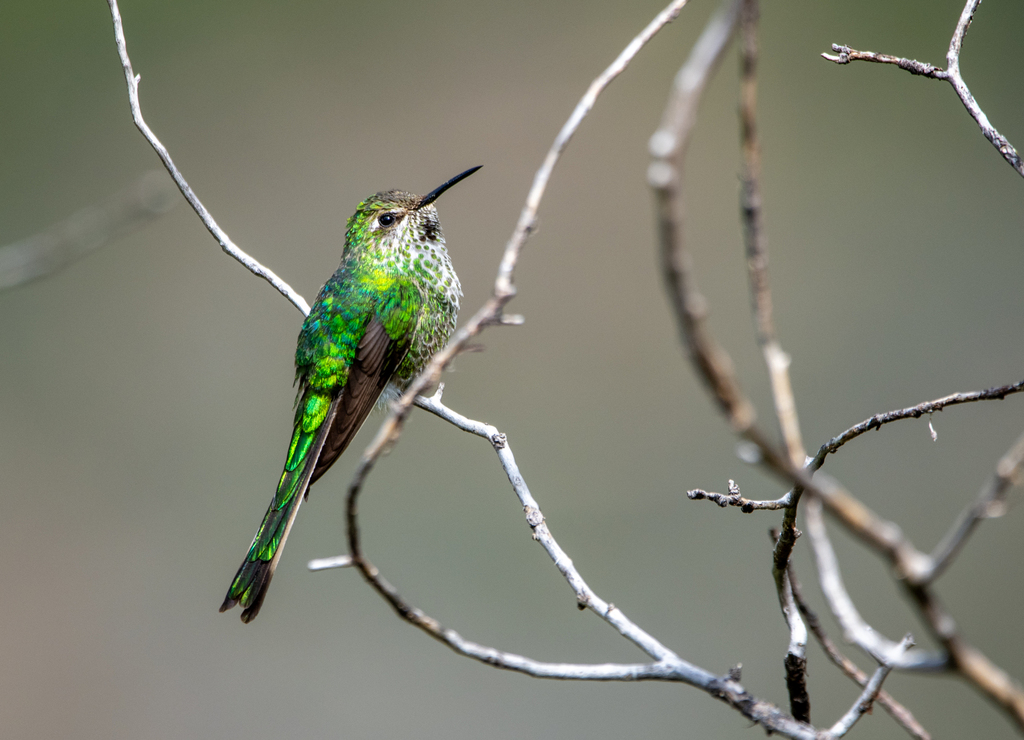
Green-tailed Trainbearer
Photo © David F. Belmonte
Photo © David F. Belmonte — CC BY 4.0 — Source: iNaturalist photo #362381450Identification
The green-tailed trainbearer is a small hummingbird with striking sexual dimorphism. Males measure 15.3–17 cm long (including a notably elongated 10.6–13.6 cm tail), while females are considerably smaller at around 11.6 cm with tails of 4.5–6.2 cm. Both sexes weigh only 3.1–4.3 grams. Males of the nominate subspecies are almost entirely glittering emerald green, with iridescent emerald throats and grayish lower bellies dotted with green. The most distinctive feature is the long, forked, black tail tipped with green. Females resemble males but have white underparts with glittering green spots and shorter tails. The species has a short, straight black bill. Subspecific variation is notable: some populations show more golden-bronze plumage, paler bellies, or variations in bill length and tail coloration.
Range & Habitat
The green-tailed trainbearer inhabits the Andes of northwestern South America, with six recognized subspecies found across Colombia, Ecuador, Peru, and Bolivia. Different populations occupy distinct regions: some subspecies are found in the Eastern and Central Andes of Colombia, others across Ecuador's mountain ranges, while populations in Peru range from Piura to Huánuco departments, and additional subspecies occur in southwestern Peru and Bolivia. The species favors secondary woodland and brushy slopes, also occurring in Polylepis woodland and páramo habitats. Elevations range from 1,700 to 3,800 meters (5,600 to 12,500 feet). An old Venezuelan record remains unconfirmed.
Behaviour & Diet
The green-tailed trainbearer is primarily nectarivorous, foraging at low to medium heights on flowers including Castilleja, Cavendishia, Rubus, Cuphea, and Palicourea species. It supplements its diet with insects captured in flight and gleaned directly from blossoms. The species likely undergoes elevational movements following breeding and flowering seasons, though its movements remain poorly documented. During the November to April breeding season, males produce a distinctive repeated gravelly 'drrrt...drrrt...' song and buzzy calls, along with snapping sounds created by the tail or wings during displays. Females construct tiny cup nests of moss and rootlets lined with soft plant material, typically placing them 2–4 meters above ground beneath slope overhangs. Clutches consist of two eggs.
Best Time & Places to See It
The breeding season from November to April offers the best opportunity to encounter this species, when birds are most active and vocal. The green-tailed trainbearer is locally fairly common throughout its Andean range, making it a rewarding target for patient observers. Visiting secondary woodlands and brushy slopes at mid-to-high elevations (1,700–3,800 m) in Colombia, Ecuador, Peru, or Bolivia offers the greatest chance of sightings. Focus on areas with flowering plants that attract the species, particularly during peak blooming periods. Early mornings typically yield the most productive observations.
Photography Tips
Photographing this trainbearer requires patience and attention to its foraging behavior at low to medium heights. Males' glittering emerald plumage demands careful exposure and white balance; overexposure risks losing the iridescent throat detail. The spectacular long, forked tail is best captured in profile during hovering or display flights. The snapping tail displays provide dramatic action shots. Position yourself near flowering plants where the species forages regularly, particularly Castilleja and Cavendishia species. Higher shutter speeds (1/2000s or faster) are essential to freeze wing motion. Dawn light at high elevations often provides excellent clarity and color saturation for capturing the male's brilliant green plumage.
Sangay National Park
Cebadas, Ecuador
+320 birds+10 mammals
High in Ecuador's Andean spine, where the Western Cordillera rises to touch perpetual snow, a landscape of volcanic drama and ecological intensity unfolds across Sangay National…
VIEW NATIONAL PARKPodocarpus National Park
Zamora, Ecuador
+496 birds+6 mammals
Where the Andes descend toward the Amazon basin, Podocarpus National Park sprawls across nearly 2,800 square kilometres of the most biodiverse terrain in Ecuador's southern highlands.…
VIEW NATIONAL PARKYacuri National Park
Las Juntas, Ecuador
+166 birds+1 mammals
Where the eastern slopes of the Andes descend into Ecuador's southern frontier, Yacuri National Park unfolds across nearly 1,300 square kilometers of montane cloud forest and…
VIEW NATIONAL PARKAntisana National Park
Quijos, Ecuador
+432 birds+21 mammals
Where the eastern Andean slopes descend into the Amazon basin, Antisana National Park sprawls across roughly 2,500 square kilometers of some of South America's most dramatic…
VIEW NATIONAL PARKCotopaxi National Park
Mulaló, Ecuador
+211 birds+6 mammals
High in Ecuador's volcanic corridor, where the páramo transitions into cloud forest along the slopes of Cotopaxi volcano, the national park unfolds across nearly 500 square…
VIEW NATIONAL PARKCajas National Park
Cuenca, Ecuador
+190 birds+7 mammals
High in the Andes above Cuenca, where elevation ranges from 3,100 to 4,200 metres, the páramo landscape dominates—a windswept realm of cushion plants, alpine grasses, and…
VIEW NATIONAL PARKNatural Serranía de los Yariguíes National Park
El Carmen de Chucurí, Colombia
+320 birds+3 mammals
Where the northern cordilleras of Colombia rise toward cloud forest, the Serranía de los Yariguíes unfolds across nearly 1,820 square kilometers of some of the most…
VIEW NATIONAL PARKNatural Farallones de Cali National Park
Buenaventura, Colombia
+733 birds+27 mammals
Where the Pacific coastal plain meets the western slopes of the Andes, Farallones de Cali National Park sprawls across nearly 3,500 square kilometers of dramatic topography…
VIEW NATIONAL PARKNatural Chingaza National Park
Junín, Colombia
+285 birds+6 mammals
Where the Andes rise above three thousand metres in the Cundinamarca region, high-altitude grasslands and cloud forests converge in a landscape shaped by both geology and…
VIEW NATIONAL PARKPuracé National Natural Park
Puracé, Colombia
+327 birds+2 mammals
Where the Andes thrust upward across southwestern Colombia, Puracé National Natural Park spans nearly 2,631 square kilometers of some of South America's most dramatic montane terrain.…
VIEW NATIONAL PARKNatural Sumapaz National Park
Cubarral, Colombia
+368 birds+1 mammals
Where the Andes descend toward the Amazon basin, the high páramo grasslands of Sumapaz National Park sprawl across more than five thousand square kilometers of Meta…
VIEW NATIONAL PARKYanachaga–chemillén National Park
Palcazu, Peru
+639 birds+6 mammals
Where the eastern slopes of Peru's central cordillera plunge into cloud forest, Yanachaga–Chemillén National Park protects nearly three thousand square kilometres of montane wilderness that few…
VIEW NATIONAL PARKManu National Park
Manu, Peru
+892 birds+26 mammals
Across the eastern slopes of the Peruvian Andes, tropical rainforest descends into the Amazon basin with a complexity that few terrestrial ecosystems match. Manu National Park…
VIEW NATIONAL PARKHuascarán National Park
Independencia, Peru
+201 birds+5 mammals
Where granite peaks pierce the Andean sky above 6,000 metres, Huascarán National Park sprawls across more than 11,500 square kilometres of Peru's Cordillera Blanca, a landscape…
VIEW NATIONAL PARKNo community photos yet. Log in to add the first one.
No community observations of this species yet.