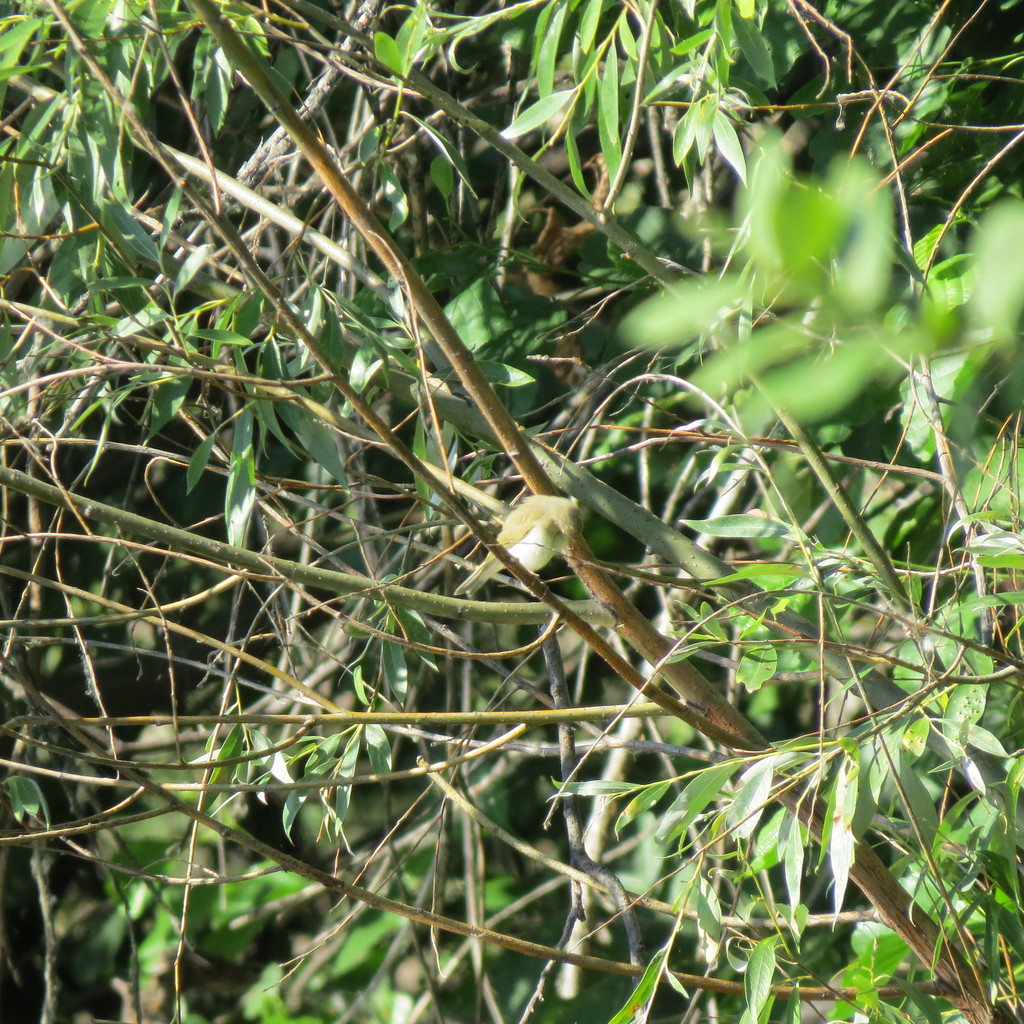
Greenish Warbler
Photo © Дарья Орлова
Photo © Дарья Орлова — CC BY 4.0 — Source: iNaturalist #86756837Identification
The Greenish Warbler is a small, typical leaf warbler with grayish-green upperparts and off-white underparts. The most distinctive field mark is a single wing bar present in southern and western populations, which separates it from most similar species—though it resembles the Arctic Warbler. It is slightly smaller than that species and has a noticeably thinner bill without the dark tip to the lower mandible seen in some congeners. Northern populations tend to be smaller than their southern counterparts, an unusual pattern that reverses the typical latitudinal size gradient found in most birds.
The song is diagnostic: a high, jerky trill that varies by population. Some birds incorporate sequences of downslurred notes, and occasionally upslurred notes, making the song structure a useful field identifier. Different subspecies show subtle plumage variations—the western viridanus is dull green with a yellowish supercilium and throat, while the eastern trochiloides is dusky greyish-green and often shows traces of a second wing bar.
Range & Habitat
This strongly migratory warbler breeds across a vast range from northeastern Europe through temperate to subtropical continental Asia, with populations wintering in India. It is a regular spring and early autumn vagrant to Western Europe, appearing annually in Great Britain, and in some years large numbers reach Central Europe, with occasional pairs remaining to breed in Germany. The breeding range spans from Western Siberia to northeastern Europe, extending southward to northwestern India at the eastern limits.
The species favours lowland deciduous or mixed forest for breeding. Non-breeding birds in warmer regions often undertake altitudinal movements, moving to montane habitats during summer months. In Bhutan, for example, birds are frequently observed in humid Fir forest at elevations up to 3,800 metres or higher during the hot season, though they do not breed at these altitudes and return to subtropical lowlands in winter.
Behaviour & Diet
Like all leaf warblers, this insectivorous passerine forages for small invertebrates among foliage. It is highly migratory, with populations moving seasonally between breeding grounds and wintering areas in India. The species exhibits interesting evolutionary patterns, functioning as a ring species with populations diverging eastward and westward around the Tibetan Plateau before meeting again to the north, resulting in complex subspecies relationships and occasional hybridization zones.
Nesting occurs on the ground in low shrub vegetation, typical of leaf warblers. Song structure varies geographically, with some populations delivering uniform, long, warbling songs, while others in the Himalayan region produce shorter vocalizations. The song differs notably from that of the closely related Two-barred Warbler, which was formerly considered conspecific.
Best Time & Places to See It
Spring and early autumn migration offer the best opportunities to encounter Greenish Warblers, particularly in Western Europe and Great Britain where they appear as regular vagrants. In Central Europe, some years produce notably higher numbers of vagrant birds. For breeding-season observations, the species is found across its extensive range from Western Siberia to northeastern Europe and into Asia, though specific localities should be determined by subspecies distribution.
Travellers visiting the Himalayas and adjacent subtropical regions during winter months may observe wintering populations. In Bhutan specifically, the species is quite often seen during the warmer months in humid montane Fir forests at higher elevations, making it a reliable find in these specialized habitats during the appropriate season.
Photography Tips
The Greenish Warbler's small size and preference for dense foliage make it a challenging subject. Focus on capturing the single wing bar visible on southern and western populations, which is a key identification feature. The bird's high, jerky song often betrays its presence, allowing patient photographers to locate and position themselves for shots. Early morning light works best for revealing the subtle grayish-green plumage tones against off-white underparts.
During migration, when birds are encountered in Western Europe, they may be less wary than breeding birds and present better photographic opportunities. Montane habitats in the Himalayas offer scenic backgrounds, though the humid forest environment and high altitude present technical challenges. Patient stalking with attention to feeding behaviour will yield the most natural and engaging images of this active, leaf-gleaning warbler.
Kanha Tiger Reserve
Altai Tavan Bogd National Park
Baikal National Park
Baima Snow Mountain National Nature Reserve
Bandhavgarh National Park
Bandipur National Park
Banke National Park
Bardiya National Park
Białowieża National Park
Nothing matches these filters.
No community photos yet. Log in to add the first one.
No community observations of this species yet.